AI Head-Hopping: How to Stop POV Drift in Your Draft
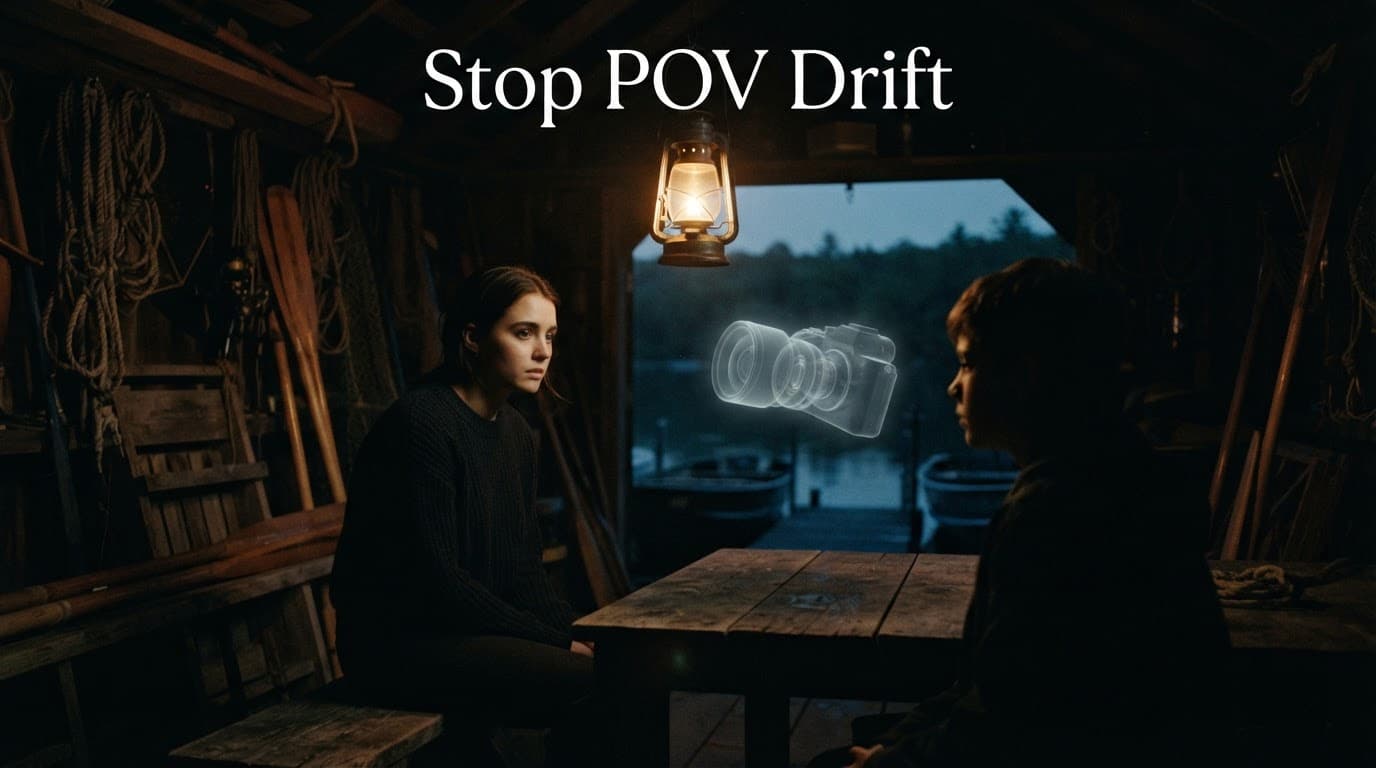
You're reading back chapter nine, the one where Tamsin finally confronts her brother in the boathouse, and it's working. Close third, tight on her, every line filtered through what she notices: the wet rope, the lantern he won't look at, the way he keeps his left hand in his pocket. Then, two-thirds of the way down the page, this:
Callum knew she'd never forgive him, and part of him was relieved.
You didn't write that. The model did. And Tamsin can't know it. She's standing six feet away, reading his face, and suddenly the narrator has walked straight through his skull and reported back. One sentence, and the scene's tension (what is he hiding?) has leaked out onto the floor.
That's head-hopping, and AI drafts do it constantly, along with its quieter cousins: past tense that slides into present, or a narrator who suddenly knows what's happening in the next room. Here's why models drift, how to lock point of view and tense before you generate, and how to audit a finished chapter.
What Is Head-Hopping (and What Isn't)?
Head-hopping is an unannounced switch from one character's inner perspective to another's inside the same scene. The Editorial Department puts it plainly: it "occurs when a writer abruptly shifts from one character's internal perspective to another's within a scene" (source). The same piece cites Browne and King's Self-Editing for Fiction Writers, which pulls a 132-word passage from Lonesome Dove where the point of view changes three times. It's a great book, and the passage is still hard to follow.
What it isn't: omniscient narration, where a narrator with its own voice sits above every character and says so up front. As Scribophile's explainer notes, most "head-hopping" in classic novels is an omniscient narrator doing its job.
The difference is consent. Omniscient asks the reader's permission on page one. Head-hopping breaks in through a window halfway through the scene.
POV drift is the broader family. It includes:
- Head-hopping: close third on Tamsin, then a sentence of Callum's thoughts.
- Knowledge leaks: the POV character "knows" something she was never told, like the dead courier's name.
- Person slips: a first-person chapter that briefly narrates in third, or vice versa.
- Tense slides: past tense that drifts into present, usually during action or right after a pasted excerpt.
In an AI draft, all four share a root and a fix.
Why AI Models Drift Out of POV
Models drift because they predict the most likely next sentence, not the next sentence your narrator is allowed to say. A model doesn't hold "whose head are we in" as a rule; it infers it from the text in front of it. When that text is ambiguous or quietly contradicts the lens, it picks whatever sounds most like a novel. In practice, drift comes from four places:
1. Your scene notes describe other characters' feelings. You write "Callum is guilty but trying to hide it" in your beat list. That's a perfectly reasonable note for you. To the model, it's an instruction to put Callum's guilt on the page, and the most direct way to do that is to narrate it. The note was written from omniscient, so the prose comes out omniscient.
2. The context mixes tenses. Summaries, outlines, and synopses are conventionally written in present tense ("Tamsin finds the ledger and confronts Callum"). Paste a present-tense summary above a past-tense chapter and you've handed the model two competing patterns. Sometimes the summary wins for a paragraph.
3. Dialogue-heavy scenes invite mind-reading. When two characters argue, the model wants to explain why each line lands, and sometimes it goes into the other character's head to get the answer.
4. The project settings got reset and nobody noticed. Sudowrite, for example, sets new projects to third-person limited, past tense, and its docs note that importing a file "will set the POV and Tense settings to their defaults" (Sudowrite docs). It's a sensible, documented default, but if your book is in first-person present and you import a revised draft, the next generation aims at the wrong target until you set it back.
The pattern underneath all four: the model writes from whatever lens your context implies, not the lens you meant. I call it lens leakage. The camera doesn't move because the model is careless. It moves because something you fed it pointed the camera somewhere else.
How to Lock POV and Tense Before You Generate
Write a short POV contract, put it at the top of every scene request, and rewrite your scene notes so they only contain what the POV character can perceive. Here are the steps in order.
1. Write a three-line POV contract
Keep it short enough that you'll actually paste it every time:
POV: close third person, Tamsin only. Past tense.
Tamsin cannot know anyone else's thoughts. Other characters' feelings appear only through what she sees, hears, or infers, and her inferences can be wrong.
No scene breaks into other viewpoints.
"Her inferences can be wrong" matters more than it looks: it gives the model a legitimate way to show Callum's guilt (Tamsin thinks he looks guilty) without hopping into him, and leaves room for misdirection.
2. Translate your beat notes into the POV character's perception
Go through your beats and rewrite every line that describes a non-POV character's interior.
- Before: Callum is guilty but trying to hide it.
- After: Callum won't meet her eye; keeps his left hand in his pocket; answers a beat too fast.
This is the most effective fix here, because it removes the instruction that caused the hop. It's Scribophile's advice for human writers (turn knowledge into observation: "I could tell by his scowl...") applied upstream, before the model sees the scene.
3. Match the tense of everything in context
If your chapter is in past tense, convert the summary and the previous-chapter recap to past tense too, or label them clearly as notes ([OUTLINE — not prose]). If you're writing in present, do the reverse. Ten seconds of edits removes the competing pattern.
4. Generate smaller pieces
A 600-word chunk drifts less than a 3,000-word chapter request: fewer chances to wander, and you catch a slip before the next chunk builds on it. If you've read our guide on continuing a scene with an AI assistant, it's the same principle: short handoffs with the last few hundred words of real prose as the anchor.
5. Track who knows what
Knowledge leaks are the hardest drift to spot by reading, because the sentence sounds fine. Keep a running list of secrets and who holds them (Callum knows the ledger was forged; Tamsin doesn't yet), and paste the relevant lines into the scene request. A story bible is the natural home for this. In NovelMage you can keep those notes in a character's Codex entry, which the AI references automatically when it writes, so you're not re-pasting "Tamsin doesn't know about the forgery" into every prompt.
How to Audit a Chapter for POV Drift
Read the chapter with one question per pass, not one pass with every question. Drift hides when you're reading for story. It shows up fast when you're reading for a single thing.
A worked audit: chapter nine, 3,400 words
Here's how the boathouse chapter actually goes through the process.
Pass one: interior verbs. Search for knew, thought, felt, wondered, realized, wanted, decided and look only at sentences whose subject isn't Tamsin. Of 31 hits, 24 are hers. Seven aren't: five are Callum, one is their mother in a remembered conversation (fine), and one is the dock foreman, who apparently "wondered why the lantern was lit." Six real hops.
Pass two: perception check. For each, ask: could Tamsin see or hear evidence of this? Four can become observation. "Callum knew she'd never forgive him, and part of him was relieved" becomes "His shoulders dropped, and for one terrible second he looked relieved." Better, honestly. Now the reader gets to wonder why. The other two get cut.
Pass three: knowledge. Read only the dialogue. Tamsin calls the courier "Ennis," a name nobody tells her until chapter twelve. One word, and it would have broken a reveal three chapters later.
Pass four: tense. Read the first two paragraphs after every break and every stitched-in regeneration. One slide: four present-tense sentences mid-fight, right at a seam.
Total: six hops, one leak, one tense slide, about thirty-five minutes. The fixes themselves took less time than finding them.
After a few chapters you'll notice drift clusters in the same places: arguments, reunions, any scene where the non-POV character holds the secret. That tells you where to put extra-specific beat notes next time.
If you're running the audit with an AI's help, ask it to list sentences that reveal a non-POV character's thoughts, with quotes, rather than asking it to "fix the POV." A list keeps you in charge of every change; a blanket fix tends to flatten the prose along with the hops. Running that kind of check over a whole manuscript is where cloud token costs can creep up, which is one reason some writers run audits on a local model. NovelMage works with Ollama and LM Studio, so a fifth or sixth pass over a 90,000-word draft costs nothing extra and the manuscript never leaves your machine.
When Breaking the Rule Is the Right Call
Switch viewpoints when you need to, but do it at a scene break and never mid-paragraph. Plenty of good books, romances especially, alternate between two leads. The convention is one viewpoint per scene, with a visible break (a line space or a centered #) before you change heads.
Romance trips people up most. One writer in r/WritingWithAI only learned head-hopping was considered a flaw when a beta reader flagged it; sliding between leads mid-scene "seemed like a logical feature of romance stories." A commenter named the cost: mixing up thoughts "dilutes character voice." Every hop blurs two characters who are supposed to sound different, compounding the problem in why AI characters all sound the same.
If you want omniscient, commit to it on page one and write your POV contract to say so. Omniscient isn't the problem. Accidental omniscient is.
Frequently Asked Questions
Is head-hopping always a mistake?
No. It's a mistake when it's unannounced inside a limited viewpoint. Deliberate omniscient narration moves between characters by design. The accidental kind, one sudden sentence of someone else's thoughts in a scene locked to one character, is what AI drafts tend to produce.
Can I switch POV in the middle of a chapter?
Yes, as long as you do it at a scene break. A blank line or a centered symbol tells the reader the camera is moving. What reads as head-hopping is switching mid-scene, especially mid-paragraph, with no signal.
Does writing in first person prevent head-hopping?
Mostly, since everything filters through "I." But AI drafts can still leak knowledge the narrator never learned, so the knowledge and tense passes above still apply.
Why does the AI switch from past to present tense?
Usually because something in its context is in present tense: a synopsis, an outline, scene notes, or the end of a previous generation. Convert those to the chapter's tense or label them clearly as notes, and check the first paragraphs after every pasted section, which is where slides tend to start.
Keep the Camera Where You Put It
POV is a promise about whose eyes the reader is borrowing. A model breaks it because your notes, summaries, or settings pointed it elsewhere. Fix the lens upstream with a POV contract and perception-only beat notes, audit one question at a time, and most drift never reaches a beta reader. For more on making a single viewpoint feel close and alive once it's locked, see our deep POV guide.
If you'd rather do all of this in one place, with Codex entries for who-knows-what, your choice of local or cloud models, and no subscription required, NovelMage is a $99.99 one-time purchase for up to three devices, with a 7-day free trial. Download NovelMage and try it on your next chapter.