How to Prove You Didn't Use AI to Write Your Novel
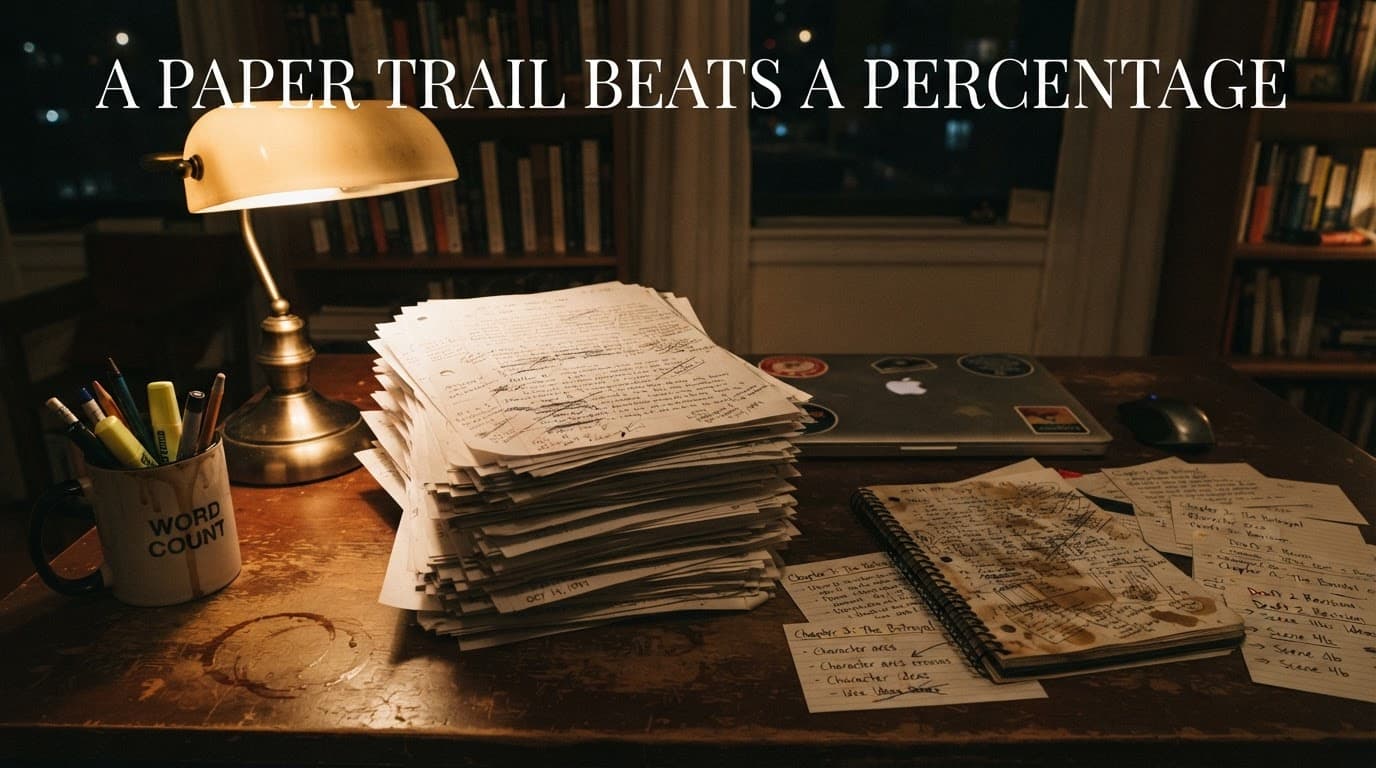
You ran your own chapter through a detector at one in the morning because someone in a Facebook group said you should, and it came back 83% AI. You wrote every word of it. You remember the Tuesday you rewrote the harbor arrival four times because the customs officer kept sounding like a cop from a different book. And now you're sitting in the dark arguing with a progress bar.
That feeling — having to prove you did the thing you actually did — is new, and it's landed on exactly the wrong side of the desk. Here's what a detector score is worth, why careful human prose is the most likely kind to get flagged, and what an actual defense looks like.
A detector score is not evidence
An AI detector doesn't detect anything. It produces a probability estimate from a statistical model, and the companies best positioned to build one have already conceded they can't do it reliably.
OpenAI launched an AI Text Classifier in January 2023 and killed it six months later. The note still sits at the top of the original announcement: "As of July 20, 2023, the AI classifier is no longer available due to its low rate of accuracy." The numbers in that same post explain why. On a challenge set of English texts, the classifier "correctly identifies 26% of AI-written text (true positives) as 'likely AI-written,' while incorrectly labeling human-written text as AI-written 9% of the time." OpenAI's own guidance was that it "should not be used as a primary decision-making tool."
Read that false-positive number with a novel in mind. Nine percent of human passages flagged means that in a 40-chapter manuscript, you should expect several chapters to come back accusing you of something. That's not a signal. That's the tool's baseline noise.
Why clean human prose gets flagged
The detectors don't look for AI. They look for statistical smoothness — predictable word choice, even sentence rhythm, low lexical surprise. Plenty of human writing has those properties, and the humans who have them get punished for it.
Stanford researchers Weixin Liang, Mert Yuksekgonul, Yining Mao, Eric Wu and James Zou ran seven popular GPT detectors against essays by non-native English speakers and against essays by American eighth-graders. Per the Cell Press release on the study, the detectors "incorrectly labeled more than half of the essays as AI-generated, with one detector flagging nearly 98% of these essays as written by AI," while correctly classifying "more than 90% of essays written by eighth-grade students from the U.S." as human. Zou's recommendation was blunt: "we should be extremely careful about and maybe try to avoid using these detectors as much as possible." The paper is on arXiv and ran in Patterns.
If you write in your second language, or you write spare prose on purpose, you are the target demographic for a false accusation.
And then there's the part nobody warns you about. A writer in this r/selfpublish thread — a children's book about her own dog, written entirely by her — got 100% human from Originality.ai's Lite model and 83% AI from the same vendor's Turbo model. Same text. Same company. Two different verdicts. A commenter in the same thread described the pattern more precisely than any vendor doc does: "my original draft shows original content on all originality.ai models, but my 9th revision shows everything as AI. The more you fine tune what you write, the more it seems to think it is AI."
Call it the revision paradox: the more you polish, the more machine-like you score. Every pass where you cut a clumsy clause, straighten a run-on, or make your gruff dockhand stop drifting into complete sentences moves your prose toward exactly the statistical evenness the detector was built to punish. The tool is measuring craft and calling it fraud.
A paper trail beats a percentage
The defense is not a better score. The defense is process — dated, boring, cumulative, and impossible to fake backwards.
This is already happening at the agent stage. A writer in this r/PubTips thread reported that an agent "requested to see the developmental notes, my planning, the architecture of my thoughts and some early drafts." 148 comments followed, most of them arguing about whether that's reasonable. One reply captured the practical problem: "For those of us who plots on post-it notes and hand writes our drafts, this isn't as easy as sending an email." And on a r/fantasywriters thread about the same anxiety, the advice that rose to the top was five words long: "keeping your drafts and revision history matters more."
Here's what that looks like in practice. Say you're Nadia, 94,000 words of second-world fantasy, eleven months of drafting, querying since March. Agent number twelve asks for your process materials. You send: a folder of 31 dated draft files, harbor-v1.md through harbor-v9.md among them; a scanned notebook page from last October where your protagonist's brother is still named Toma and you crossed it out twice; four voice memos recorded in a car; and a chapter-nineteen file whose modification timestamps cluster across six evenings in a single week. None of that is proof in a courtroom sense. All of it is a texture no one generates after the fact. Nine versions of one scene, each wrong in a different direction, is the shape of a person thinking — and a model asked to fake that trail would produce nine versions that are all wrong in the same direction.
That's the asymmetry worth understanding: a score can be argued with, a year of mess cannot be manufactured.
The practical catch is where your mess lives. If your manuscript exists only inside a subscription tool's cloud, your evidence is a vendor's database row, and you've seen what happens when one of those shuts down on six weeks' notice. Working in a desktop app like NovelMage, where projects sit as files in your own filesystem and no server ever touches the manuscript, means your Time Machine snapshots, File History, or synced-folder versions are already building the trail without you doing anything. One genuine exception: if you've drafted the whole book in Google Docs, don't migrate now — its automatic revision history is the best paper trail you'll ever have, and trading it away mid-manuscript would be a bad swap.
What "Human Authored" certification actually certifies
The Authors Guild's Human Authored mark is a registered attestation with legal consequences for lying, not a test result. It's worth having, as long as you know which of those two things you're buying.
The Guild expanded the program on March 2, 2026 to all authors whose books are published in the United States. It costs $10 per title for non-members and is free for Guild members. You create an account, complete third-party identity verification, then execute a license agreement per title representing that the book is Human Authored — after which you get a downloadable mark and a registration number. Readers can check a title against a public database.
The definition is stricter than most people assume and looser than the rest assume. Per the program FAQ, Human Authored means "the text of the work was fully authored by one or more human beings and not generated by GAI, except that a de minimis (e.g., very small or trifling) amount of text may be generated or modified by or with the use of GAI" — spelling and grammar tools, index generation, and preparatory work like outlining and brainstorming all sit on the permitted side.
The most useful sentence in the whole FAQ is the Guild's admission about why it works this way: "we are not aware of any truly reliable way to test whether a work includes AI-generated material." So the program doesn't vet manuscripts. It's self-certification, backed by enforcement against people who misuse the mark. Which is the honest design — and it quietly confirms the argument of this entire post. The organization with the most incentive in publishing to build a working detector looked at the options and chose a signature over a score.
Build the trail, starting with your next session
- Stop overwriting. Save each meaningful revision as its own dated file rather than saving over yesterday's.
ch04-2026-09-23.mdcosts you nothing and is worth more than any certificate. - Keep the ugly stuff. The abandoned subplot, the character sheet where your antagonist had the wrong eye color, the note that says WHY DOES SHE EVEN GO TO THE DOCKS. Failed work is the least forgeable thing you own.
- Photograph the analog. Notebook pages and index cards count. Scan them the week you write them, not the week you're asked.
- Let the filesystem do it. Turn on Time Machine or File History, or keep the project folder in something that versions automatically. If you're drafting in NovelMage, the project is already local files, so this is one checkbox rather than an export workflow.
- Keep any AI use on your own machine. If you do run a grammar pass or a brainstorm through a model, running it locally through Ollama or LM Studio means there's no third-party log of your manuscript existing anywhere — which is a cleaner position to be in than "I used a cloud tool, and their retention policy is whatever it is this quarter."
- Register the mark if it fits. $10 and an afternoon, if your book qualifies under the de minimis standard.
When someone actually accuses you
Answer the process question, not the score question. If an agent asks for receipts, send the folder — that request is becoming normal enough that refusing reads worse than complying. If a reader or reviewer posts a detector screenshot, the reply is not a better screenshot; it's the OpenAI note and the Stanford finding, which are both citable in two sentences.
And keep the stakes in proportion. The bestseller that got a 60% AI reading from a detector — the case we went through in what readers actually punish — still sold. Detector scores move Reddit threads far more than they move markets. What moves markets is whether chapter three works.
Frequently Asked Questions
Do AI detectors actually work on fiction?
Not reliably enough to act on. OpenAI withdrew its own classifier in July 2023 citing a 26% true-positive and 9% false-positive rate, and the Stanford study found seven detectors misclassifying more than half of a set of human-written essays, with one flagging nearly 98% of them. Fiction makes it worse, because stylized prose, deliberate repetition, and heavy line-editing all push text toward the statistical evenness detectors read as machine-generated.
Should I pay for the Authors Guild Human Authored certification?
If your book genuinely qualifies, $10 per title is cheap insurance for front-matter credibility, and it's free if you're already a Guild member. Just be clear about what you're getting: a verified-identity attestation in a public database, not a lab result. It deters casual accusations; it does not test your manuscript.
An agent asked to see my early drafts. Is that a red flag?
It's increasingly common rather than suspicious, and the r/PubTips thread on exactly this ran 148 comments without landing on "walk away." Send the materials you have. If your process is genuinely post-it notes and longhand, say so and send photographs — the texture of real mess is the point, not the file format.
Does using Grammarly or spellcheck disqualify me?
No. The Authors Guild FAQ explicitly puts "GAI-powered spelling and grammar check applications" on the de minimis side, along with index generation and preparatory brainstorming or outlining. The line it draws is generation: text the model wrote versus text you wrote that a model checked.
I've been overwriting one file for two years. Am I out of luck?
You have more than you think. Email attachments to beta readers, message threads where you pasted a paragraph, cloud-storage version histories, your query drafts, the notes app on your phone. Pull all of it into one dated folder this week, and start the clean practice going forward — a trail that begins today still covers the rest of the book.
Your defense was always going to be the work itself: the nine versions of the harbor scene, the crossed-out name, the year. The only real task is keeping it where you can find it.
If you'd rather that trail live on your own disk than in someone's cloud, NovelMage is a desktop app for Windows and macOS with a $99.99 one-time lifetime license covering up to three devices and all future updates — no subscription, no servers touching your manuscript, and a 7-day free trial that doesn't ask for a card. Your files stay yours, which turns out to be the same thing as your evidence staying yours.