Is Your Agent Running Your Manuscript Through AI?
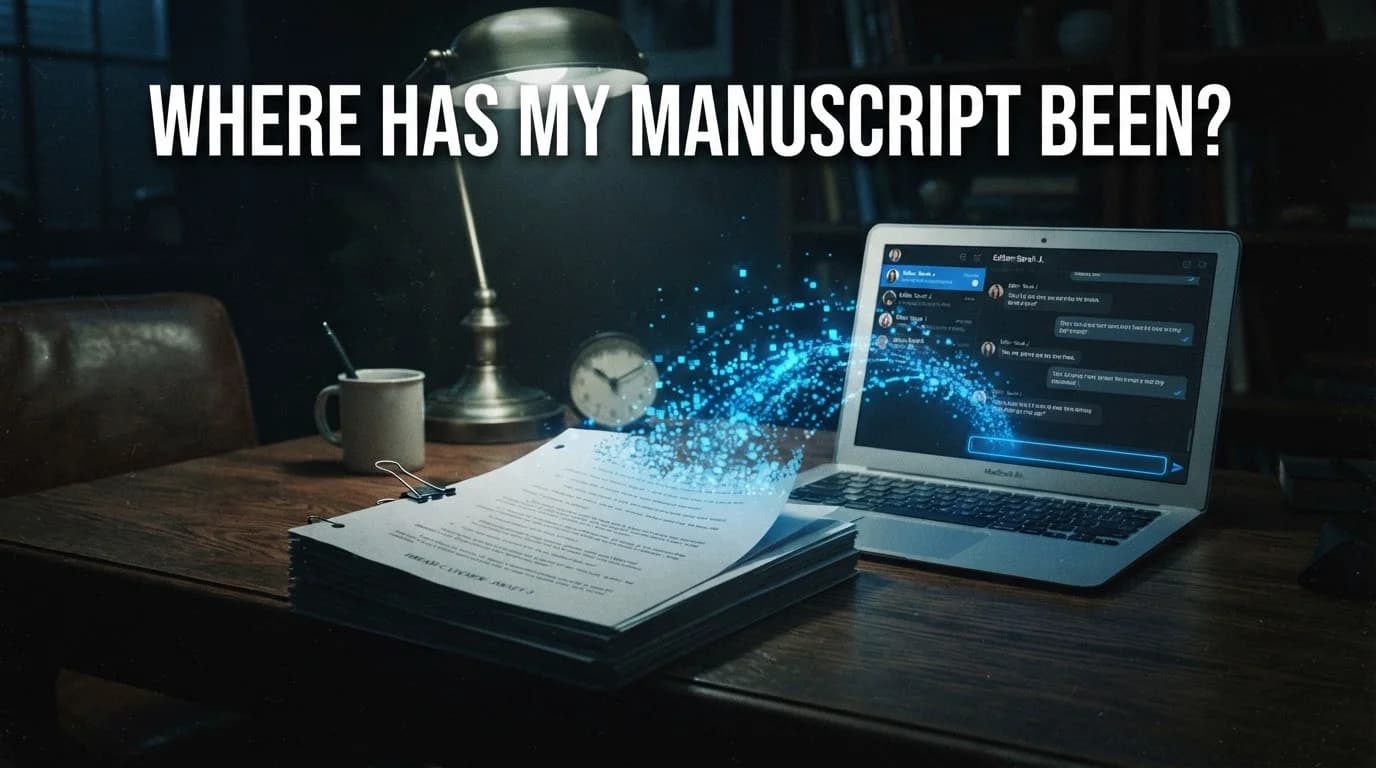
You paid $1,850 for the developmental edit. Eleven pages came back, and page four lists three comp titles — one you know, two you've never heard of. You search both. Neither exists. Not out of print, not obscure. Never published.
And the feeling that arrives isn't really about comps. It's the cold arithmetic underneath: where has my manuscript been?
Writers have spent three years being asked whether they used AI. Almost nobody has told them what the industry is doing with their pages on the other side of the inbox. Can you find out, can you object, does it matter — that's what this post is for.
Yes, it's happening, and some of it is on the record
The best-documented version isn't a rumor on a forum. In spring 2026, Curtis Brown agent Gordon Wise told The Bookseller that some editors are uploading confidential manuscripts to ChatGPT to "read" them quickly, and that conversations at that year's London Book Fair suggested the practice had become widely adopted. His framing was pointed: agents ask clients to disclose AI use, so publishers owe the same transparency back.
The Authors Guild responded in April 2026 with a statement that uploading a copyrighted work or an author's personal information into AI systems without permission may violate the author's copyright or right of privacy. That's a position, not a court ruling — worth holding lightly. But the Guild backed it with something concrete, which we'll get to.
Two things are true at once, and conflating them is how writers end up either paranoid or complacent. There is a documented, industry-level concern about editors running submitted manuscripts through consumer chatbots. There is also a large volume of individual suspicion — a rejection that came back too fast, feedback that reads oddly generic — where the writer has no way to know. On r/PubTips, one writer whose second book was dying on submission put it exactly: "rejections have come swiftly this time… Now, I'm having the even more terrifying thought that ChatGPT is reading my book and deciding on its market viability." That's a real fear. It is not, by itself, evidence.
The one tell that actually holds up
Most AI tells writers trade are weak. Em dashes are not evidence — novelists have used them for two centuries. "Generic phrasing" is what tired people produce at 11pm. Running the email through a detector, or asking a chatbot whether a chatbot wrote it, returns a confident answer with nothing behind it.
The hallucinated comp is the fingerprint.
When a writer on r/PubTips received editorial feedback containing two comp titles that don't exist, the thread didn't debate it. "Fake titles for comps = definitely AI," one commenter wrote, and that's roughly right, because a human editor who has read widely enough to recommend comps does not invent two of them. Language models do invent them, constantly and fluently. The same logic applies to a quoted line that isn't in your manuscript, a page-number reference pointing at the wrong scene, or a character described with the wrong eye color when your text is consistent about it.
So the test isn't stylistic. It's factual: does the feedback contain claims that are checkable, and do they check out? Search every title. Find every quoted line in your own document. If the letter references your chapter 12 reveal and your chapter 12 has no reveal, you have something. If you just don't like the tone, you have a hunch. Detection is genuinely hard, which is a problem cutting in more than one direction as watermarking arrives.
What actually happens when a manuscript goes into a chat window
Here's the part that matters more than whether the feedback was any good, and almost nobody explains it: which account it was pasted into changes everything.
OpenAI's own enterprise privacy page states that data from ChatGPT Business, Enterprise, Edu, and the API Platform "isn't used for training our models" by default. In the same breath, describing what is used: "We also use data from versions of ChatGPT and other services for individuals." An editor pasting your 96,000 words into a corporate workspace their publisher administers is one situation. An editor pasting the same words into their personal ChatGPT tab on a Sunday evening is a different one — that content sits in the individual bucket, unless that person has gone into settings and switched training off, which most people never do.
Both are confidentiality problems. Only one of them plausibly ends with your unpublished novel in a training set. The industry conversation flattens these into "AI," and the flattening is why nobody can get a straight answer.
This also explains why the Authors Guild's remedy is worded the way it is. Their model publishing contract clauses don't say "no AI." They say: "Publisher shall not upload the Work or any of Author's personal information to consumer-facing AI systems for purposes such as generating summaries, assessments, or marketing copy without written permission from the author" — and where permission is given, the publisher must ensure the manuscript isn't used for third-party training, "such as by opting out of allowing training in user settings." A separate clause has the publisher warrant it "will not use AI to substantially edit a manuscript (excepting the use of basic spelling and grammar-checking applications)."
That is a workable ask. "Please respect my work" is not.
Should you put a no-AI line in your query letter?
No. And this is the most common version of the question — a writer on r/PubTips asked whether adding a polite P.S. asking agents not to run the query through AI would be a faux pas. The thread's answer was near-unanimous, and it's correct for an unglamorous reason: at query stage you have no leverage, and the line reads as a person managing a grievance rather than pitching a book.
There's a practical wrinkle too, raised by someone in that thread who'd interned reading queries: Gmail will sometimes auto-summarize incoming mail whether or not the reader asked it to. A request the agent can't technically honor isn't much of a request.
Query stage is the wrong moment. Not because your concern is unreasonable, but because you're asking the person with all the power for a favor before they've read a page. The question of what you disclose to agents about your own AI use has the same shape from the opposite direction, and the same answer: nothing you say in the query improves your odds.
Where you actually have leverage
Leverage arrives with an offer, and it arrives once.
Picture it concretely. Maya has a 96,000-word literary thriller. Thirty-four queries out, two fulls, one offer of representation. That call — the one where the agent asks if she has questions — is the single point in the process where an agent is selling to her. The questions writers are told to ask are about editorial style, submission strategy, communication cadence. Add one: what's your agency's policy on putting client material through AI tools, and does that policy follow the manuscript to editors on submission?
That question costs nothing at offer stage. It costs everything at query stage. And the answer is informative either way — an agent who has thought about it will have an answer, and an agent who hasn't just told you something too.
Then, at contract, the Guild's clause language is sitting right there to be pointed at. You aren't inventing a demand; you're citing a model clause a major writers' organization publishes for exactly this. Agencies are already moving — The Bookseller noted the Curtis Brown concern surfacing precisely as more agencies fold AI clauses into their own contracts.
If it's already happened with a freelance editor you hired, the calculus is simpler, because there you're the client. Maya's editor sent eleven pages containing two invented comps; the same editor's letter two years earlier ran six pages with margin notes and no comps at all. She's owed a re-edit or a refund, and asking plainly — I couldn't locate two of these titles; can you tell me where you found them? — beats an accusation, because it gives an honest person room to answer and a dishonest one nowhere to stand.
One thing you're not owed: a new disclosure obligation. As a commenter in that thread put it, "It's not an infectious disease, your manuscript hasn't caught AI by coming into contact with it." Undo the changes you didn't want, and your book is your book. What you tell readers later is a separate decision with separate stakes.
The half of the pipeline you control
You can't audit their pipeline. You can audit yours.
Every writer in these threads is discovering the same thing from the wrong end: a manuscript pasted into a chat window has been handed to a company. That's true when an editor does it without telling you. It's equally true when you do it at 1am to ask why chapter nineteen drags — and most writers using AI for craft work have never checked which bucket their own account falls into.
The fix is unglamorous and entirely in your hands. Draft against a model running locally through Ollama or LM Studio and the text never leaves the machine: no account, no retention window, no setting to have gotten wrong. Use a cloud model through your own API key and you're at least in the developer bucket rather than the consumer one. This is the architecture offline-first tools are built around, and it's why NovelMage runs as a desktop app on Windows and macOS with local models or your own keys — a $99.99 one-time license instead of a subscription, with no NovelMage server that ever holds manuscript text. Ask it who knew about the poisoning before chapter fourteen, and the question and the answer both stay on your disk.
Being honest about the limit: going local doesn't retrieve the copy already sitting in twelve agents' inboxes, and if you're on submission, that horse is out.
But the industry will spend years arguing about consent, and the writers who come out of it best will be the ones who already know exactly where their own words have been.
Frequently Asked Questions
Can I ask an agent not to run my query through AI?
You can, but in a query letter it costs more than it buys — you have no leverage before anyone has read your pages, and the request reads as friction. Ask at the offer call instead, when the agent is selling to you: what's the agency policy on AI tools, and does it follow the manuscript to editors on submission? Then push for explicit language at contract.
If an editor ran my manuscript through AI, do I have to disclose AI use when querying?
No. Someone else's use of a tool on your text doesn't make your text AI-generated, and disclosure questions on submission forms ask what you did. Reject any changes you didn't want, and query normally.
Is my copyright actually at risk if someone pastes my unpublished manuscript into ChatGPT?
The Authors Guild's stated position is that uploading a copyrighted work into an AI system without permission may violate the author's copyright or right of privacy — that's an advocacy position, not settled law. The concrete risk is more specific: consumer ChatGPT accounts sit in the pool of data OpenAI uses to improve models unless the user has switched training off in settings, while Business, Enterprise, Edu and API data is excluded by default. So the exposure depends entirely on which kind of account it was.
How can I actually tell whether AI touched the feedback I received?
Check facts, not style. Search every comp title; verify every quoted line against your document; confirm page and chapter references land where they claim. Invented comps and quotes you never wrote are strong signals. Em dashes, generic phrasing, and AI-detector scores are not — they produce confident false positives on ordinary human writing.
What should I do about the AI tools in my own drafting process?
Find out which account your text goes into. If you use a chatbot's consumer tier, check the training toggle in settings. If you'd rather the question never arise, run a local model through Ollama or LM Studio so the manuscript stays on your machine — NovelMage's $99.99 lifetime license covers up to three devices and works with local models or your own API keys, and there's a free seven-day trial if you want to test the workflow before deciding.