What Is a Beat Sheet? A Novelist's Save the Cat Guide
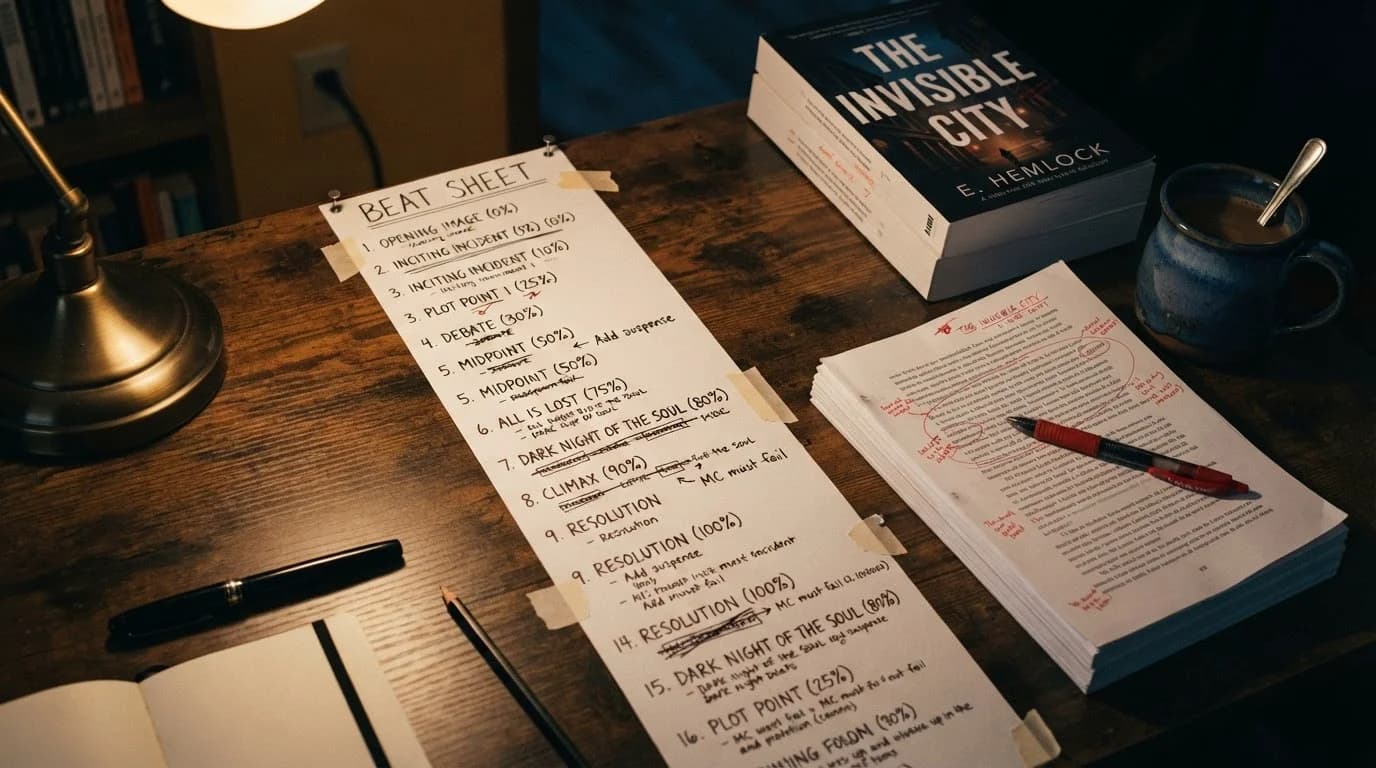
You're 61,000 words in and something between chapter fourteen and chapter twenty-six has gone soft. The sentences are fine. Your characters still sound like themselves. Your beta reader said "it's a little slow through the middle," couldn't say more, and you've spent two weeks rereading those chapters hunting for the bad one — when the problem was never a chapter at all.
A beat sheet is the tool built for exactly that failure. It won't help you write a better sentence. It will tell you that a section meant to end at the halfway mark is still running at 68%, and that the turn you thought was your midpoint is sitting 17,000 words too late.
What a Beat Sheet Actually Is
A beat sheet is a one-page outline of your novel's turning points — in the Save the Cat method, fifteen of them — each written in a sentence or two and pinned to a rough position in the manuscript. It's not a chapter plan. It's a list of the moments where the story changes direction, and where in the book each one lands.
Save the Cat's own description is that the beat sheet "gives writers a clear roadmap of 15 story beats from Opening Image to Final Image—ensuring structure, pacing, and character transformation stay aligned in any medium," per the official beat sheet page. Their writer's guide to beats defines a beat as "a significant story moment that changes the direction of the plot, reveals new information, or shifts the emotional stakes." Kindlepreneur puts the test more bluntly in its beat sheet guide: "A beat is not just an event. It's a turn. Something should shift."
That distinction is the whole thing, and it's where most outlines quietly fail. "Maren rides three days to the coast and argues with her brother about their mother's will" is an outline entry. It becomes a beat only if Maren gets off that road holding something she wasn't holding when she got on — a decision, a lie, a suspicion about who really signed the document.
Blake Snyder enforced this with a length limit. Reedsy's guide quotes him on the discipline: "If I can't fill in the blank in one or two sentences — I don't have a beat yet!" If you can't compress the turn into two sentences, you haven't found the turn. You've found a chapter you'd like to write.
The 15 Beats and Where They Land
Here's the full sheet with the percentage positions Jessica Brody adapted for novelists in Save the Cat! Writes a Novel. Multiply by your target word count to get a rough marker.
| # | Beat | What it does | Position |
|---|---|---|---|
| 1 | Opening Image | The "before" world, in one scene | 0–1% |
| 2 | Theme Stated | Someone names what the protagonist needs to learn | ~5% |
| 3 | Setup | Protagonist, world, flaw, stakes | 1–10% |
| 4 | Catalyst | The disruption that starts the story | ~10% |
| 5 | Debate | Resistance, hesitation, or investigation | 10–20% |
| 6 | Break Into Two | She commits, and Act 2 begins | ~20% |
| 7 | B Story | The relationship that drives the inner arc | ~22% |
| 8 | Fun and Games | The promise of the premise, delivered | 20–50% |
| 9 | Midpoint | A false victory or false defeat that reframes everything | ~50% |
| 10 | Bad Guys Close In | Pressure compounds, inside and out | 50–75% |
| 11 | All Is Lost | The lowest point | ~75% |
| 12 | Dark Night of the Soul | She sits in the wreckage | 75–80% |
| 13 | Break Into Three | The breakthrough | ~80% |
| 14 | Finale | The test of whether she actually changed | 80–99% |
| 15 | Final Image | The "after" world | 99–100% |
Reedsy is careful to note that "the percentages serve as a guide, rather than a prescriptive formula," and the published novels it analyzes don't hit the marks exactly. Treat a beat that's 6% off as noise. Treat one that's 20% off as a finding.
What a Beat Sheet Doesn't Do
Here's the honest limitation, and it's sharper than most beat sheet guides will admit. The framework tells you where things go. It has almost nothing to say about how to make them good.
Mythcreants makes this case hard in its critique of the novel beat sheet, and the line that stuck with me is this one: "Instead of telling you how to do something, she thinks the hard part is figuring out where to put it. Like you've already completed your masterful oil painting, and now you need a little advice on where to hang it for the best lighting." Their point about the Fun and Games section is fair too — a beat that spans 30% of your novel and amounts to "plot happens here" isn't instruction.
They're right. And it's the most useful thing anyone has said about beat sheets, because it names the division of labor precisely: a beat sheet is a map of where, not a manual of how.
Which happens to be the exact half that AI drafting is worst at. A language model will hand you competent, atmospheric, technically clean prose for any scene you describe, all day, forever. What it cannot do is notice that the scene shouldn't exist, or that it's arriving 12,000 words after the moment it needed to land. The model writes the painting. It has no opinion about the wall.
Building One: A Worked Diagnosis
The fastest way to see what a beat sheet is worth is to reverse-engineer one from a draft you've already written.
Say you're Priya, 92,000 words into a mystery, and the middle is mush. You write fifteen lines describing the book as it actually is — not as you planned it — and note the word count where each lands. The Catalyst, her brother's body found in the reservoir, is at word 4,100: 4.5%, a touch early, fine. Break Into Two at 26,000 is 28% — late, but survivable.
Then you get to the midpoint and the sheet stops cooperating. The moment you think of as your midpoint — the detective realizing the coroner lied — is at word 63,400. That's 69% of the book. Which means Fun and Games, that supposedly 20-to-50% stretch, is running from 26,000 all the way to 63,000. Forty percent of the manuscript. And the true middle of your book, word 46,000, is a chapter where two characters drive to a town and talk.
The diagnosis isn't "chapters 14 through 26 are weak." It's that the book has no midpoint. Everything readers call a sagging middle is happening in the 23,000 words between where the turn should be and where it is. The fix isn't a rewrite of thirteen chapters — it's moving one revelation forward by roughly 17,000 words and letting the back half become a story about what that lie costs. That's a structural edit you can plan in an afternoon, and you could not have seen it by rereading.
One honest caveat: if you're a committed discovery writer, don't build a beat sheet before you draft — you'll write to the sheet and the book will feel like it. Draft first, diagnose after.
Feeding Beats to an AI Model
If you're drafting with AI, the beat sheet is the highest-leverage thing you can put in front of it — but not by pasting all fifteen beats and asking for a chapter. Give the model one beat at a time, with four things attached:
- The beat itself, in Snyder's two sentences, plus the beat before and after it. The model needs to know what state the story is entering and leaving.
- The position. "This is the All Is Lost at 75%" carries real information about tension: nothing resolves here, and the reader should not be comforted.
- Who knows what as of this moment. This is where generated chapters break down most often — a character acts on information she hasn't been told yet. If you keep a Codex or story bible, pull the relevant entries in; we went deep on that failure mode in why AI forgets your story details, and the retrieval side is covered in what a lorebook actually is.
- The turn, stated as a requirement. "By the last line, Maren must believe her brother forged the signature. She does not say so." Models will happily write a beautiful scene in which nothing changes, because nothing in your prompt told them something had to.
What comes back will be structurally correct and often emotionally distant — the model hits the beat and narrates it from twelve feet away. That's a separate, fixable problem, and it's the one we broke down in why AI writing feels flat. Structure first, then close the narrative distance.
The mechanical part of this gets easier when your tool already knows the shape of the manuscript. In NovelMage, the manuscript is organized into acts, chapters, and scenes with running word counts, so a beat's actual percentage position is something you can read off the sidebar instead of maintaining in a spreadsheet — and because it runs as a desktop app against your own models (local via Ollama or LM Studio, or your own Claude, GPT, or Gemini keys), the whole draft you're diagnosing stays on your machine.
The Reverse Beat Sheet
Beat sheets are usually sold as a planning tool, and they're better as a diagnostic one. If you have a finished draft, generate a one-line summary of every scene, print the list, and mark which fifteen entries are turns. Most drafts that "feel slow" will show one of three patterns: a Fun and Games section eating the midpoint, a Dark Night of the Soul compressed to a paragraph so the emotional low never registers, or a Theme Stated that appears at 40% instead of 5% — meaning the reader spends the first two-fifths of the book not knowing what it's about.
Per-scene summaries are tedious to write by hand, which is why NovelMage generates chapter and scene summaries from the manuscript itself; the point is to get the whole book onto one page where the shape is visible.
Frequently Asked Questions
Do I have to use all 15 beats?
No. The beats that earn their keep in nearly every novel are Catalyst, Break Into Two, Midpoint, All Is Lost, and Break Into Three — five turns that determine whether a book has momentum. Opening Image and Final Image are optional framing devices; B Story is meaningless if your protagonist's arc is driven by a rival rather than an ally. Track the five, and treat the other ten as prompts.
Is Save the Cat too formulaic for literary fiction?
The critique is real, and the answer is to use the sheet backwards. As a generator it produces predictable books; as an X-ray it's neutral, because it only reports where your turns actually fall. A quiet literary novel with a midpoint at 71% has the same pacing problem as a thriller with one — the reader just describes it more politely.
What's the difference between a beat sheet and a three-act structure?
Resolution. Three-act structure gives you two hinge points and three blocks; a beat sheet subdivides those blocks into fifteen labeled moments with position guidance. Save the Cat's fifteen beats map onto three acts — beats 1–5 are Act 1, 6–12 are Act 2, 13–15 are Act 3.
Can AI write my beat sheet for me?
It can, and the result will read like every other beat sheet, because generic structure is exactly what a model produces without your specifics. The better use is auditing: paste your fifteen beats and ask which ones fail the "something shifts" test, and which two are the same turn wearing different clothes. That second question catches more problems than any generated outline will.
Start With Fifteen Sentences
Fifteen sentences is the cheapest draft you'll ever write, and the only one that can tell you your book's problem is a missing midpoint rather than a weak chapter. Write them for whatever you're working on now — even the messy 61,000 words — and see where the numbers land.
If you'd rather do it against a manuscript that already tracks its own act, chapter, and scene structure, NovelMage is a one-time $99.99 purchase for Windows and macOS, with a 7-day trial and no subscription. Your draft never leaves your device.