Why AI Forgets Your Story Details (It Never Knew Them)
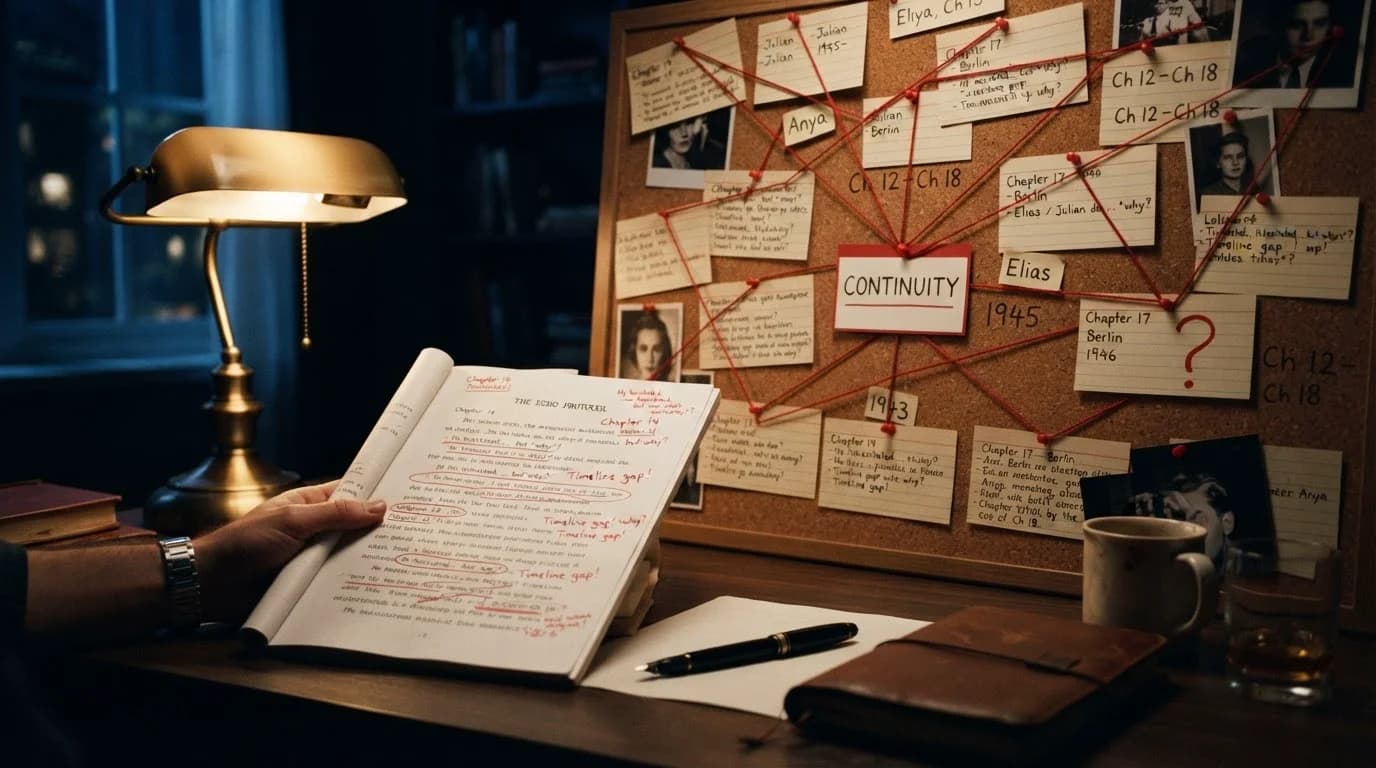
Short answer: AI doesn't forget your story details — it never had them. A model generating chapter 20 sees only what's sitting in its context window at that moment, so everything outside it gets confidently invented. The fix isn't a bigger context window or a longer story bible; it's retrieving only the handful of entries each scene actually touches, and tracking who knows what as of which chapter.
You're twenty chapters in and something is wrong that you can't name. The prose is fine. The pacing is fine. But your spymaster's burn scar has moved to the other hand, your coronation is either six weeks out or a month out depending on which chapter you're reading, and a character just referenced a betrayal she doesn't find out about for another forty pages. None of that came from a bad sentence. It came from the machine confidently filling a gap it couldn't see.
This is the failure mode that actually sinks AI-assisted novels, and it's not the one everybody's watching for. Writers spend enormous energy hunting prose tells — the em dashes, the "it's not just X, it's Y" cadence, the banned-word lists. Meanwhile the thing a reader actually puts in a review is that the author apparently didn't read their own book.
Why AI forgets your story details
It doesn't forget them. It never had them. A language model generating chapter 20 is working from whatever text is sitting in its context window at that moment — your prompt, your notes, maybe the last few chapters — not from your manuscript as a whole. Everything outside that window doesn't exist. Everything inside it competes for attention.
Two pieces of research make the mechanism concrete. Stanford's Nelson Liu and colleagues, in Lost in the Middle, tested models on multi-document question answering and key-value retrieval and found that "performance is often highest when relevant information occurs at the beginning or end of the input context, and significantly degrades when models must access relevant information in the middle of long contexts, even for explicitly long-context models." That's a retrieval benchmark, not a novel — but the shape of it should worry you, because a story bible pasted into the middle of a long prompt is exactly the position that tests worst.
Chroma's Context Rot report (Kelly Hong, Anton Troynikov and Jeff Huber, July 2025) pushed on this across 18 models including GPT-4.1, Claude 4, Gemini 2.5 and Qwen3, and concluded that "models do not use their context uniformly; instead, their performance grows increasingly unreliable as input length grows." The finding that matters most for novelists is the one about distractors: "Even a single distractor reduces performance relative to the baseline (needle only), and adding four distractors compounds this degradation further."
Read that again with a manuscript in mind. A distractor is text that looks like the thing being asked for but isn't. Your codex is full of distractors by design — four characters with similar names, two cities in the same duchy, three timeline entries about the same war. The more thoroughly you document your world, the more near-misses you hand the model.
So you're squeezed from both ends. Give it too little and it invents bridges you never wrote; give it everything and the signal drowns in your own worldbuilding. Your AI isn't losing the plot. It's guessing at the parts of your book it can't see, and guessing well enough that you don't notice.
The three kinds of drift, and only one is about facts
Most writers think of continuity as a fact problem — eye colour, hair length, the name of the inn. That's the easiest tier to catch and the least damaging to miss. They get harder from here.
Fact drift is the surface layer. Ilsabet's scar is on her left hand in chapter 3 and her right in chapter 22. A character's sister is thirty-two but he's known her for thirty-four years. Trivially checkable once you're looking, invisible while you're drafting.
Timeline drift is worse because it compounds. If the coronation is six weeks out in chapter 12 and a month out in chapter 14, every travel scene between them is now wrong too. Fixing the date doesn't fix the three chapters that were paced against the wrong date. One flag, six edits.
Knowledge-state drift is the one that quietly ruins books, and almost nobody tracks it. It's not what is true — it's who knows it, and since when. If you fed the model your outline so it would stay on plot, you also handed it every reveal in the book. It has no concept that the treaty betrayal in your chapter-24 notes is a secret in chapter 20. So your protagonist reacts, subtly, correctly, to something she hasn't learned yet — and your reveal lands four chapters later on a reader who already felt it. Nothing in that scene is factually contradictory. It's just dramatically dead.
There's a fourth sitting off to the side — voice drift: your gruff dockhand who speaks in fragments starts producing balanced, complete sentences around chapter 15, because that's the model's gravitational pull. If that's your main symptom, it's a separate fight — keeping your voice intact while using AI is a craft problem more than a memory one.
Continuity is a state problem, not a fact problem. A reference doc tells the model what is true. It doesn't tell the model what is true yet.
Why your story bible isn't working
Because a document the model doesn't read at generation time is decoration. Here's the trap: you build a 12,000-word world bible, paste it into the chat once, draft forty scenes off that single paste, then wonder why chapter 30 contradicts chapter 4. That bible left the context window a long time ago.
Both obvious fixes fail. Paste everything every time and you've built a haystack out of your own notes and asked the model to find a needle in it. Paste nothing and trust it to remember, and it fabricates. A story bible nobody retrieves is a diary, not a database.
What works is retrieval: only the entries this scene actually touches, injected at the moment of generation, every time. That's the entire design idea behind a codex — NovelMage's Codex pulls the relevant character, location and lore entries into the prompt per scene rather than making you re-paste your world, which is the difference between notes you keep and notes the model uses.
Building a record that actually holds
Here's the process, in the order it works.
1. Write facts as atomic, checkable statements. Not "Ilsabet is scarred and secretive." That can't be violated because it can't be tested. Write "Burn scar, back of left hand, from the Varen fire." Now a chapter either contradicts it or doesn't. One fact per line, phrased so a contradiction would be obvious to a stranger. The same discipline governs how a lorebook entry is written and when it actually fires — an entry vague enough to trigger on every chapter is worse than no entry at all, because now it's a distractor in every prompt you send.
2. Record state changes with chapter numbers. Every entry that can change over the book gets a timestamp: Ch. 9 — Ilsabet learns Corwin is her half-brother. Ch. 14 — she tells Sera. Nobody else knows through Ch. 22. This is the knowledge-state ledger, the single highest-value thing on this list, and the one no generic "character profile" template asks you for.
3. Declare your intended contradictions before you check anything. This is the step people skip and then abandon the whole process over. A planted secret is structurally identical to a continuity error — a character behaving in a way that contradicts established facts is exactly what your twist looks like from the inside. Any continuity check you run, human or machine, will flag your best plotting as a bug. So write your deliberate misdirections down first, as a short list, and check around them. Otherwise you will spend an afternoon "fixing" your own foreshadowing. That list does double duty on the other side of the problem, too: the setups an AI draft plants and then never pays off are invisible to any continuity pass, because an unfired gun contradicts nothing. Only your own list of what you meant to plant will catch those.
4. Feed the scene, not the book. For a given scene, the model needs the two or three characters present, the location, the rules that constrain the action, and the knowledge-state of everyone in the room. It does not need your magic system's economic implications. Every irrelevant entry you include is a distractor competing with the one that matters.
5. Make the continuity pass a separate step — and re-run it after revision. Don't try to catch drift while drafting; you'll do neither well. Walk the finished manuscript chapter by chapter against the record, then run it again after any big revision, because editing breaks things that used to be correct. Cut a scene in chapter 6 and you've orphaned the callback in chapter 21.
The machinery starts paying for itself somewhere north of two POVs and 60,000 words; below that, one page of notes and your own memory will carry it fine. And it keeps scaling past a single book. By the time you're drafting a sequel, the record is your institutional memory, because you no longer reliably remember book one either — keeping book three true to book one is this same ledger with a volume number added to every timestamp, and with everything an earlier book established treated as immutable unless you're deliberately retconning it.
What this looks like on a real book
Priya is 74,000 words into a three-POV political fantasy — 31 chapters across five months, drafted in one long chat with her outline pasted at the top, which is how most of this happens.
Her first full pass took about twenty minutes a chapter, call it ten hours across a week, and produced 47 flags. Nine were her deliberate misdirection: Ilsabet's loyalty is supposed to look contradictory until chapter 26. She wrote those down as intended and stopped re-litigating them.
Of the remaining 38, the scar was a one-line fix. The coronation timeline was one flag that became six edits, because two travel sequences had been paced against "a month" and one against "seven weeks." Four were knowledge-state leaks of the worst kind — her spymaster reacting to the Varen betrayal in chapters 20 and 21, three chapters before she's told. That's not a find-and-replace. She rewrote both scenes so the reaction became suspicion instead of knowledge, and they're better scenes now than they were.
Then she cut a subplot in revision, re-ran the pass, and found eleven new contradictions that hadn't existed the first time. That's the part that convinces people this is a permanent step, not a one-time cleanup. Total: about fourteen hours, and one review she never got.
Where the tooling actually helps
Nothing above requires software. A spreadsheet, a chapter-by-chapter read and some discipline will get you every one of those five steps.
Where a purpose-built tool earns its place is steps 4 and 5 — the ones that are tedious every single scene rather than once. Pulling the right three codex entries into the prompt for scene 112 isn't creative work; it's clerical work you'll quietly stop doing at 11pm on a Tuesday. Tools that keep the codex alongside the manuscript do it automatically: NovelMage injects the relevant entries as part of scene generation, and because it's a desktop app, the continuity pass can run against a local model through Ollama or LM Studio, so your unpublished manuscript stays on your machine while you grind through 31 chapters of it.
NovelMage is $99.99 one-time for up to three devices, future updates included, with a 7-day trial that doesn't ask for a card — worth pricing against a per-month tool you'd be renting for the length of a book. You can see the full pricing and start the 7-day trial.
Frequently Asked Questions
Does a bigger context window fix AI continuity problems?
No, and it's the most expensive wrong assumption in AI-assisted writing. Chroma's testing across 18 models found performance grows less reliable as input length grows even on simple retrieval tasks — a million-token window is capacity, not comprehension. A 120,000-word manuscript pasted in full gives the model more places to lose your fact, not fewer.
Should I paste my whole story bible into every prompt?
No. Every entry that isn't relevant to the current scene acts as a distractor, and Chroma's report found that even a single distractor measurably degrades retrieval accuracy. Send the characters present, the location, the constraining rules, and who knows what as of this chapter. Nothing else.
How do I stop the AI from spoiling my own plot twists?
Stop feeding it your full outline mid-book, and maintain a knowledge-state list instead — who knows each secret, and from which chapter. If the model can see the reveal, it will write characters who subtly behave as though they already know it, which reads as flat rather than as an error.
Can AI check continuity, or does it cause the problem?
Both, and that's not a contradiction. Generation drifts because the model can't see the whole book. Checking works because you hand it two things at a time — this chapter, and the record — a small, well-scoped comparison rather than an act of memory. Declare your intended twists first, or it will flag every one of them.
Does any of this change when I'm writing a series instead of one book?
It stops being optional. Within one manuscript you can sometimes brute-force continuity by rereading; across three books you cannot, because the thing that has drifted is your own memory of what you established two years ago. The method is identical — atomic facts, chapter-stamped knowledge states, a declared list of intended misdirections — but every timestamp now carries a volume number, and the cost of a miss is a reader who has been with you for 300,000 words and notices.