Claude Opus 5.5 for Creative Writing: Draft With Taste
You have a scene you've been avoiding for three weeks. It's the one where your narrator finally sits across from her father in the hospice cafeteria, and every version you've drafted either says too much or says nothing at all. Claude Opus 5.5 came out on September 22, supposedly writing "more naturally." The question you care about is narrower: can it write that scene, or at least a version of it you'd want to steal from?
Short answer: Claude Opus 5.5 is the strongest everyday Claude model for drafting fiction from a blank page, and it fixed the two habits that made Opus 5 hard to live with: bloat and ignoring your style rules. It still over-explains, and it needs your prose in the prompt before it sounds like anyone. Used for drafting at high effort with a real brief, it's the best price-to-taste ratio Anthropic sells.
What Claude Opus 5.5 actually is
Opus 5.5 is Anthropic's flagship-tier model in the 5.5 family, released September 22, 2026. Anthropic positions it "for long-running agentic coding and knowledge work," not for fiction, but its launch notes put unusual weight on writing quality.
From Anthropic's announcement: Opus 5.5 "performs at the level of Claude Fable 5.1 on most work and costs 40% less to run than Opus 5." It "communicates more naturally than prior models," and early testers "found its writing clearer and easier to follow." One tester's line, quoted by Anthropic: "it writes the way I do." It's a marketing page, but prose got a paragraph of its own this time instead of a footnote under the coding benchmarks.
The numbers a novelist needs, from Anthropic's model overview and pricing page:
| Opus 5.5 | Fable 5.1 | Sonnet 5.5 | |
|---|---|---|---|
| Input / output per million tokens | $4 / $20 | $10 / $50 | $2 / $10 |
| Cached input (read) | $0.20 | $0.25 | $0.20 |
| Context window | 1M tokens | 1M tokens | 1M tokens |
| Default API effort | medium | high | high |
A million tokens is about 555,000 words on the current tokenizer. Your whole manuscript fits, story bible included. The line to notice is the cache price: Opus 5.5 reads cached context at 5% of its input price, the same $0.20 as Sonnet.
What changed for writers since Opus 5
Opus 5.5 is shorter, plainer, and more obedient than Opus 5, and fiction is where verbosity and drift show first.
Opus 5's writing problems were measurable. A roundup on StashBase collects Arena's August analysis: Opus 5 averaged 510 words per response against Opus 4.5's 158, with sentences 58% longer and em dashes at 2.3 times the rate. Early customer Box reported that Opus 5.5 used a third of the tokens Opus 5 did. The same piece flags the change that matters most in practice: Opus 5 "ignored style guides as a piece got longer," and Opus 5.5 holds them.
For a novelist, that last point is the whole game. You write a style sheet that says your dockhand speaks in fragments, that nobody "lets out a breath they didn't know they were holding," that interiority stays in close third. Opus 5 would follow it for two pages and then drift, until your gruff dockhand was speaking in balanced subordinate clauses like a provost. Opus 5.5 keeps the rule on page nine.
Where Opus 5.5 is strong: the blank page
Opus 5.5 is at its best when nobody has decided yet what the scene should contain. Its advantage is which concrete detail it reaches for, not grammar or structure.
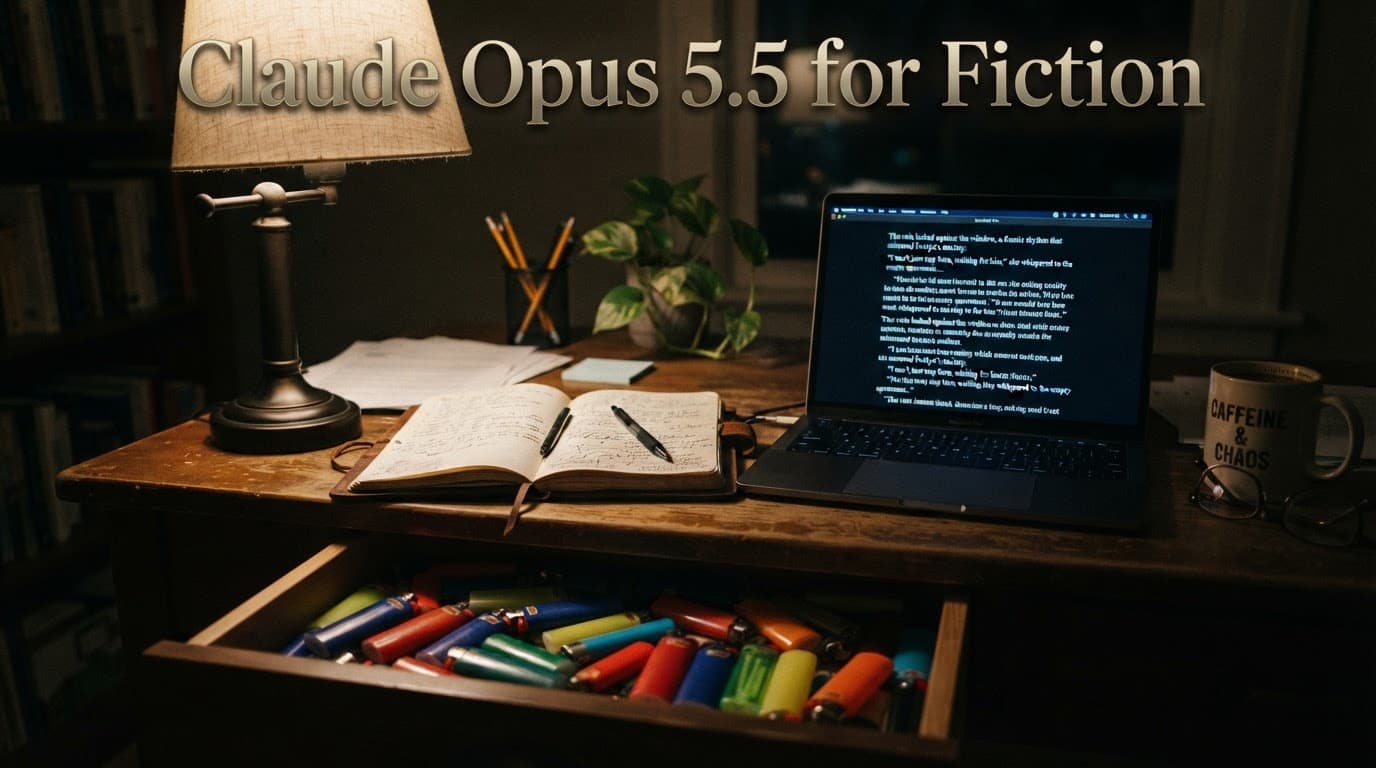
The cleanest evidence is a head-to-head test on Vocal. The tester gave Opus 5.5 and Sonnet 5.5 the same prompt: "4 a.m., in a convenience store, an old man does not arrive." Opus filled the store with a driver buying Red Bull, a cat tripping the motion sensor, and a clerk who ends the piece by opening the lighter drawer, counting the lighters, and pushing it shut. The tester's summary: "Opus puts the feeling inside an ordinary action." Sonnet, by contrast, built designed images.
That's the skill to pay for. Call it finding the lighter drawer: the small, unremarked physical action that carries the grief so the narration doesn't have to. Your hospice scene doesn't need the narrator to think about how much time is left. It needs her father to keep straightening the sugar packets.
There's some benchmark support, read narrowly. On Lech Mazur's creative writing benchmark, which has models weave ten required elements into 600–800-word stories, Opus 5.5 at high effort scores 3.767, just behind Fable 5.1 (3.796) and Opus 5 at xhigh (3.777). That's a short-story test, not a novel test, but it puts Opus 5.5 within a hair of a model that costs 2.5 times as much per token.
And one reader-response data point: Barry, writing in the Endless Hybrids newsletter, gave Opus 5.5 a photograph he found in Buenos Aires in 2008 and asked for a Borges-style story about the man in it coming to life. His verdict on the result: "not AI slop." He's candid that part of its pull was personal: the story wove in places and memories he recognized. The more of your material you hand it, the better it gets, and the harder it is to judge objectively.
Where it still falls short
Opus 5.5 buries the point. It drafts better than it edits, and it explains things your reader already understood.
OrcaRouter ran the same prompts across five frontier models, and its finding is specific: asked to open an essay, Opus 5.5 took 37 to 39 sentences to cover what a human reviewer covered in 21, and "spent a full paragraph on a point the reviewer made in eight words." That was an essay, not fiction, but you'll recognize the fiction version immediately. The confrontation lands, and then there's a paragraph of the narrator processing what just happened, and then a closing line that names the emotion the scene already delivered.
The fix is partly in the prompt and partly in your own hand. Opus 5.5 drafts like a writer and wraps up like a tour guide; cut the last paragraph of most scenes it gives you and you'll usually be right. We go deeper on that habit in why AI prose defaults to telling, and the same tactics apply here.
It also doesn't arrive with a voice. StashBase's verdict holds: it "still doesn't write like a person out of the box." The model that writes "the way I do" only does so after it has read the way you do.
A worked month: drafting a novel on Opus 5.5
A full first draft on Opus 5.5 through the API costs roughly $45 to $70 in tokens, depending mostly on whether your tool caches the repeated context. Here's how that number is built.
Imogen is drafting a 96,000-word literary thriller: 32 chapters, four scenes each, about 750 words per scene. Every request sends the same front matter: a story bible, the chapter outline, and three pages of her own finished prose as a voice sample. Call that 20,000 tokens. Then the part that changes per scene: the scene brief and the last 2,000 words of manuscript, about 4,000 tokens. Back comes a 750-word scene, about 1,350 tokens, plus thinking. At high effort, assume another 3,000 tokens of thinking per request, billed as output. (That's an estimate; real thinking usage varies with the scene.)
Without caching, one request costs: 24,000 input tokens at $4 per million is 9.6 cents, plus 4,350 output tokens at $20 per million is 8.7 cents. About 18 cents. Imogen rerolls most scenes twice, so 128 scenes become 384 requests, and the draft comes to about $70.
With caching, the 20,000-token front matter is read at $0.20 per million instead of $4, which drops it from 8 cents per request to under half a cent. Each request falls to about 11 cents, the draft to about $41, plus a few dollars of cache writes at the start of each sitting. Call it $45.
The same draft on Fable 5.1, uncached, runs about $176. With the two models three hundredths of a point apart on that benchmark, spend Fable money, if at all, on the six scenes the book lives or dies on.
The point of the arithmetic: pay for the first draft, not the fortieth. Opus 5.5's premium buys you taste at the stage where taste is the bottleneck. Once the scene's choices are made, compression and consistency passes go to Sonnet 5.5 at half the price, which is the workflow we laid out in our Sonnet 5.5 creative writing breakdown. If you're mostly revising a finished draft rather than writing new pages, Sonnet is simply the better buy.
Switching models per request is the part a chat window makes tedious. In NovelMage you add your own Anthropic API key once, pick Opus 5.5 for the drafting request and Sonnet 5.5 for the tightening pass, and pay Anthropic's rates directly with nothing marked up in between.
How to prompt Opus 5.5 for fiction
Opus 5.5 rewards a detailed brief and punishes a vague one. Five habits do most of the work.
1. Raise the effort. The API default for Opus 5.5 is medium. OrcaRouter's recommendation was to "draft with it, and draft at high effort or above," and that matches what the benchmark scores were measured at. Medium is fine for summaries and outlines. A scene you care about deserves high.
2. Give it your prose, not adjectives. "Spare, literary, restrained" are words the model has seen ten million times. Two pages of your finished chapters it has never seen.
3. Supply the specifics yourself. Another line from OrcaRouter: "Supply your own examples rather than asking it to invent them." Tell it the father keeps a roll of antacids in his shirt pocket. Tell it the cafeteria smells of floor wax and tomato soup. It's excellent at deploying a concrete detail; it's merely good at inventing one.
4. Ban the wrap-up by name. Tell it to end on an action or a line of dialogue, with no reflection afterward. Because Opus 5.5 actually holds writing rules, naming the habit works now.
5. Keep the facts in front of it. A 1M-token window doesn't help if you didn't put the right facts in it. Eye color, who knows which secret by chapter twelve, which hand the captain lost two fingers on: those belong in a story bible the model sees every request. NovelMage's Codex keeps those entries attached to the project and feeds the relevant ones into each generation, so you're not re-pasting a bible into a fresh chat every session.
Frequently Asked Questions
Is Claude Opus 5.5 good for creative writing?
Yes, especially for drafting new scenes. In a side-by-side test it carried emotion through ordinary physical actions where Sonnet 5.5 reached for symbolic images, and on a 600–800-word short story benchmark it scored within 0.03 of Fable 5.1. Its main weakness is over-explaining at the end of scenes, which a direct instruction and a light edit fix.
Should I use Opus 5.5 or Fable 5.1 for a novel?
Opus 5.5 for the bulk of drafting. Fable 5.1 costs 2.5 times as much per token, and Anthropic positions it for demanding reasoning and long-horizon agentic work rather than prose. On the short-story benchmark the two are nearly tied. If you prefer Fable's voice on a particular scene, use it there. For the full lineup, see our guide to the best Claude model for creative writing.
How much does it cost to write a novel with Opus 5.5?
Through the API, a 96,000-word first draft with two rerolls per scene runs about $45 with prompt caching and about $70 without, assuming high effort. Prices are $4 per million input tokens, $20 per million output, and $0.20 per million cached input tokens. Fast mode, which Anthropic says runs up to 2.5 times faster, doubles those rates to $8 and $40.
The bottom line
Opus 5.5 is the first Opus in a while that you can hand a scene brief and get back something shaped like fiction rather than a report about fiction. It finds the lighter drawer. It still wants to explain the lighter drawer afterward, so cut that paragraph and keep the rest.
If you want to run it with your story bible attached and your manuscript files on your own Windows, macOS, or Linux machine, download NovelMage and try it free for 7 days. After that it's $99.99 once for a lifetime license, and you bring your own Anthropic key.