Show, Don't Tell: Why AI Prose Defaults to Telling
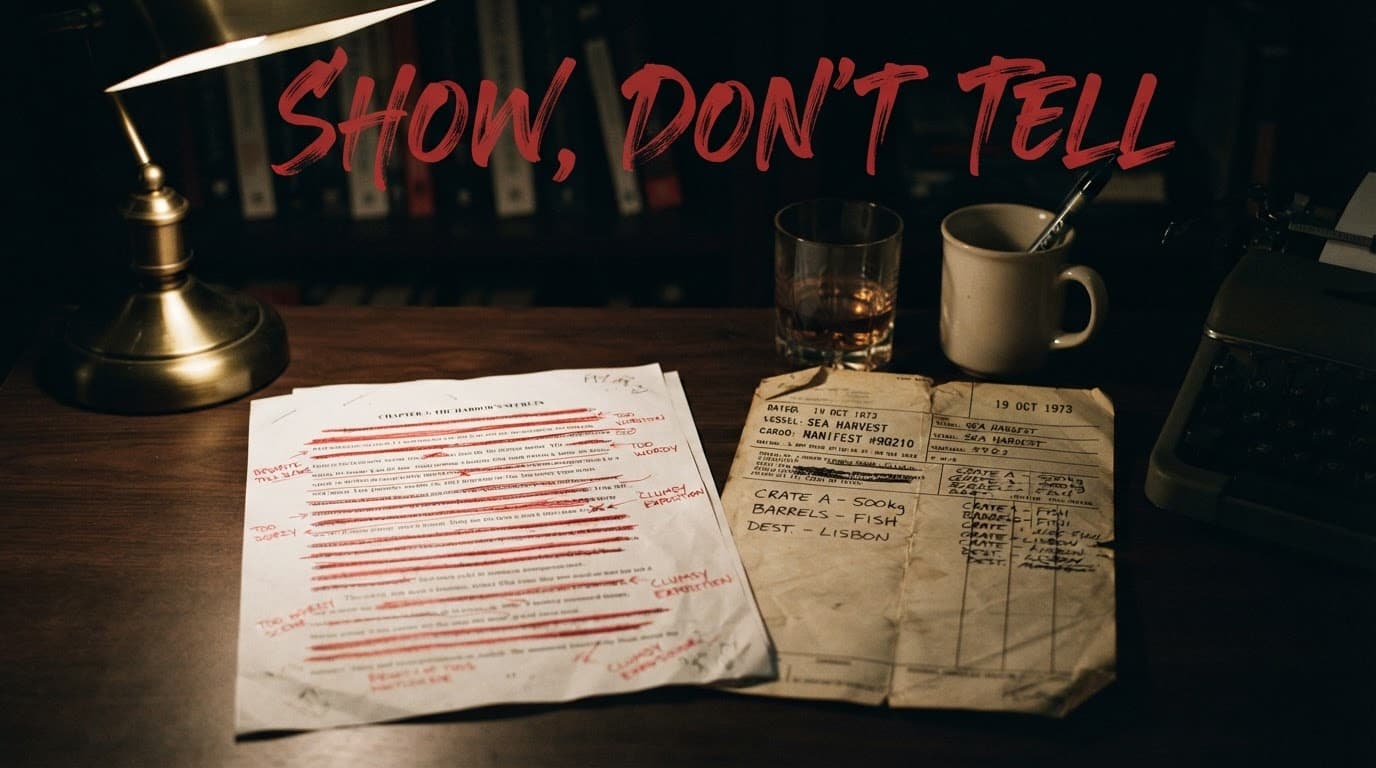
You asked for the scene where Maya finds out her brother has been selling harbor manifests to the customs office. What came back was 900 clean words, correctly paced, hitting every beat you specified. And you can't use a line of it, because the paragraph that's supposed to break her reads:
Maya felt a wave of betrayal wash over her. She realized that the brother she had trusted her whole life had been lying to her all along, and it hurt more than she could have imagined.
Nothing is wrong with that. It's grammatical, on-topic, and it tells you precisely what happened inside her. It's also dead on the page, because it hands you the conclusion and keeps the scene to itself.
What "show, don't tell" actually means
Showing puts the reader inside the evidence; telling hands them the verdict. Reedsy defines the technique as one "in which story and characters are related through sensory details and actions rather than exposition." Writers.com frames it as a transaction with the reader: "Rather than asserting something for the reader to accept, your writing transmits something for the reader to experience."
The line usually attributed to Chekhov has been quoted so often it's gone soft, but it still works: Don't tell me the moon is shining. Show me the glint of light on broken glass.
Here's the version I come back to while editing. Telling states a conclusion the reader has to take your word for. Showing lays out the evidence and trusts them to reach it — and that act of reaching is the entire pleasure of reading fiction. Name the emotion and you've done the reader's work for them; they resent it without knowing why.
Maya's paragraph isn't badly written. It's a summary of a scene standing where the scene should be.
Why AI-generated prose defaults to telling
Because you asked it a question, and it answered you. That's the whole mechanism, and understanding it precisely changes what you do about it.
Laura Hartenberger, who teaches writing at UCLA, put it exactly in an essay on what AI can't do with description: "If you ask it to convey something, it will answer as directly as possible, which means it will favor exposition." A model asked for a scene where a character feels betrayed treats feels betrayed as the deliverable and ships the information. Directness is the trained behavior — what makes a model useful for a hundred other tasks, and exactly wrong for fiction.
The second half of the problem is specificity. Hartenberger notes that generated description "will rarely produce truly unexpected, ultranuanced, pleasantly divergent, or potently obtuse word pairings," and her example is the perfect diagnostic: "'Gentle breeze' is so generic as to be empty, a line that could describe practically any breeze, in any setting." That's the real tell. Not bad prose — unowned prose, detail transplantable into any other book without anyone noticing.
Journalists land on the same complaint from another direction: in iMEdD Lab's report on how AI prose diverges from human writing, MediaWise's Alex Mahadevan describes the giveaway as "a lot of words that don't say anything. In journalism, we always say, 'Show, don't tell.'"
Where I part ways with the strongest version of this argument: Hartenberger frames it as something AI fundamentally cannot do, and that conflates a default with a ceiling. Ask for "a scene where Maya feels betrayed" and you'll get exposition. Ask for "this scene with no emotion named anywhere in it — she's holding a manifest in her brother's handwriting and has to decide whether to put it back" and the output changes character entirely. The model isn't refusing to show; it's answering the question you asked, and convey her betrayal is a question whose honest answer is a sentence about betrayal.
Which locates the work: in the prompt and in a revision pass, not in resignation.
Step one: run the filter-word pass
The fastest way to find telling in a draft is to stop reading for quality and start searching for eight words.
Felt. Thought. Wondered. Realized. Noticed. Saw. Seemed. Decided.
These are filter words. They put a narrating layer between the reader and the experience, and they're the load-bearing verbs of told prose. A writer in an r/writing thread on interiority in third person gave the cleanest rule of thumb I've seen: "If you find yourself using words like 'thought' 'felt' etc. a lot, you need to 'zoom in' a little." Their example — instead of He put his hand in the water. It felt cold. He wondered if he could swim in this, write The water was cold. Very cold. How could anyone swim in this?
Notice the fix added no sensory description. It removed the reporting frame. Most telling in an AI draft dissolves this way: you're not writing new prose, you're deleting the narrator's summary and letting what's underneath stand. Same machinery as narrative distance and the deep POV fix — filter words are the most findable symptom of a camera parked too far back.
Do it as a search, not a read-through. You will not catch "realized" by reading; your eye slides over it. Find-and-replace across every chapter at once turns a vague worry into a list you can work down.
A worked pass, start to finish
Priya is 63,000 words into a second-world political fantasy, drafted with a model doing first passes on scenes she outlined. She runs the filter-word search on chapter nineteen: 3,100 words, 34 hits across the eight terms. One every 91 words. Chapter nineteen is where Maya finds the manifest.
She doesn't fix all 34. Twenty-one sit in transitional passages — a carriage ride, two paragraphs compressing a council session — and those stay. Thirteen are inside the two scenes the chapter turns on. Those get rewritten by hand.
The betrayal paragraph after that pass:
The handwriting was her brother's. Not similar to his — his, the same cramped left-slant he used on birthday cards, the same habit of closing his 4s. Maya read the tonnage figures twice, and then a third time, and her thumb went on smoothing the crease at the top of the page long after the crease was gone.
Same information. No emotion named. The reader arrives at betrayal about half a second after the thumb, and because they got there themselves it lands as recognition rather than instruction.
It's 58 words against the original's 36, which is the trade nobody mentions: rendered prose runs longer. But Priya only rendered 13 paragraphs in a 3,100-word chapter, so the chapter gained a few hundred words, not a few thousand. Twenty minutes of work. Not a rewrite — a pass.
What to show and what to tell
Not everything. This is the part the advice always skips, and skipping it is how writers end up with 700-page manuscripts where crossing a room takes four paragraphs.
Writers.com is refreshingly direct: "Nobody uses 'Show, don't tell writing' all the time in creative writing, because some pieces of information are better off summarized." Their list of what telling does well is worth memorizing — minor characters, unimportant stretches of time, transitions between scenes, and deliberate contrast against passages you've rendered fully.
Working novelists get there from experience. In a thread on the show-don't-tell problem, where the poster admits "finding the perfect balance is incredibly difficult," one reply cuts it short: "It's show and tell. Show don't tell only will have you turning a 300 page story into 700 pages." Another supplies the decision rule: "I generally tell when I need to speed up the pace and I show when I need to slow down and flesh out a scene."
Show the turns, tell the travel. Any moment where a character's understanding, allegiance, or intention changes gets rendered. Everything that merely moves them between those moments gets summarized. If you've beat-sheeted the novel you already have the list — the beats carrying structural weight are exactly the scenes that earn full rendering.
The honest caveat: if the problem with your draft is that the plot doesn't work, a showing pass will only give you well-rendered scenes of events that still don't add up. Fix the structure first.
Prompting for showing in the first place
Name the evidence, not the emotion. Four patterns that change output immediately:
- Ban the abstraction outright. "Write this scene without naming any emotion, and without the words felt, realized, or knew." Hard constraints beat adjectives like "vivid" or "immersive," which a model will agree to and then ignore.
- Hand it the character's physical vocabulary. Not "she's anxious" but "when she's anxious she goes very still and starts organizing whatever is in front of her." Now it has something specific to stage.
- Ask for the object, not the mood. "What is in her hands during this scene, and what does she do with it?" The manifest and the smoothed crease came out of a question like that.
- Split generation from rendering. Let the model draft functional blocking, then run a second pass on the three paragraphs that matter, one at a time, with the constraints above. Asking for structure and prose in one shot gets you neither.
That second pass is iterative — you'll run a paragraph four or five times before one earns its place, which matters when every generation is metered. It's the specific reason revision-heavy writers end up running local models through Ollama or LM Studio, where the fifth attempt costs what the first did: nothing. NovelMage is built around that setup — local models or your own Claude, GPT, or Gemini keys, manuscript never leaving the machine.
The overcorrection to watch for
Once you can see telling, you will overcorrect, and the result is worse. She felt tired becomes three paragraphs of eyelid choreography. Nobody answers a door without a meditation on brass.
The test isn't "did I describe it." It's whether a specific reader-side inference is being earned. If a gesture doesn't let the reader conclude something they couldn't conclude before, it isn't showing — it's furniture. Readers are getting fast at spotting prose that's dressing rather than doing, and they punish generic texture harder than they punish AI involvement itself.
Frequently asked questions
Is "show, don't tell" outdated advice?
The absolutist version was always wrong, and plenty of nineteenth-century novels ignored it, introducing a character by stating appearance and temperament in the same breath. What holds up is narrower: moments of change need rendering, and naming an emotion inside one of them forfeits the reader's participation. It's a tool for finding which passages are load-bearing, not a rule for every sentence.
Can AI write showing prose at all, or do I rewrite everything by hand?
It can, but only against constraints. The default failure isn't incapacity — it's that convey her grief is a request whose direct answer is a sentence about grief. Forbid the emotional vocabulary, supply the character's physical habits, ask what object is in their hands, and output moves substantially toward showing. You'll still hand-finish the three or four paragraphs per chapter carrying the most weight. That's the job.
Does a local model handle a showing pass as well as a frontier model?
For constrained rewriting of a single paragraph, better than you'd expect — this is a narrow task with a clear target, not open-ended invention. NovelMage recommends a 7B-parameter model as the practical minimum for local use, runs natively on Windows and macOS, and costs $99.99 once for a lifetime license covering up to three devices, with a 7-day full-access trial and no card required. For heavier lifting, plug in your own Claude or GPT key and pay per token.
Will the filter-word search catch everything?
No — maybe two-thirds. The rest is abstraction without a filter verb: the room was tense, the mood had shifted, there was something menacing about him. Once you've cleared the eight words, search for was followed by an abstract noun. Slower, and it's where the stubborn telling hides.
Metered generation is what quietly stops people from running enough passes. NovelMage is an offline desktop app that runs local models or your own API keys, and you can try every feature free for seven days before the one-time $99.99 license — no subscription, manuscript on your machine the whole time.
Now go run the eight-word search on your worst chapter. You'll know inside ten minutes whether this is your problem.