Claude Watermarks AI Text: What It Means for Novelists
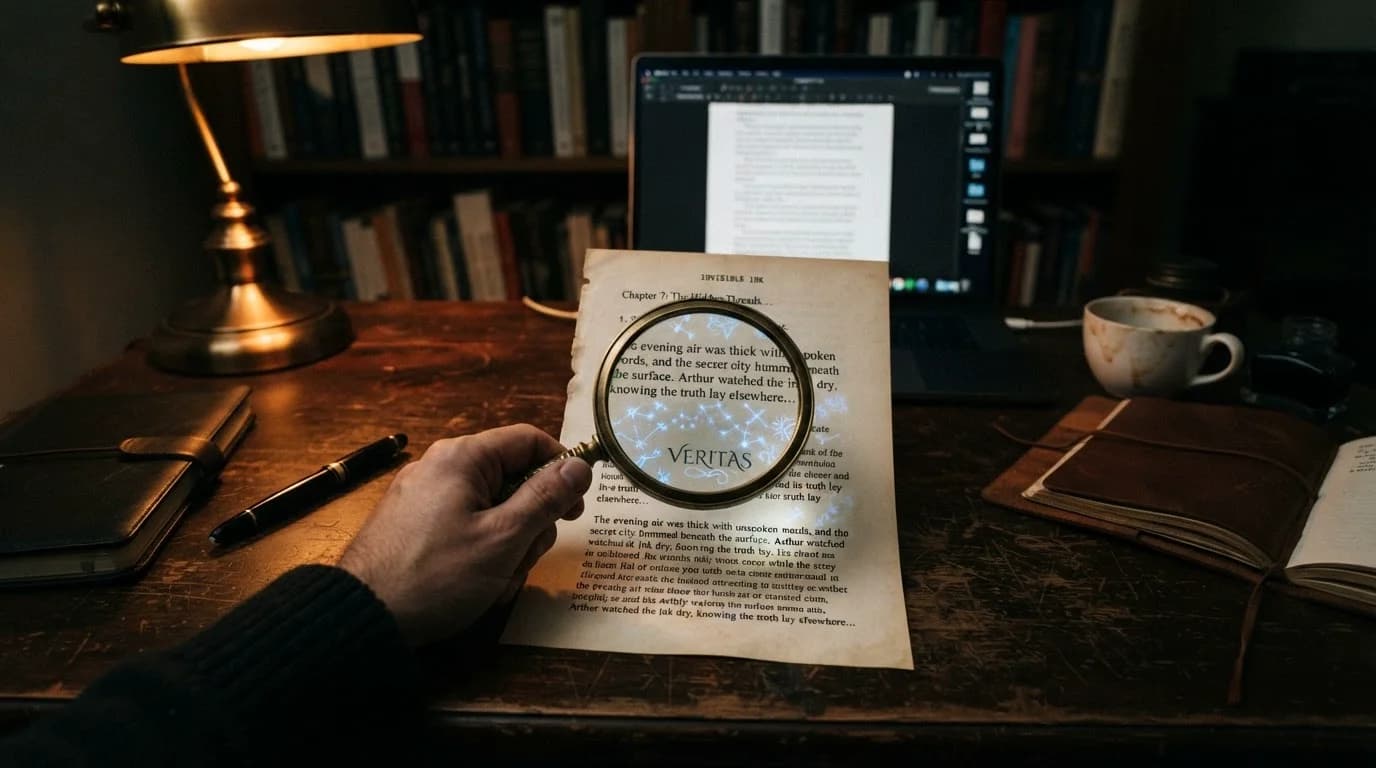
The message from your writing group lands at 11pm: did you see Anthropic is watermarking everything Claude writes now? You have 78,000 words in a draft. Somewhere in there is a fight scene Claude helped you unstick last March, forty chapters you ran through it for line edits, and a synopsis you'd rather not think about. Your first thought isn't legal or philosophical. It's: is my book marked?
Short answer: parts of it probably are, the parts you're worried about probably aren't, and the document most at risk isn't in your manuscript at all.
What Anthropic actually shipped
Anthropic now embeds an imperceptible watermark into text generated by supported Claude models, and attaches signed provenance metadata to generated files. It's applied at the model level, so it doesn't matter which Claude surface the text came from.
The details, from Anthropic's own support documentation: Claude models launched on or after August 2, 2026 support marking at launch, and older models are being retrofitted with no stated timeline. Marking applies across the API, Claude, Claude Code, Claude Cowork and Claude Tag, and through AWS, Google Cloud and Microsoft Foundry — worldwide, not just in the EU. Generated .png, .jpg and .svg files carry C2PA provenance metadata, which can be stripped by re-saving or screenshotting. Text is the durable one.
The sentence that set the writing forums on fire is Anthropic's: the watermark "will travel with the text when it's copied and pasted elsewhere, and may persist through some editing."
Two things Anthropic has not published: how the watermark works technically, and the detector. Both are described as forthcoming.
Does this mean your novel gets labelled as AI?
No. Nobody is requiring an AI icon on your cover, and the rule that triggered all this explicitly leaves fiction alone.
The regulation behind it is Article 50 of the EU AI Act, and it has two separate halves that keep getting collapsed into one panic. The first is on providers — Anthropic, OpenAI, Google — who must mark generative outputs in a machine-readable format. The second is on deployers, meaning people publishing the output, who must label two categories: deepfakes, and AI-generated text published to inform the public on matters of public interest.
That second trigger is construed broadly. According to Paul Weiss's analysis of the Commission's finalised guidelines, it covers politics, public health, consumer safety, the environment, financial matters, and scientific or cultural developments — and it explicitly excludes AI-generated fiction, product descriptions, and chatbot replies seen only by the person who asked.
So the obligation lands on the model, not on your manuscript. Your secondary-world fantasy is not a publication informing the public on a matter of public interest, and the EU has said so in as many words. What is true: the mark is in the text, and once a detector exists, someone can run it.
How a text watermark actually works
It isn't hidden characters, zero-width spaces, or anything you could find with a hex editor. It's a bias in word choice, applied while the text is being generated.
Anthropic hasn't described its method, but one production scheme has a full public technical description: Google DeepMind's SynthID-Text, published in Nature in October 2024. It modifies only the sampling procedure — no retraining — and detection works without access to the model.
Picture it in fiction terms. Your antagonist leaves a room. The model has thirty defensible words for how she does it: strode, stalked, swept, left, marched, walked out. All fine, none wrong. A watermark tips that tournament by a hair, every time, according to a key. One sentence tells you nothing. Ten thousand words is a signature.
Which is exactly why volume matters. The EU's Code of Practice exempts text under 200 tokens — roughly 150 words — from the watermarking requirement entirely. Anthropic's own limitations page says a mark may not be detectable when "the passage is very short, leaving too little text for a reliable signal."
The watermark lives in the choices, not the characters. You can't strip it with find-and-replace, and you don't need to — you dilute it by writing.
What survives editing, and what doesn't
A light touch survives. Real rewriting doesn't.
Google's SynthID documentation says its text watermarks are robust to "cropping pieces of text, modifying a few words, or mild paraphrasing," but that detector confidence "can be greatly reduced when an AI-generated text is thoroughly rewritten, or translated to another language." A 2025 robustness assessment presented at TrustCom found that paraphrasing, copy-paste rearrangement and back-translation significantly degrade SynthID-Text's detectability. Anthropic says the same about its own marks: no reliable signal when text has been "heavily edited, paraphrased, translated, or mixed into other writing."
A worked example
Maya has a 92,000-word fantasy she's been building for fourteen months, and she used Claude three different ways.
Six scenes she couldn't crack, generated and pasted in, then trimmed — about 11,000 words, maybe 70% of the original wording still intact. That's the strongest signal in the book.
Line edits across forty chapters: she'd feed a paragraph, get a tightened version, take roughly half of it and retype it in her own rhythm. Scattered, short, heavily reworked. Weak to nothing.
And a 900-word synopsis, generated in a single pass, lightly repunctuated, pasted into forty query emails.
Maya is worried about the manuscript. The synopsis is the actual exposure. It's the highest concentration of unedited model prose she owns, it clears the ~150-word threshold six times over, and it's the one document she voluntarily sent to forty strangers — strangers who increasingly put an AI disclosure question right on the submission form.
Your query package is more watermarked than your novel. The fix isn't deletion. It's an afternoon rewriting 900 words in your own voice, which improves the synopsis anyway.
This isn't an Anthropic problem to switch away from
Every major provider selling into Europe ends up here within months. Article 50's transparency obligations apply from 2 August 2026. About 190 organisations had signed the Commission's Code of Practice on Transparency of AI-generated Content by the end of July 2026. Generative systems already on the market get a deferral to 2 December 2026, and watermark-detection interoperability is required by 2 February 2027. Non-compliance carries fines up to the greater of €15 million or 3% of worldwide annual turnover.
Anthropic moved first and applied it globally rather than geofencing the EU. That's a difference in timing, not destination.
Switching cloud vendors to dodge a watermark is a plan with a December expiry date.
What running the model yourself actually changes
A watermark is applied at generation time by whoever runs the model. If nobody runs it but you, nobody applies one.
This isn't a loophole — it's architecture. SynthID-Text ships open source in Hugging Face Transformers, and it's strictly opt-in: you pass a watermarking configuration and your own private keys to the generation call. Omit it and identical weights produce unmarked text. Pull Llama, Qwen or Mistral onto your laptop through Ollama and there is no provider in the pipeline with a key, an obligation, or a reason to mark anything. Article 50(2) binds providers placing systems on the EU market. It does not bind a novelist running weights on a MacBook.
That stacks neatly with the reason a lot of writers already keep a local model in their kit — drafts that never leave the machine they were written on. In NovelMage it's a dropdown: point the app at Ollama or LM Studio and the generation happens locally, offline, with nothing leaving your device.
Be honest about the trade, though: a 7B model on a laptop will not out-write Claude Opus on the single hardest scene in your book, and if prose quality on that scene is your real bottleneck, use the good model and then rewrite what it gives you.
Don't get locked into one vendor's policy
The lesson isn't "avoid Claude." It's that one company's policy change shouldn't be an emergency for you.
Anthropic hasn't published its detector, its accuracy thresholds, or any dispute process. The Code requires signatories to make detection available free of charge, with unrestricted access for regulators, media, fact-checkers and researchers. What none of it specifies yet is how a writer contests a false positive on a chapter that's substantially their own but got polished by Claude in one pass.
You don't have to predict how that resolves. You just need your manuscript somewhere the model is a setting rather than the product. OpenRouter turns most providers into a single API key you can swap in seconds, and bring-your-own-key plus local support makes changing models a dropdown rather than a migration.
Pricing structure matters here more than it looks. NovelMage is a $99.99 one-time lifetime license for the desktop app, usable on up to three devices, rather than a subscription bundling someone else's model into the bill — so a vendor's policy shift costs you an afternoon of reconfiguration instead of a migration.
A working policy for your manuscript
- Name your clean-room documents. Query letter, synopsis, first ten pages, contest entries, author bio. Short, high-scrutiny, most likely to be run through a detector by someone deciding about you. Write these yourself, start to finish.
- Use cloud models where they don't produce shipped prose. "Why does act two sag?" "Which chapter order is clearest?" Character interviews, continuity audits, a read on whether your gruff sergeant has drifted into complete sentences. The output is a conversation, not text you paste.
- Retype, don't paste. This sounds superstitious and isn't. Retyping a suggestion in your own rhythm is the same operation the research calls thorough rewriting — and it's also the fix for prose that reads flat because it's the model's voice, not yours.
- Generate prose locally when you want prose generated at all. Structural thinking on the big cloud models, actual sentences on a local one, is a defensible split on both privacy and provenance grounds.
- Keep your drafts. Dated files and version history are the only affirmative evidence of authorship anyone has ever had. Provenance runs both directions, and yours is the side you control.
Frequently Asked Questions
Does Claude watermark everything I write with it?
It marks text Claude generates, on supported models — those launched on or after August 2, 2026, with older models being retrofitted on no announced timeline. Text you typed yourself isn't marked by Claude reading it. But the rewritten paragraph Claude hands back when you ask it to tighten your prose is Claude-generated text, which is why "I only used it for editing" isn't the clean exemption most writers assume.
Can I remove the Claude watermark?
Not with a tool, and not by swapping characters — it isn't stored in characters. The published research shows this class of watermark degrades under thorough rewriting, paraphrasing and translation, and Anthropic says the same about its own. You dilute it by rewriting the passage until it's genuinely yours, which is what you'd want to do to that prose regardless.
Will an agent or publisher be able to check my manuscript?
Eventually, probably. The Code of Practice requires signatories to provide a free detection mechanism, and Anthropic says details are coming. What doesn't exist yet is a published accuracy threshold or a dispute process.
Do local models add a watermark?
No, unless you deliberately add one. Watermarking happens during generation, inside whatever serves the model. Google's SynthID-Text is open source and opt-in — you supply the keys and config yourself. Run Llama, Qwen or Mistral through Ollama or LM Studio on your own hardware and no watermarking step exists in the pipeline.
Does the EU AI Act require me to label my AI-assisted novel?
No. Deployer labelling under Article 50(4) covers deepfakes and AI-generated text published to inform the public on matters of public interest, and the Commission's guidelines place AI-generated fiction outside that trigger. Your publishing contract, your agent's submission form, or a platform's terms of service may still ask you to disclose — those are separate promises, and they're the ones likely to bite.
The practical upshot
Nothing about your finished book changed this week. What changed is that unedited model prose now carries a signal you can't see, concentrated in documents where high volume and low editing overlap — which describes a synopsis far better than it describes a novel you've revised four times.
The durable answer isn't avoidance. It's keeping the generation step somewhere you control: locally when you want words on the page, on a big cloud model when you want a second opinion, and never in a tool that makes switching between the two a project.
If you'd rather your drafting stayed on your own hard drive, NovelMage runs offline on Windows and macOS with Ollama or LM Studio, or your own Claude, GPT or Gemini keys when you want the big models on a hard chapter. The trial is seven days with no credit card.