Do You Have to Disclose AI Use to Literary Agents?
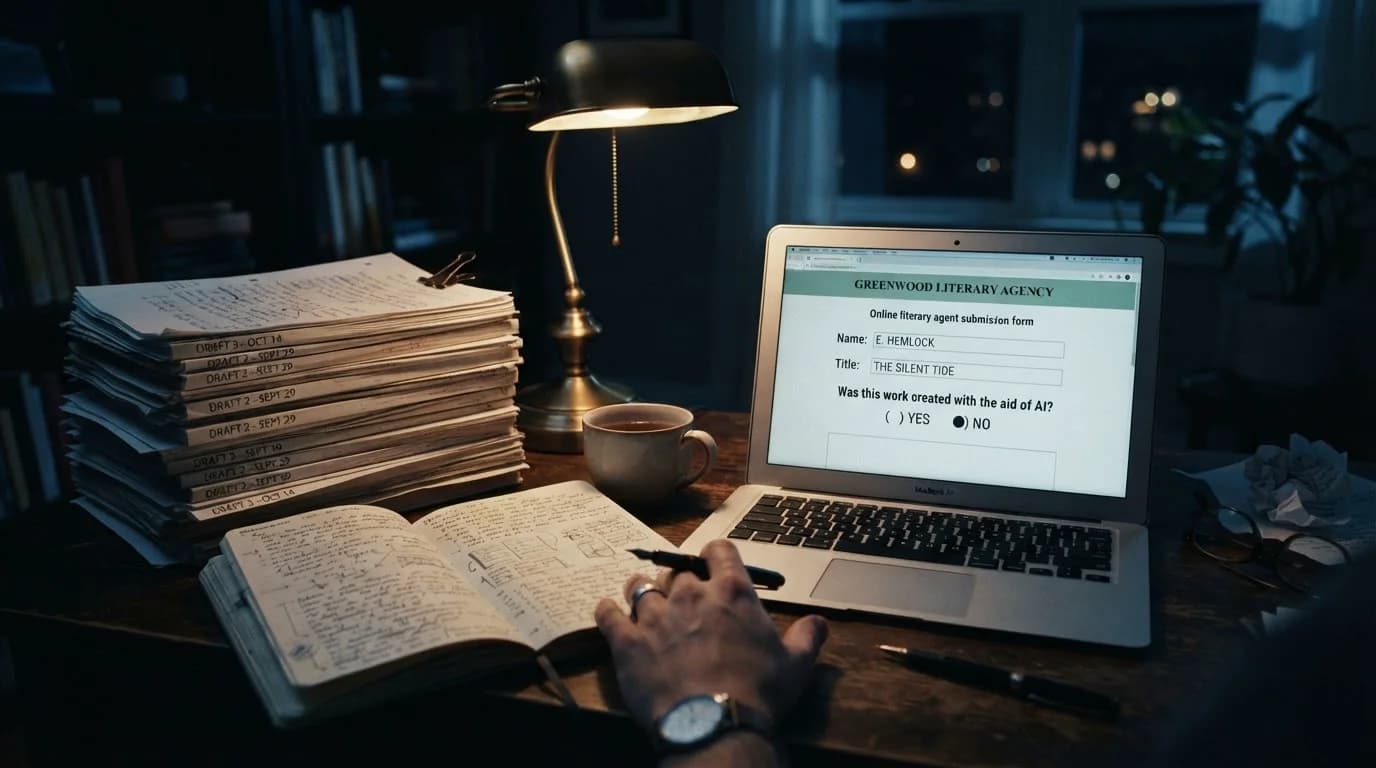
You're twelve agents into a query round and the form has a radio button you didn't expect. Was this work created by or with the aid of AI? Yes / No. No text box. No "yes, but." You used ChatGPT to talk through a sagging middle act eight months ago, you run Grammarly on every chapter, and once, at 2am, you asked a model to show you three ways a character might refuse a phone call — then wrote your own version and deleted all three. Your cursor hovers. Whatever you click feels like a lie.
That anxiety is doing more damage to more querying writers than actual AI use is. So let's answer the question properly, with what agents and publishers have actually put in writing.
The short answer: generated prose gets disclosed, assistance mostly doesn't
If AI wrote sentences that survive into your manuscript, disclose it. If AI helped you think, research, outline, or clean up typos in prose you wrote, you're describing normal tool use and it doesn't need a disclosure.
This isn't a soft consensus — it's the line the industry's own documents draw. The Authors Guild's model AI contract clauses require that an "Author shall disclose to Publisher if any AI-generated text is included in the submitted manuscript, and may not include more than [a de minimis/5%] AI-generated text." Note what triggers the obligation: AI-generated text included in the manuscript. Not AI consulted. Not AI opened in another tab.
Amazon draws the same line for self-publishers. KDP's content guidelines require you to declare AI-generated content — anything "created by an AI-based tool," even if you edited it heavily afterward — while AI-assisted content, where you "created the content yourself, and used AI-based tools to edit, refine, error-check, or otherwise improve" it, needs no disclosure at all. Two categories, one dividing line, and the line is authorship of the words.
Publishing consultant Jane Friedman puts it about as plainly as it can be put in her AI and publishing FAQ: "Using AI to research, brainstorm, generate outlines, or edit your own work does not affect your copyright, and does not need to be disclosed or disclaimed in any legal sense."
Nobody is auditing your process. They're auditing your prose.
Why the yes/no box feels like a trap (and how to answer it)
The form is binary because the agent's underlying question is binary, even though yours isn't. They want to know whether they'd be selling a manuscript with an authorship problem.
Most writers submit through platforms like QueryManager, and the AI question there is typically phrased as whether the whole or any part of the submitted work was created by or with the aid of AI — yes or no, no context field. That "or with the aid of" clause is what snags honest writers, because read maximally it swallows spellcheck.
Read it the way the industry reads it: the agent is asking about generated text. If you have none, answer no — and if you want to sleep better, add a line to your query's bio paragraph: "No part of this manuscript was generated by AI." That's a stronger claim than the form asked for, it's true, and it puts the thing they care about on the record in your own words.
If your answer is genuinely mixed, say yes and explain in the query letter. An agent who is fine with disclosed assistance will read on. An agent who isn't was going to drop you at contract stage anyway, and better now than after a fourteen-way auction.
The case that made everyone paranoid — and what it was actually about
In July 2026, a debut crime novel called Call Me, I'll Hide the Body by Jerry Falade drew a fourteen-way auction, with Minotaur at Macmillan US offering more than $2 million. Weeks later the deal was gone. His agents said they could no longer verify how the book had come to exist: "We can no longer substantiate that, and we are withdrawing the book."
Falade denies using AI. He has also argued the scrutiny was racially motivated, noting that three Black authors saw deals cancelled or disrupted over AI suspicion in the same year, and has questioned the reliability of AI-detection software. No determination of AI use was ever published. That matters, and it's the part most breathless retellings skip.
But look at the mechanism that actually killed the deal, because it's the transferable lesson. Nobody proved anything. The agency simply reached a point where it could no longer substantiate the account it had given a publisher, and withdrew rather than carry unverifiable risk into a seven-figure contract. Writers on r/PubTips clocked the implication immediately: was the author supposed to have saved every draft?
Yes. That's the actual takeaway. Not "never touch AI" — "be able to show your work."
Chain of custody: the thing to build before anyone asks
Detection software isn't what saves you. It's probabilistic, it's worse on short passages than long ones, and it flags plain, clean prose — which is exactly what a lot of good thriller writing looks like. What saves you is evidence that a human wrote this over time, in rough order of how much it's worth:
- Dated drafts, kept. Not one file overwritten 400 times. Separate versions —
draft-01,draft-02-post-beta— with their original filesystem timestamps intact. This is the single highest-value habit on the list and it costs nothing. - Artifacts that predate the manuscript. Handwritten notebooks, outline documents, the abandoned 12,000-word version where the sister was still alive. Messy process evidence is very hard to fake and very convincing.
- Third-party witnesses to the writing. Beta reader emails with dates, critique-group threads, a writing partner who can say they read chapter 9 in March. Human corroboration outranks any file.
- Records of what tools you did use, and for what. If you brainstormed with a model, a note saying "used Claude to generate 40 loglines on 3 March; none used verbatim" turns a scary question into a boring, answered one.
The structural problem is that a lot of writers' drafts don't live anywhere they control. They live in a subscription tool's cloud, which is fine right up until it isn't — as the writers scrambling to export their work after PlotDrive announced its shutdown found out. A manuscript you can't export on demand is a chain of custody you don't own. Working in a desktop app where the book is a file on your disk — NovelMage keeps manuscripts local rather than on its own servers — means your version history is just your backups, and it's yours whether or not the company you bought from still exists in 2030.
There's a second reason writers are getting cagey about where their prose lives. In one r/PubTips thread on whether AI exposure by a third party needs disclosing, a writer discovered a critique partner had been running their chapters through a model, and the replies noted that some agents themselves openly feed submissions into AI checkers. If you'd rather your unpublished draft not sit in anyone's logs, running a local model through Ollama or LM Studio means the prose never leaves the machine at all — no upload, no retention question to answer later.
A worked example: what Priya ticks
Priya has a 92,000-word thriller and eleven agents on her list. Her actual AI history, honestly inventoried:
- Grammarly on every chapter since 2024.
- Roughly six conversations with ChatGPT about her second act, one of which produced the idea that the detective's alibi should come from the person she's protecting.
- Forty loglines brainstormed with a model; she wrote her own from scratch after reading them.
- One night in chapter 17, she asked for a paragraph of stalled description, got about 600 words, kept none of it, and wrote the scene herself the next morning.
- A query letter she drafted herself and asked a model to critique.
Priya ticks no. Every item on that list is assistance: tool use, ideation, and critique, with zero generated sentences surviving into the manuscript. Under KDP's framing she isn't even in the disclosure category, and under the Authors Guild's clause there's no AI-generated text to disclose. The 600 words are the only item worth a second look, and they're not in the book.
What would flip her to yes: keeping those 600 words and editing them. Not because 600 words out of 92,000 is morally different, but because that's generated text included in the submitted manuscript, which is precisely the trigger the model clause names. Assistance is a tool question. Authorship is a sentence question.
If Priya wants belt and braces, she adds one line to her query — "No part of this manuscript was generated by AI" — and keeps her drafts, notebook photos, and beta reader emails in one folder. That's the whole compliance burden. It takes an afternoon.
The one situation where none of this helps
If a meaningful chunk of your manuscript is AI-generated prose you edited into shape, disclosure strategy won't rescue the submission. Plenty of agents — and the r/PubTips community whose rules state outright that most agents and publishers won't accept work created or edited with generative AI — will pass on principle regardless of how you phrase it. Rewriting those passages in your own voice, or querying agents whose stated policies allow disclosed assistance, are the two honest paths. Finessing the checkbox is not a third one.
For everyone else — the overwhelming majority, writers who used AI to think and then wrote the book themselves — the anxiety is disproportionate to the exposure. Keeping your own voice on the page is a craft problem worth solving on its own merits, and it happens to be the same thing that makes the disclosure question easy.
Frequently Asked Questions
Do I have to disclose using AI for my query letter?
The query letter isn't the work, so it usually falls outside a disclosure question about the manuscript. But it's a bad idea anyway, and not for compliance reasons: agents read thousands of queries and have gotten fast at spotting model-flavored pitch copy. A query is 300 words in your voice, sitting directly next to sample pages in your voice. Making those two things not match is a strange way to open.
Can AI detection software get me rejected?
It can start a conversation you'd rather not have. These tools are probabilistic and perform noticeably better on book-length text than on short excerpts, which means a flagged sample chapter is a suspicion, not a finding. The defense isn't arguing with the tool's score — it's producing dated drafts, prior versions, and people who watched you write it.
What about the Authors Guild "Human Authored" certification?
It's a mark you can put on a book to certify human authorship, and its standard is a useful benchmark even if you never buy one. Per the Human Authored FAQ, the text must be "fully authored by one or more human beings and not generated by GAI, except that a de minimis... amount of text may be generated." Grammar and spell-check tools, indices, tables of contents, and "researching, brainstorming, outlining, or any purposes other than generating text" are all explicitly fine. It costs $10 per title and is free for Authors Guild members.
A critique partner ran my chapters through an AI without telling me. Do I disclose that?
No. You didn't use AI to write, and no generated text entered your manuscript. What happened is a privacy problem, not an authorship one, and disclosure questions are about authorship. Worth changing how you share drafts going forward; not worth shelving a book over.
Write it, keep the receipts
The querying writers getting hurt right now mostly aren't the ones who used AI. They're the ones who can't demonstrate how their book got written — because their drafts were overwritten, or lived in a tool that lost them, or never existed as separate files at all. Fix that and the checkbox stops being frightening.
If you'd rather your manuscript and the model working on it both stay on your own machine, NovelMage is a desktop app for Windows and macOS at $99.99 one time for up to three devices, with a 7-day free trial that doesn't ask for a card. Your book stays a file you own — which, as it turns out, is also the cheapest chain of custody there is.