Editor Used AI on Your Manuscript? Add This Clause
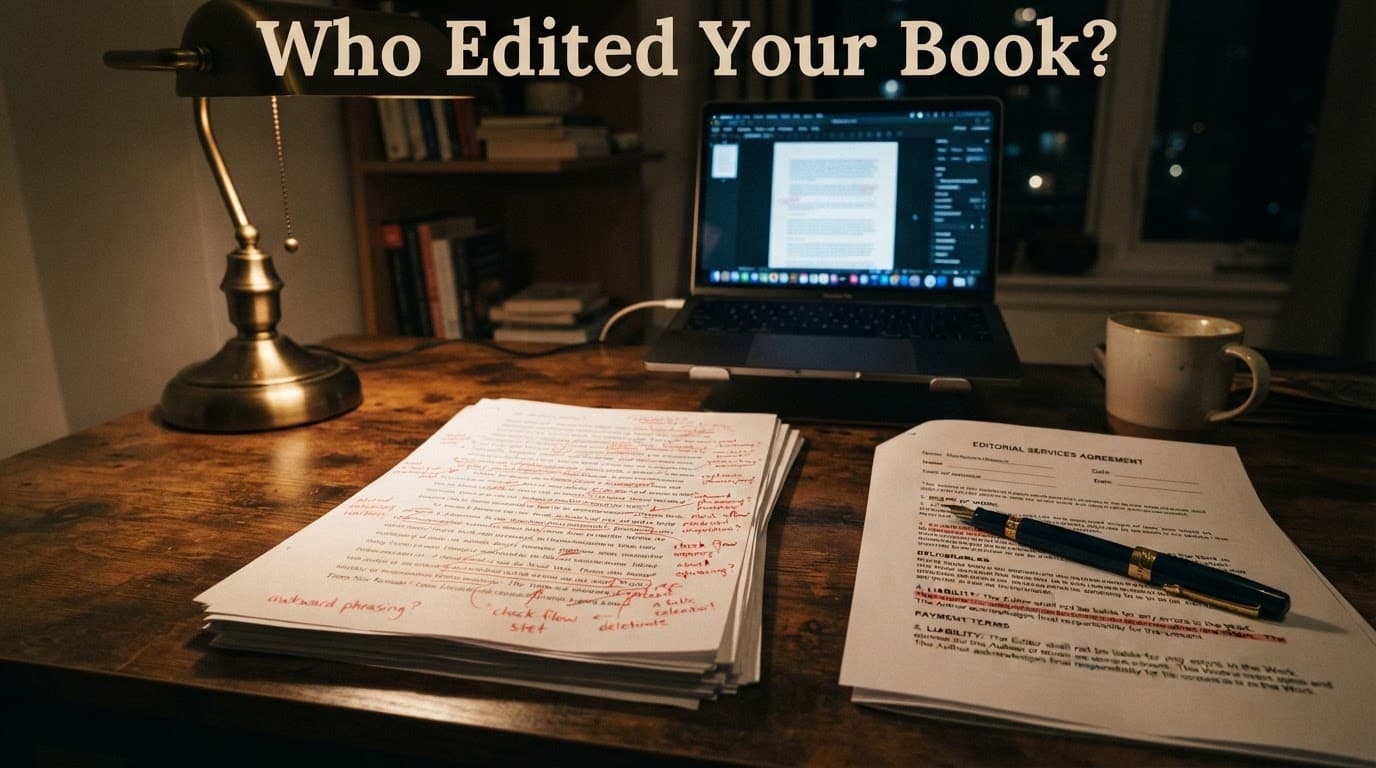
You found the editor through a friend of a friend. Their sample edit on your first ten pages was sharp, and they quoted a fair price for the full manuscript. You signed a one-page agreement that covered the fee, the deadline and the number of rounds. It said nothing about AI, because last year nobody thought to ask.
Then the Shy Girl story broke, and now you're rereading that one-page agreement wondering what you'd have if your editor's "polish" turned out to be a chatbot's. Short answer: probably nothing. You can fix that before your next job, and it takes about six sentences of contract language.
What happened with Shy Girl, and what it does and doesn't prove
Hachette cancelled Mia Ballard's horror novel Shy Girl in March 2026 after The New York Times brought it evidence that the text appeared AI-generated. Ballard denied using AI herself and said someone she hired to edit an earlier self-published version had. That claim is unverified, and nobody has publicly established who put what into the book.
The facts that are on the record are bad enough. The book was self-published in February 2025 before Hachette's Orbit imprint acquired it. According to the Boston Globe's report, the UK edition had already come out and sold about 1,800 print copies, and the book was gone from Amazon and Hachette's site within a day of the Times' inquiry. The same report notes that Hachette asks authors to disclose whether they used AI while writing. Scroll's write-up traces the suspicion back to a 2025 Reddit post from a self-described editor who flagged the prose tics: an adjective in front of almost every noun, descriptions in lists of three, the same handful of overused words.
Here's what the case proves for everyone else. Whoever touched the sentences, the author's name was on the cover, the author's contract got cancelled, and the author was left saying it wasn't me in public. You can't hand off liability for your sentences the way you hand off the work on them.
Why your editor's AI use becomes your problem
Your editor isn't a party to your publishing contract, your KDP account, or your agent's submission form. You are. Every disclosure question downstream gets answered in your name, so you need to know exactly what happened to your manuscript upstream.
Look at where the questions come from. The Authors Guild's model publishing contract clauses include one under which the author must disclose to the publisher if any AI-generated text is in the submitted manuscript, with a bracketed threshold the parties fill in (de minimis or 5%). Amazon asks you a version of the same thing every time you publish, and we've covered how KDP separates AI-generated from AI-assisted text. If you're querying, some agents ask too. Our post on disclosing AI use to literary agents walks through those forms.
You can only answer those questions honestly if you know what your freelancer did. Call it the chain of custody for your sentences. A freelancer who quietly ran your chapters through a chatbot and accepted its rewrites has put words in your manuscript that you'll later swear are yours.
There's also a second risk, separate from the prose: the upload itself. The Guild's guidance says editors, agents and others with access to authors' work shouldn't upload manuscripts to consumer chatbots without the author's written permission, and that anyone who does use them should opt out of training. An editor who pastes your unpublished thriller into a free chatbot account has handed it to a third party under terms you never agreed to.
Editors are already writing contracts that protect them. Josh Bernoff's suggested ghostwriting and editing clauses require clients to disclose AI-generated text and add a 50% premium when more than 25% of it came from AI. Developmental editor Mary Kole rewrote her client agreement after unknowingly taking on two AI-assisted novels. Her addendum has clients represent that they've disclosed any AI-generated content, and it states that her deliverables are original work by human professionals. That's reasonable. Your side of the agreement should be just as specific.
What to put in an AI clause in your editing contract
A working AI clause does six things. It defines AI. It says which tools are allowed. It bans uploads you haven't approved. It requires disclosure. It has the editor warrant the work is human. And it gives you a remedy if any of that turns out to be false. The wording below is a starting point you can adapt. It isn't legal advice, and on a five-figure ghostwriting or book-doctor deal it's worth paying a publishing attorney to review.
-
Define the term. "'Generative AI' means any large language model or machine-learning system that generates or rewrites text, including chatbots and AI features built into editing software." Without a definition, "I didn't use AI, I used the rewrite button" becomes an argument.
-
Carve out what you're fine with. "Standard spelling and grammar checking is permitted." This matches the Authors Guild's own line between basic spell-check and substantive AI editing. Most editors run some checker, and a blanket ban scares good editors away.
-
Ban uploads you haven't approved. "Editor will not upload, paste, or otherwise submit any portion of the Manuscript to a generative AI system without Author's prior written approval." This covers the privacy risk even if no AI text ever comes back into the draft.
-
Require disclosure and approval for anything beyond the carve-out. "If Editor wishes to use generative AI for any task beyond spelling and grammar checking, Editor will describe the tool and the task in writing and obtain Author's written approval before proceeding." Some authors will happily approve an AI-assisted timeline check. The point is that you decide.
-
Get a warranty of human work. "Editor warrants that all suggested revisions, line edits, and editorial comments delivered under this Agreement were written by Editor." Kole's addendum makes the same promise from the editor's side. Ask for it in writing.
-
Attach a remedy. "If Editor breaches sections 3–5, Author may terminate this Agreement, is entitled to a refund of fees paid for the affected work, and Editor will provide a written account of which portions of the Manuscript were affected." That last clause is the one that matters most. If a publisher ever asks you what happened, a written account from the editor is the document you'll need.
Add a survival line so the warranties outlast the job ("Sections 3–6 survive completion or termination of this Agreement") and a file clause requiring the editor to delete their copies once you've accepted the final round.
A worked example: Delia's line edit
Delia has an 88,000-word domestic thriller that's been through two drafts and three beta readers. She hires a line editor at $2,200 for one full pass plus a follow-up round, with the six clauses above in the contract. The editor signs without fuss and mentions they use a grammar checker, which clause 2 already permits.
The edit comes back in tracked changes. Around chapter twenty-two Delia notices something. Her detective's partner, a man who talks in grunts and half-sentences for three hundred pages, suddenly speaks in tidy, balanced paragraphs. I understand your frustration, and I think we should consider every possibility. Every scene in that stretch has three-beat descriptions. The rain is cold, relentless and unforgiving.
Without a contract clause, all she can do is send an awkward email and hope. With one, she has a procedure. She asks in writing, under clause 4, whether any generative tool was used on chapters 20–26. The editor admits they ran a rough patch through a chatbot to "smooth the pacing" when they fell behind schedule. Clause 6 gets Delia a refund for those chapters ($350, prorated by word count), a written account of the affected scenes, and an editor who confirms they've deleted the chatbot history. She rejects the tracked changes in chapters 20–26, restores her own text from the pre-edit file, and has a different editor re-do those chapters.
Total damage: one week and a slightly awkward relationship. Without the clause, the same discovery could have surfaced after publication, in an Amazon review.
How to vet an editor before you sign
Ask about AI directly, before money changes hands, and listen for a specific answer. A good editor will tell you which tools they use and for what, without hedging. The vague answers are the ones to worry about.
- Ask what's on their machine. "Which software do you edit in, and do you use any AI features in it?" Good answer: "Word with tracked changes and a consistency checker, nothing generative." Bad answer: "I use whatever helps."
- Ask for tracked changes, always. A clean, already-accepted file shows you nothing about how the edit was made. Tracked changes let you read every intervention against your original.
- Pay for a sample edit first. Ten pages edited live, in their normal workflow, tells you more than a portfolio. Then compare the voice of their suggested lines against the rest of their sample. One voice is a person; several voices across ten pages is worth a question.
- Keep your own pre-edit file. Save a dated copy of exactly what you sent. That's your baseline if anything is ever disputed.
You can also shrink what you send out in the first place. If you'd rather handle continuity and consistency passes yourself before paying a human for the craft-level edit, NovelMage runs local models through Ollama or LM Studio, so the manuscript stays on your device and you know exactly which AI touched it and when: you.
If you think your editor already used AI
Don't start with a detector. Start with your own files and a direct question. The Authors Guild's October 2026 best practices for publishers say no one should rely solely on an AI detector to decide whether a book contains AI text. The same goes for deciding whether your editor used one. We tested how far detector scores can be trusted on fiction in our Pangram on novels breakdown. Short version: a score isn't proof.
What actually works:
- Diff the files. Compare your pre-edit manuscript against the edited version scene by scene. AI rewrites tend to show up as whole-paragraph replacements, not word-level edits.
- Read for the tells Shy Girl got flagged for. Stacked adjectives, lists of three, a gruff character drifting into complete sentences, the same three words on every page.
- Ask in writing. Name the chapters and ask the editor if any generative tool touched them. Most people will tell you the truth when the question is that specific.
- Reject and restore. Roll the affected passages back to your text. Your words are still your words, and a dispute over the edit doesn't change that.
- Answer disclosures from what you know. If AI text survived into a version that's already published or submitted, the honest disclosure is yours to make. That's exactly why the paper trail matters.
Frequently Asked Questions
Can I sue an editor who used AI on my manuscript without telling me?
That depends on your contract and jurisdiction, which is exactly the problem: if your agreement never mentioned AI, it's hard to show the editor broke a promise they never made. Nothing public has tested that kind of claim yet. A written warranty plus a refund-and-account remedy gives you something concrete to enforce without going to court.
Is it reasonable to ban editors from using Grammarly or spell-check?
Usually not. Basic spelling and grammar checking is the line the Authors Guild itself draws in its publisher clauses, and banning it will cost you good editors for no real protection. Ban generative rewriting and unapproved uploads. Permit the checker.
Do I have to disclose to KDP or a publisher if my editor used AI?
The disclosure is about the content of the book, not who generated it. If AI-generated text from an editor's pass ended up in the final manuscript, it counts the same as if you'd generated it. Reject and replace it before you publish, and you have nothing to disclose.
What if my editor refuses to sign an AI clause?
Ask why. Some editors object to vague wording rather than the principle, and they'll sign a version with a clear spell-check carve-out. If they won't promise not to paste your manuscript into a chatbot, that tells you what you needed to know.
Make the next contract the safe one
You can't go back and add a clause to last year's edit. You can make sure the next manuscript you hand over leaves with a written promise about what happens to it, and comes back with a paper trail you'd be comfortable showing a publisher. If you'd like more of the drafting and revision under your own roof, try NovelMage free for 7 days. It's $99.99 once for a lifetime license on up to 3 devices, it works with local models or your own Claude, GPT or Gemini key, and your manuscript stays on your computer.