KDP AI Disclosure Rules: Generated vs Assisted (2026)
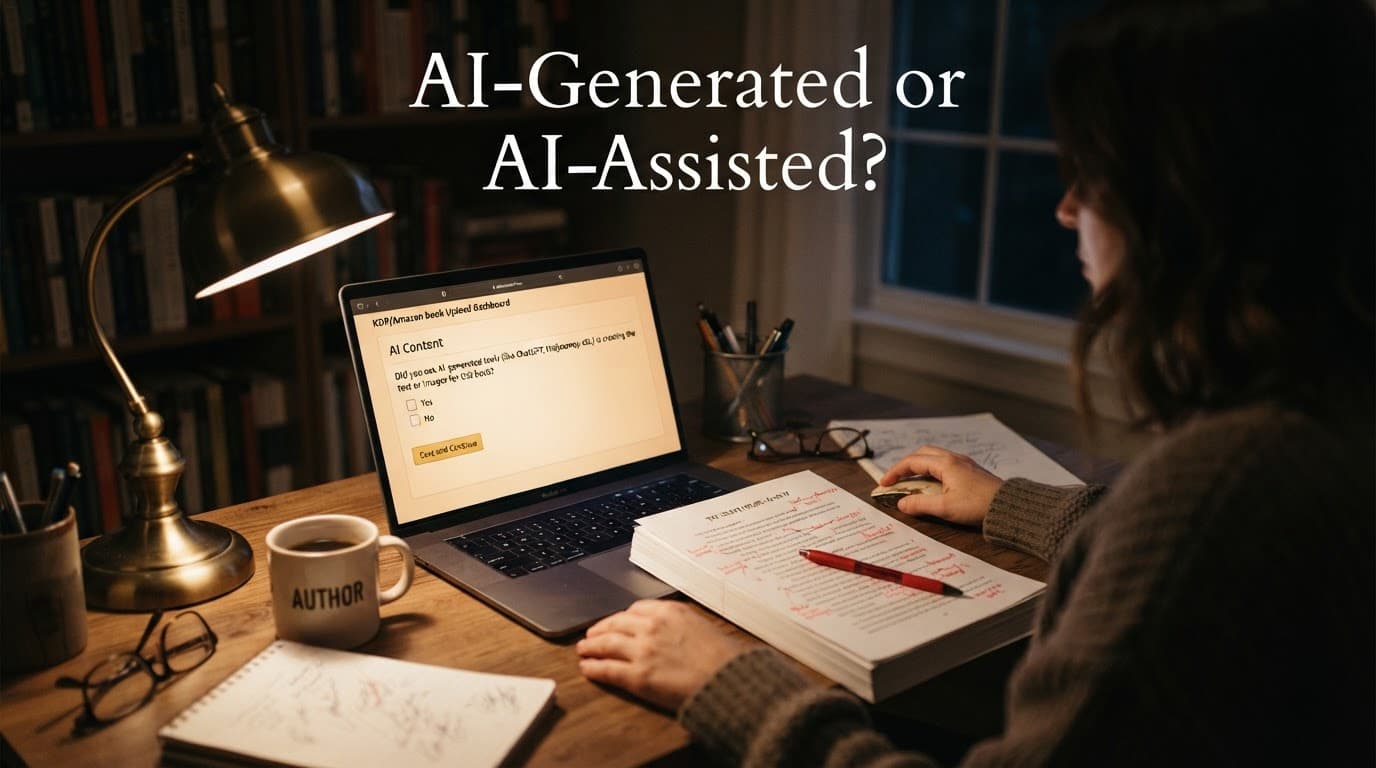
You're on the Content tab of the KDP publishing flow, the manuscript is uploaded, the cover previewer finally shows the spine at the right width, and then a box called AI-Generated Content asks you a yes-or-no question: did you use AI tools to create text, images, or translations in this book?
Your cursor sits over "No." You wrote this book. You also asked Claude to help you untangle the second act last spring, ran every chapter through a grammar checker, and, if you're honest, let a model rough out the scene where your heroine finally reads her sister's letters because you'd been stuck on it for two weeks. Does any of that make the answer "Yes"?
Amazon's rule is narrower and more specific than most of the panic around it. It turns on one question, and once you know it, almost every case sorts itself in about ten seconds.
What KDP actually requires you to disclose
Amazon requires you to disclose AI-generated text, images, or translations when you publish a new book or republish an edited one. AI-assisted content (your own writing, improved or checked by AI, or ideas you brainstormed with AI) does not need to be disclosed at all.
That's the whole policy, and it lives in Amazon's own KDP Content Guidelines. The two definitions are worth reading word for word, because everything hangs on the exact phrasing:
- AI-generated: "We define AI-generated content as text, images, or translations created by an AI-based tool." And the clause that trips people up: if a tool created the actual content, it's AI-generated "even if you applied substantial edits afterwards."
- AI-assisted: "If you created the content yourself, and used AI-based tools to edit, refine, error-check, or otherwise improve that content," it's AI-assisted. Brainstorming falls on the same side: using a tool "to brainstorm and generate ideas" while you "ultimately created the text or images yourself" is AI-assisted too. Amazon adds: "It is not necessary to inform us of the use of such tools or processes."
The policy isn't new. Amazon introduced it in September 2023, after talks with the Authors Guild, which called it a welcome first step while noting Amazon hadn't agreed to its request for public labels on AI-generated books. What's changed is how many authors now sit in the gray zone.
The first-draft test: who made the words first?
The simplest way to apply Amazon's definitions is to ask who produced the first version of the content. If you did, and AI only touched it afterwards, it's assisted. If a tool did, and you touched it afterwards, it's generated, no matter how hard you rewrote it.
Call it the first-draft test: Amazon asks who wrote the first draft, not who wrote the last one. It feels like a chapter you rewrote line by line should count as yours. Under KDP's definition, it doesn't; rewriting is recorded separately on the form, but it doesn't move the content across the line.
The flip side is just as important and usually gets less airtime. A huge share of what novelists actually do with AI is on the assisted side and requires nothing from you:
- Talking through a sagging midpoint with a chatbot, then writing the chapters yourself
- Asking a model to flag where your POV slips from Mara's head into her brother's
- Running chapters through Grammarly or ProWritingAid to catch comma splices and repeated words
- Getting feedback on whether a gruff character has drifted into suspiciously complete sentences by chapter twenty
None of that is disclosable. The book production service ebookpbook, which walks through the form field by field in its guide to declaring AI use on KDP, makes a useful refinement: the question is what the tool did in your manuscript, not what the tool is called. A grammar checker correcting your sentence is assisted. The same app's "rewrite this paragraph" button, drafting replacement text you then accept, produced the words.
This is also the workflow where the tool you draft in matters least for compliance but most for comfort. If you brainstorm and line-check inside NovelMage with a local model through Ollama or LM Studio, the manuscript never leaves your machine while you do the assisted-side work, which is the part most novelists actually want AI for.
How the KDP AI disclosure form works
The form is a single yes/no question. "No" completes the section. "Yes" opens three separate dropdowns, one each for text, images, and translations, and each can be set independently, including to "none."
According to ebookpbook's walkthrough, each dropdown then asks two follow-up details: how much of the book the AI produced (some sections or the entire work) and whether you edited the output minimally or extensively. Those details describe the AI-generated content you've already declared. They don't reclassify anything as assisted, which is exactly why "but I rewrote it heavily" gets recorded there rather than letting you answer "No" at the top.
Three practical details catch people:
- You answer it once per format. The section appears separately in the Kindle eBook, Paperback, and Hardcover workflows. Publishing an ebook and a paperback means filling it out twice, and the answers can legitimately differ if the print edition carries different interior images.
- Images include the inside of the book. Amazon's guidelines say "AI-generated images include cover and interior images and artwork." Chapter-head ornaments, a map of your harbor city, scene-break dingbats from an image generator: all images.
- It applies when you publish or republish. Amazon asks for disclosure when you publish a new book or "make edits to and republish an existing book." A title you uploaded in 2022 and haven't touched isn't something the policy asks you to revisit, but the moment you republish it with a new cover, the form applies to the book as it stands now.
A worked example: one romantasy, three answers
Here's how it plays out on a real-shaped book.
Priya is publishing The Salt Widow's Daughter, a 94,000-word romantasy, the first in a planned trilogy. Over eleven months her process looked like this. She spent a weekend arguing with Claude about whether the betrayal should land at the 50% mark or the 75% mark, then wrote her own beat sheet. She drafted all thirty-two chapters herself. Twice she got stuck, once on the ballroom scene in chapter nine and once on the bridge between the midpoint and the dark moment, and both times she had a model generate a rough version, about 4,100 words between them, which she then tore apart and rebuilt until maybe a third of the original sentences survived. She ran the whole manuscript through ProWritingAid. Her cover started as a Midjourney image that her designer recomposited, retouched, and lettered in Affinity. The interior map she drew by hand and scanned.
What does Priya answer?
- Top question: Yes.
- Text: AI-generated, some sections, extensively edited. The 4,100 words started as model output. Her heavy rewrite doesn't change that, but it's exactly what the scope and editing follow-ups exist to record. The beat-sheet argument and the ProWritingAid pass are assisted and don't appear anywhere.
- Images: AI-generated. The cover began in an image generator, and Amazon's rule about substantial edits applies to images the same way it applies to text. The hand-drawn map is hers.
- Translations: None.
Then she does it again for the paperback.
Notice what Priya didn't have to agonize over: eleven months of conversations with a model about structure, voice, and continuity. Most of her AI use was invisible to the form, by design. The disclosure covered about 4,100 words and one cover, out of 94,000.
What happens if you get it wrong (and why to err toward "yes")
Amazon enforces the content guidelines with automated systems and human reviewers, and it can reject or remove books that don't comply. But the disclosure itself isn't shown to readers, so declaring borderline content appears to cost you nothing.
Amazon's guidelines describe enforcement "using a combination of machine learning, automation, and dedicated teams of human reviewers." It says it will "reject or remove content that does not adhere to these guidelines," may "request additional information relating to your book before it's available for sale," and that if it removes a title it notifies you and you "can appeal our decision."
Against that, look at what disclosing costs. Amazon's guidelines don't say the answers appear on your product page. ebookpbook's review of Amazon's published guidance found no indication that declared books are displayed, ranked, or paid differently from undeclared ones. The one reader-facing label it did find belongs to Kindle Translate editions, which carry language labels because of the translation tool itself, not because of anything you tick on the form.
So the risk runs one way. Over-declaring has no identified consequence; under-declaring puts the title at risk. For a genuinely ambiguous case, like an unlabeled stock image that looks like generator output, declare it. That's the closest thing to a rule of thumb this policy has: when the form is unclear, the safe answer is the honest one.
That's a different question from whether to tell readers, which is a marketing decision, not a compliance one. If you're weighing a note in your front matter, the research we covered in the AI disclosure penalty post is the place to start. And if your worry is the opposite, that a detector will flag a book you wrote entirely yourself, how to prove you didn't use AI to write your novel covers the paper trail that actually holds up.
Keep a disclosure log while you draft, not after
The easiest way to answer the KDP form accurately is to note AI-generated passages as they happen. Reconstructing eleven months of process on upload day is where honest authors make mistakes.
The failure mode isn't lying. It's forgetting. You won't remember in October that chapter fourteen's opening began as a model draft in March, especially after two rewrites. A disclosure log can be as plain as a text file:
Mar 14 — Ch. 9 ballroom, ~2,300 words generated as rough draft, rebuilt by hand. Text/AI-generated.
Apr 2 — Brainstormed 40 names for the northern pass. Picked "Gallow's Reach." Assisted, no disclosure.
Jun 20 — Cover base from image generator, designer recomposited. Images/AI-generated.
Three habits make it useful:
- Log at the scene level. "Used AI today" is useless. "Ch. 9, from 'The orchestra stopped' to scene end" tells you exactly what the text dropdown describes.
- Log generated text even when you plan to rewrite it. Under the first-draft test, the rewrite doesn't change the answer. Write it down before you know how much will survive.
- Keep the log with the manuscript. Put it in the same project folder, version it the same way, back it up the same way. If you draft in NovelMage, your manuscript and notes are saved locally in standard file formats, so the log can sit right next to chapter nine on your own disk instead of in a chat history on someone else's server.
The same habit pays off if you're writing a series. Book three's form only covers book three, but if your series bible and your disclosure log live together, you won't be guessing which book's cover came from where when you republish the whole trilogy with matching designs.
The short version
Did an AI tool create the first version of any text, image, or translation in this book? That's the only question KDP is asking. Keep a log while you write, and upload day is a two-minute form instead of an archaeology dig.
If you want the assisted side of that workflow (brainstorming, continuity checks, line feedback) with your manuscript stored on your own computer, NovelMage is a desktop app for Windows and macOS that runs local models through Ollama or LM Studio, or your own Claude, GPT, or Gemini keys, for a one-time $99.99 instead of a monthly subscription. You can try NovelMage free for 7 days, no credit card required.