How to Write a Query Letter Agents Actually Request
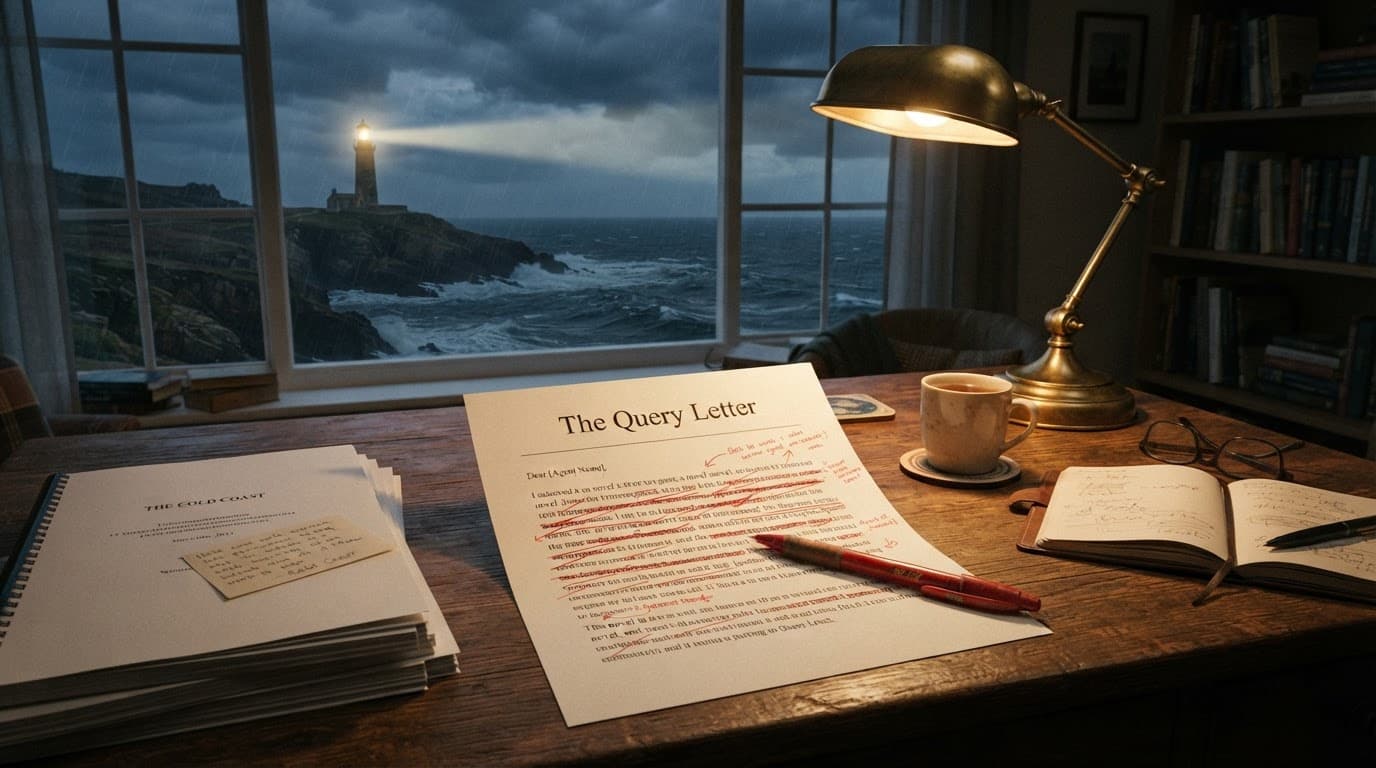
The manuscript is done. You've read the synopsis aloud twice, and it holds. You've got a spreadsheet with forty agents sorted by genre, and the first submission form is open in another tab. The box marked Query is empty, and the cursor has been blinking in it long enough that you've started rewording your own name.
This is the strangest page in publishing. You spent two years writing 90,000 words, and now an agent reading a crowded inbox will decide from roughly 300 of them whether to read the rest. Here's how to write those 300 words so the answer is yes, whether you draft with AI or not.
What Is a Query Letter?
A query letter is a one-page business pitch whose only job is to get a literary agent to request your manuscript. It's not a summary or a cover letter. It's a sales sheet with a story in the middle.
Most guides agree on the shape. Scribophile describes it as "a short, one-page letter: usually around 3–4 paragraphs" in its guide to writing a query letter. Jane Friedman's complete guide to query letters puts it at about one single-spaced page, roughly 200 to 450 words, with the story description itself at 150 to 300. If you aim for 250 to 350 words total, you'll fall inside nearly everyone's range.
Every query does four jobs: housekeeping (title, genre, word count), the pitch (protagonist, want, obstacle, stakes), comps (two or three recent books that place yours on a shelf), and a short bio. Personalization is an optional fifth. It helps when it's real and hurts when it's faked.
The Query Letter vs. the Synopsis
The query sells the premise; the synopsis proves you can land it. The query stops at the moment of greatest tension and never gives away the ending. The synopsis tells the whole story, ending included, in plain chronological prose.
A query that summarizes chapters one through thirty reads like a synopsis that lost its nerve. Keep them separate: a query is a promise, and a synopsis is the receipt. If you haven't written the receipt yet, our guide to writing a novel synopsis agents actually read walks through it beat by beat.
How to Write a Query Letter, Step by Step
1. Open with the housekeeping (or the hook)
The safest opening is one plain sentence: THE SALT WIDOW is a 92,000-word gothic mystery. Literary agent Britt Siess, in a Writer's Digest piece on nailing your query, puts title, genre, and word count first so the agent doesn't have to hunt for them. Friedman's guide lets you lead instead with your strongest selling point, whether that's a referral, a conference meeting, or the story itself. Either works. A rhetorical question ("What would you do if your sister came back from the dead?") doesn't, because a tired agent's honest answer is "close the email."
Check your word count against your genre, too. Friedman notes that debuts often land around 80,000 words and that anything past 120,000 is a hard sell.
2. Write the pitch paragraph around one decision
This is the paragraph that gets you the request, and it's where most queries go soft. Friedman frames it as three questions: who is the protagonist, what problem do they face, and what choices must they make? Kat Jo Lewis's 2026 query letter walkthrough offers a starter template that's worth stealing for your first draft: [Title] is about a [protagonist] who desperately wants…
Give it one named protagonist with a concrete detail ("a grieving widow" is generic; "a widow who still sets two places at dinner because the coroner never found a body" isn't), the inciting event, the want and the obstacle, and end on the choice they can't avoid, not on how it turns out.
Apply what I call the noun test: every sentence in the pitch should contain at least one noun that only your book could have. If a sentence would fit a hundred other manuscripts unchanged ("But nothing is as it seems," "She must confront her past"), cut it or rebuild it around something specific.
Cap the cast at two or three names. A fourth turns your pitch into a list.
3. Pick comps that are recent and honest
Comps tell an agent who will buy your book. Siess's rule is blunt: "A book that's more than five years old is probably too old for the market now." Editors quoted in Reedsy's query letter guide go further and say two years is better. Friedman warns against comping to "an international bestseller that's been turned into a blockbuster movie" and to the classics. She suggests two well-chosen titles are enough and that they should show you actually read in your genre.
One sentence does it: THE SALT WIDOW will appeal to readers of [recent gothic title] and [recent mystery title]. Siess treats comps as optional if you truly can't find good ones.
4. Keep the bio short and true
Two or three sentences: specific publication credits if you have them, plus life experience that bears on the book (the former ER nurse writing a hospital drama). Friedman is explicit: don't invent credits, and don't apologize for lacking them. Leave out how long the book took and what your family thinks of it.
5. Personalize only when it's real
A line like "I'm querying you because you represented [specific book] and have said you want atmospheric mysteries with a dark coastline" earns its place. "I admire your client list" doesn't. Address the agent by name; Scribophile notes most prefer their first name. Then follow that agent's submission guidelines exactly, including the page count they ask for, whether to paste or attach, and any form fields. Their guidelines override every general rule in this post.
A Worked Example: From 412 Words to 304
Marisol finishes her gothic mystery in March. Her first query draft is 412 words. It opens with two paragraphs about the lighthouse town her grandmother grew up in. The pitch introduces the widow, her missing husband, his brother, the harbormaster, the harbormaster's daughter, and a ghost. It ends with "As the storm rolls in, Elena must face the truth about her past, her marriage, and herself." Her comps are Rebecca and Gone Girl.
She runs the noun test first. "Face the truth about her past" fails; so does "a town full of secrets." She rebuilds the closing line around the one object in her book that no other book has: the husband's wedding ring, which turns up inside a fish sold at the dock market eight months after he drowned. The new last line is "Elena can take the ring to the police and lose the only person in town who believes her, or she can keep it and start asking who sold that fish."
Next she cuts the cast. The harbormaster and his daughter matter in the book but not in 200 words, so they go. So does the ghost, which is atmosphere, not plot. Six characters become three: the widow, the drowned husband, and his brother.
Then the comps. Rebecca is nearly ninety years old and Gone Girl is a blockbuster, exactly the pairing every guide warns against. She swaps in two gothic mysteries from the last three years that she's actually read.
The grandmother's lighthouse history moves to her bio as a single line: "I grew up spending summers in a fishing village on the Maine coast that inspired the novel's setting." It's relevant, it's true, and it's one sentence.
Final count: 304 words. Nothing in the book changed; every sentence of the query now carries weight.
Using AI to Write a Query Letter (Without Sounding Like Everyone Else)
AI is good at the parts of a query that are mechanical and bad at the part that matters. It can trim a 412-word draft to 300, catch a buried word count, and flag a comp that's ten years old. Left to write the pitch from scratch, it produces sentences that fail the noun test almost by design: "a web of secrets," "a race against time," "everything she thought she knew."
It's the same problem we covered in why AI characters all sound the same: from a two-line premise, a model reaches for the most probable phrasing, and the most probable phrasing is everyone's. Give it specifics and it compresses them well.
A workflow that holds up:
- Write the ugly draft yourself, answering who, what problem, and what choice at whatever length it takes.
- Feed the model your real material. Paste your synopsis and the inciting-incident scene and ask for the five most concrete details in it. You're mining, not generating.
- Ask for cuts, not rewrites. "Cut this to 200 words without adding any phrase that isn't already in my draft" keeps your voice intact.
- Use it as a hostile reader. "You are an agent who has read 300 queries this week. Which sentence made you stop paying attention?" is a far more useful prompt than "Make this better."
There's also a privacy angle. Step 2 means pasting your full synopsis, ending included, into whatever chat window you use. If you'd rather that never touch someone else's server, NovelMage keeps the manuscript on your own machine and runs local models through Ollama or LM Studio, or your own Claude, GPT, or Gemini API key when you want a bigger model.
Some submission forms now ask directly whether AI was used. Our post on whether you have to disclose AI use to literary agents covers what those checkboxes are really asking.
Query Letter Mistakes That Get an Instant Pass
- Revealing the ending. That belongs in the synopsis.
- Grading your own book. "A gripping page-turner" is the agent's call. Friedman: "resist the temptation to editorialize."
- Marketing plans for fiction. You're selling the story, not your platform.
- "Dear Agent." It signals a mass send. Scribophile also advises sending each query individually, never CC'd.
- Querying an unfinished book. It should be complete and, in Scribophile's words, "completely free of typos."
- Following up too soon. Scribophile suggests waiting about three months unless the agency says otherwise.
Frequently Asked Questions
How long should a query letter be?
Aim for 250 to 350 words, which keeps it to one page. Jane Friedman's range is 200 to 450 words, with the story description itself at 150 to 300. Past 400, you're almost certainly including characters or subplots the agent doesn't need yet.
Should a query letter include the ending?
No. The query stops at the protagonist's central dilemma. The ending goes in the synopsis, which many agents request alongside the query.
How many comp titles should I use?
Two or three, published within roughly the last five years and ideally the last two or three. Avoid megabestsellers and classics. Agent Britt Siess treats comps as optional if you're unsure how to choose them.
Can I use AI to write my query letter?
Use it to tighten, cut, and stress-test a draft you wrote. Pitches generated from a short premise lean on stock phrases agents see constantly; feeding the model your actual manuscript details works far better. Check each submission form for AI-disclosure questions.
What do I write in the bio if I've never been published?
A sentence or two on anything that connects you to the book, such as your profession or the experience that sparked the story. Don't apologize for a missing publication history; the premise is what's being judged.
Write the Query Before You Need It
Draft your query before the final revision. If the pitch can't pass the noun test, the problem may be in the book rather than the letter, and it's cheaper to learn that now than after forty rejections.
If you want the manuscript, the synopsis, and the query drafts in one place, with local models that keep every chapter on your own laptop, NovelMage is a $99.99 one-time purchase for Windows and macOS.