Inkfluence AI vs NovelMage: Generator or Workbench?
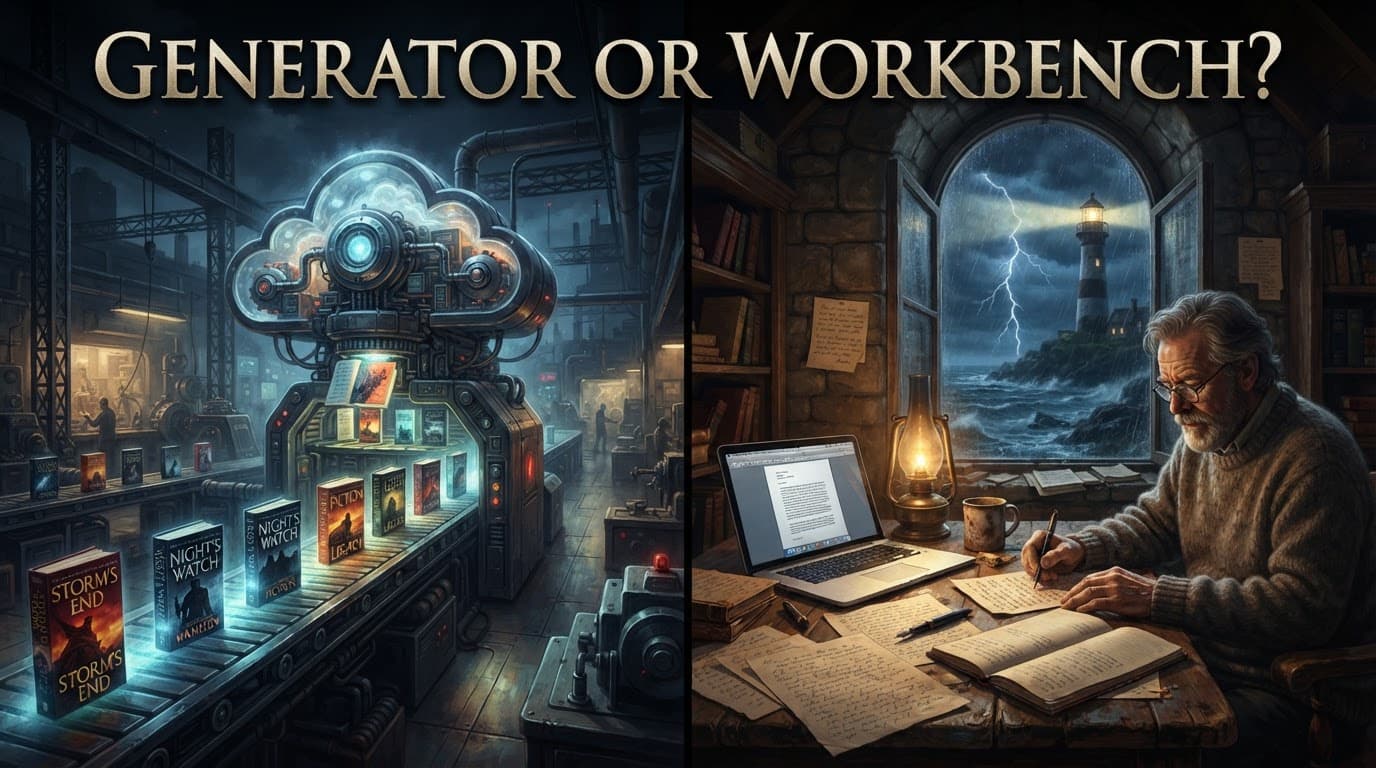
You typed a premise into a box: a lighthouse keeper's daughter, a drowned village, a brother who comes back from the sea wrong. Four minutes later you had a chapter outline. Twenty minutes after that you had chapters. It was thrilling, and a little unsettling, because when you opened chapter six to fix one line of dialogue, you realized you weren't sure which parts of the book you'd decided and which parts had been decided for you.
That's the real question underneath "Inkfluence AI vs NovelMage." It isn't about which feature list is longer. Inkfluence AI is built to generate a book. NovelMage is built to help you write one. Both are legitimate, and they suit different writers. This post weighs them honestly, using Inkfluence's own published documentation and pricing, so you can tell which one fits the book you're making.
The short answer: a generator vs. a workbench
Inkfluence AI is a cloud book generator. You give it a premise and it plans the outline and drafts the chapters in order, then packages the result with a cover designer, EPUB/PDF/DOCX export and audiobook narration. NovelMage is an offline desktop writing app for Windows, macOS and Linux. You draft the novel yourself, with an AI that you choose (a local model or your own Claude/GPT/Gemini key), and your manuscript stays on your machine. It costs $99.99 once.
If your goal is "a finished, publishable file this month with as little hands-on drafting as possible," Inkfluence is designed for exactly that. If your goal is "my novel, in my sentences, with an AI that does the parts I hand it," NovelMage is the better fit. The rest of this post covers where that split shows up in practice.
What Inkfluence AI actually does well
Inkfluence's strongest point is that its continuity system is more serious than most generators'. According to its own explainer on book consistency, every chapter is written with the story bible, the previous three chapters word for word, a "running record" of what has already happened, a list of what each character in the chapter already knows, and the events planned for the next three chapters, which the model is told to hold back. Fiction is generated strictly one chapter at a time, in order.
The "who knows what" list deserves real credit. A generated twist that gets re-announced as news in chapter nine is one of the most common failures in AI drafts, and Inkfluence addresses it directly. (We covered why models lose these details in why AI forgets your story details: the short version is that they never had them unless something put them in the context window.)
The packaging is also real. Its pricing page lists a Creator plan at $9.99/month or $89/year with EPUB, PDF and DOCX export, an advanced cover designer and 15 audiobook chapters a month. Premium costs $19.99/month or $179/year and adds unlimited chapters and HD voices. There's a free tier with 5 chapters to start, 5 more each month, and PDF-only export. If you want one subscription that goes from premise to cover to audiobook, few tools package that tightly.
Where the generator model gets in your way
The friction starts once you want to own specific decisions. Three details from Inkfluence's own documentation matter here.
The running record isn't yours to edit. Inkfluence's explainer says plainly that the running record "is written from the chapters and is not edited by hand." If you rewrite a scene so the brother never reaches the boathouse, the record doesn't learn that from your edit. You can update the story bible, but Inkfluence notes that saved changes are used the next time a chapter is generated or regenerated and "do not rewrite chapters that already exist." For a writer who revises by hand, the book's memory and the book's text can quietly diverge. This is the gap between memory you curate and memory that's curated for you.
The chapter math is built for shorter books. Inkfluence's own 2026 roundup reports a median AI chapter of about 1,900–2,000 words on its platform, with a full novel landing around "30,000 to 40,000 words and up." That's novella territory. A 90,000-word adult fantasy at that chapter length is roughly 45–47 chapters. The pricing page lists Creator at 35 chapters a month (the same page also says "unlimited" in another spot, so confirm before you budget). Either way, a full-length book plus regenerations can push you toward Premium or toward the credit packs ($9.99 for 15 chapter credits).
Your manuscript lives in someone else's cloud. Inkfluence's privacy policy is reasonable on paper. It says your content is not used to train its models, lists OpenAI as the AI provider ("no training on your data"), and uses Firebase/Google Cloud for storage, encrypted in transit and at rest. That's a standard SaaS setup, but it is still a setup where the book exists on servers you don't control. You also can't choose a different model for prose you don't like.
The workbench approach: what changes when you draft the book yourself
A workbench tool assumes the sentences are yours and the AI is a collaborator you direct. Drafting is slower than one-click generation, and that's the trade. What you get back is control over the specific things that make a novel feel authored rather than assembled.
Consider a single continuity detail: Odile, your lighthouse keeper's daughter, has a burn scar on her left palm from the lamp oil. In a generator, that fact lives in a story bible field and the model is asked to honor it. In a workbench, that fact lives in an entry you wrote, which you can change the moment you decide in revision that the scar should be on her right hand, and the next scene you draft uses the corrected entry. NovelMage's Character Codex works this way. You keep entries for characters, places and world rules, and the AI pulls the relevant ones in while it writes. If you've never built one, our guide to what a story bible is and how to build one is a good starting template, and it works in any tool.
The second difference is the model. Inkfluence runs on the model it chose. In NovelMage you connect a local model through Ollama or LM Studio, which is free and runs entirely offline, or you bring your own Claude, GPT or Gemini API key. That matters more than it sounds. If one model keeps giving your gruff harbor pilot tidy, complete sentences, you can switch to a different model and redraft those scenes. A generator gives you one voice to argue with.
A worked year: Odile's 90,000-word novel
Here's how the two approaches compare over a real drafting year. Say you're writing The Keeper's Daughter, a 90,000-word gothic fantasy, over twelve months with a heavy revision pass in the last three.
On Inkfluence Creator billed yearly, you pay $89. Generation is fast: at roughly 2,000 words a chapter, the first draft is about 45 chapters, spread over two months to stay under a 35-chapter cap. Then revision starts. You rewrite the middle third by hand, because the brother's return reads like a mystery when you wanted dread. The running record still reflects the generated version. You regenerate four chapters after updating the story bible, which spends allowance. By month twelve you've paid $89, and in year two you pay $89 again, or $179 if you moved up to Premium to stop counting chapters. The cover and audiobook are included, which is a genuine saving if you were going to buy those anyway.
On NovelMage, you pay $99.99 once. You draft with a local model for free, or with your own API key and pay your provider only for what you actually generate. The middle-third rewrite is just writing: you change the Codex entry for the brother, draft the new scenes with the AI reading the corrected entry, and the reference material says what you now say, not what the first draft said. In year two you pay nothing. The license covers up to three devices, so the desktop and the laptop you take to the café both count.
In year one, Inkfluence's $89 is cheaper than NovelMage's $99.99, and it includes a cover. By the end of year two, NovelMage is cheaper, and the gap grows every year you keep writing. More importantly, the revision months play out differently. In one tool, revision means arguing with the generator's memory. In the other, revision is the job and the tool is built around it.
Who should pick which
Pick Inkfluence AI if you want to go from premise to finished EPUB, cover and audiobook quickly, you're comfortable with a cloud subscription, and you think of the AI as the drafter and yourself as the editor. Romance and genre writers working on shorter books in rapid-release cycles are well served by that packaging, and the who-knows-what tracking is better than most generators manage.
Pick NovelMage if you think of yourself as the drafter, you revise heavily, you want to choose (and change) the model, or you'd rather your manuscript never sit on someone else's server. That last point carries real weight for anyone who has read a vendor breach notice. You can try NovelMage free for 7 days with no credit card.
One thing worth knowing whichever you choose: readers and platforms increasingly care where the sentences came from. Amazon's KDP form distinguishes between AI-generated and AI-assisted text, and the line between them is roughly the line between these two tools. Our breakdown of KDP's AI disclosure rules walks through where your workflow lands. And if you're publishing into a crowded genre, what readers actually punish is worth reading before you hit publish. They don't punish the tool. They punish the flatness.
Frequently Asked Questions
Is Inkfluence AI good for writing a full-length novel?
It can draft one, and its continuity system (story bible, last three chapters in full, a running record, and per-character knowledge tracking) is stronger than most generators'. Its own data puts a typical generated novel at 30,000–40,000 words and up, though. A 90,000-word book means roughly 45 chapters of generation plus regenerations, which can push past the Creator plan's listed 35-chapter monthly allowance.
How much does Inkfluence AI cost compared to NovelMage?
Inkfluence AI is free for 5 chapters (plus 5 a month), $9.99/month or $89/year for Creator, and $19.99/month or $179/year for Premium. NovelMage is a $99.99 one-time lifetime license covering up to three devices. You supply the AI, either a free local model via Ollama or LM Studio or your own API key. Inkfluence is cheaper in year one, and NovelMage is cheaper from year two onward.
Does Inkfluence AI train on my manuscript?
According to its privacy policy, no. It states that it doesn't use your content to train its models, and that its AI provider, OpenAI, doesn't train on your data. Your book is still stored in the cloud (Firebase/Google Cloud). NovelMage stores files locally, and with a local model it makes no network calls at all.
Can I fix continuity errors myself in Inkfluence AI?
You can edit the story bible, and changes apply the next time a chapter is generated or regenerated. They don't rewrite existing chapters, and the running record can't be edited by hand. If you revise heavily by hand, a tool where you directly control the reference material, such as an editable codex, will drift less.
The bottom line
A generator answers "can I have a book?" A workbench answers "can I write my book faster without losing it?" Both are fair questions, and only you know which one you're asking. If it's the second, try NovelMage free for 7 days, then keep it for a one-time $99.99. Your chapters, your Codex and your model choice all stay on your own machine.