The AI Disclosure Penalty: Should You Tell Readers?
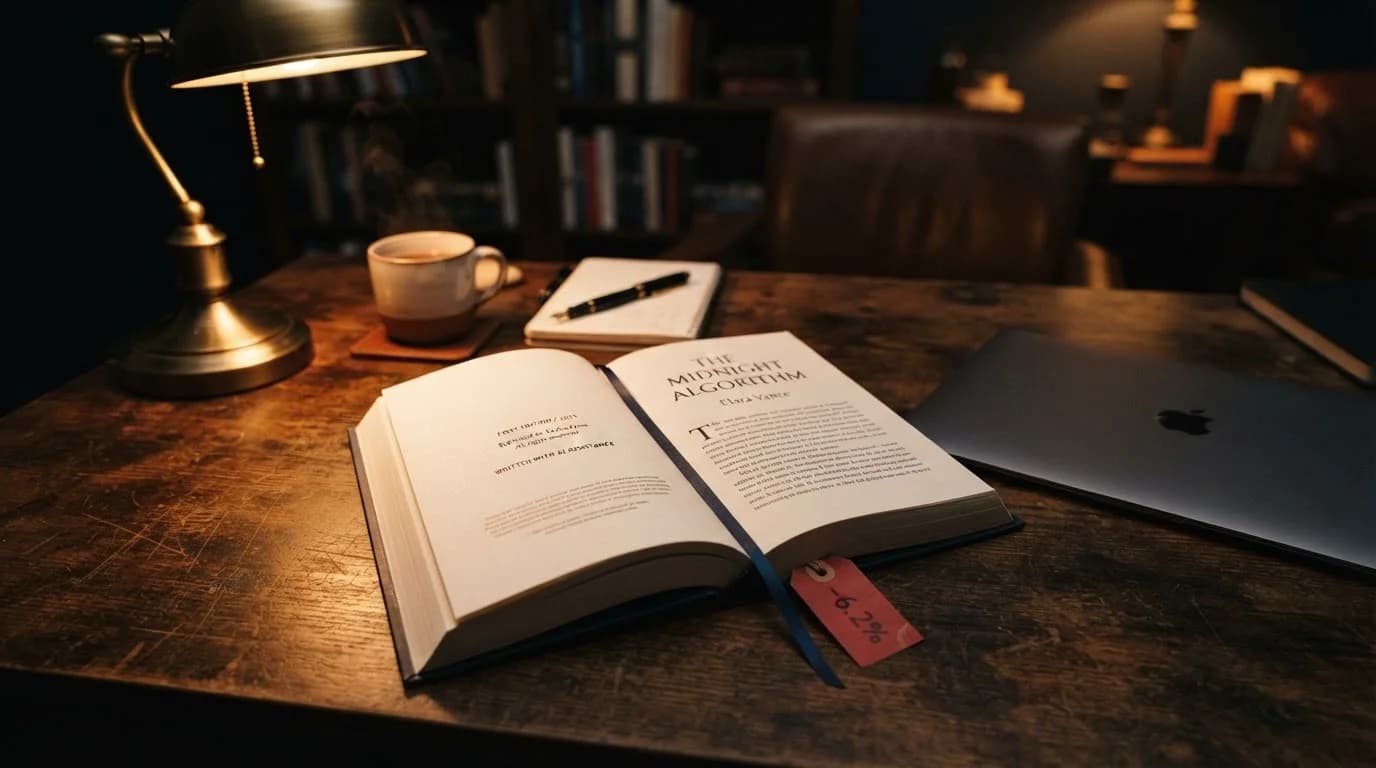
You're on the last screen before publish, and there's a question you didn't plan for: does this book contain AI-generated content? Behind you are nine months, a story you've been carrying since you were nineteen, and a drafting process where the model helped you unstick a sagging middle and rough out forty scenes you then rewrote by hand. Ahead of you is a book description you still have to write, and the question of whether the words written with AI assistance belong anywhere in it.
The ethical question you've probably already settled. The one that keeps you on that screen is narrower and more uncomfortable: what does honesty cost?
As of this year, there's a number.
Yes, disclosure carries a measurable penalty — about 6.2%
Telling readers AI was involved lowers how they rate the exact same writing by roughly 6.2% on average. That figure comes from Raj, Berg, and Seamans' The Artificial Intelligence Disclosure Penalty, published in the Journal of Experimental Psychology: General in 2026: 16 preregistered experiments, 27,491 participants, run between March 2023 and June 2024. The design is brutally simple. Everyone reads the same poem or story. The only thing that changes is who they're told wrote it. Average Cohen's d across studies: 0.24.
Two things about that number matter more than the number itself.
First, it's an evaluation penalty, not a sales figure. The researchers measured enjoyment, appeal, perceived quality, and creativity — plus one behavioral measure, whether people would give up a ten-cent bonus to read another sample. Nobody in that lab bought a paperback. Anyone telling you disclosure costs 6.2% of your revenue is extrapolating past the evidence.
Second, the penalty attaches to the label, not to the prose. The words on the page were identical across conditions. Readers weren't detecting anything. They were told something, and the telling changed the verdict.
"AI-assisted" doesn't buy you a discount
This is the finding that should reorganize your plan, because most writers' instinct is to soften the label rather than drop it. Call it AI-assisted. Say collaboration. Emphasize the human in the loop.
The researchers tested exactly that. Studies 5a–5c labeled stories as products of human–AI collaboration, an approach that reduces algorithm aversion in other domains and had shown some promise for AI-generated images. Their summary is one sentence: "Collaboration labels offered no relief; readers still discounted the writing once AI involvement was disclosed."
Nothing else they tried worked either. Reframing the evaluation as art rather than objective quality: no. Telling participants the AI was cognitively or emotionally capable: no. Giving the software a name and a gender: no. Testing whether disclosure made people ambivalent rather than negative: it just made them negative. Their own conclusion, in the paper: "Despite our deliberate attempts, we were unable to find consistent moderation of the effect."
The uncomfortable translation for a working novelist is that your readers aren't grading your prose, they're grading your process — and once AI enters the description of that process, the dial moves the same distance whether you spent an afternoon or a year.
There's a mechanism behind it. Across all 16 studies, the effect was mediated by perceived authenticity: people rate AI-involved writing as less authentic, and therefore less worth their appreciation. Not less skillful. Less real.
The one moderator everyone assumes exists, doesn't
You'd expect readers who use AI themselves to shrug it off. They don't, reliably. The authors tested familiarity with AI tools as a moderator in every single study and found significant moderation in three of sixteen — positive in two, negative in one. Their verdict: "familiarity with AI does not appear to be a reliable moderator of the AI disclosure penalty in this set of studies."
So the strategy of finding the AI-friendly corner of your genre and disclosing loudly there is not, on this evidence, a strategy. It's a hope.
One caveat worth stating because it's the kind of thing that gets a post dismissed if it's glossed over: the writing samples in these studies were generated with ChatGPT, chosen in March 2023 because it was the best-known model, then kept for consistency. The study is not a verdict on how good AI prose can be in 2026. It's a verdict on what happens when you say the letters A and I.
Getting caught is worse than telling
Here's the finding that resolves the temptation the last three sections build. A separate line of research — Schilke and Reimann's "The transparency dilemma: How AI disclosure erodes trust", thirteen experiments in Organizational Behavior and Human Decision Processes (2025) — found that people who disclose AI usage are trusted less than people who don't, across supervisors, professors, analysts, investment funds, and creatives. Same shape of penalty, different outcome variable.
But they also tested the alternative. Their words: "while AI disclosure jeopardizes trust, the exposure of undisclosed AI usage by a third party has an even more detrimental effect." The disclosure penalty held whether disclosure was voluntary or mandatory, and it was comparatively weaker than the hit from being outed.
So: you can price a disclosure. You can't price an exposure. One is a fixed, known, roughly 6% cost you absorb at launch. The other is an unbounded liability that detonates at a time chosen by someone who is not you — a reviewer, a Goodreads thread, a detector screenshot. If you've read about what watermarking AI text means for novelists, you already know the exposure risk isn't getting smaller over time.
What 6.2% actually looks like in a launch
On a first novel, 6.2% is roughly one rounded star-rating step: visible on your product page, survivable, and smaller than several things you have more control over. Here's the arithmetic carried through an actual launch.
Say you're Marisol, publishing a cozy mystery in November. Your ARC readers liked it; the honest expectation for your first thirty reviews is somewhere around a 4.3 average. You've decided to put a two-line process note on your copyright page.
Apply the penalty as measured — a haircut on evaluations, not on units — and 4.3 becomes about 4.03. On Amazon's rounded display, that's a book showing 4.0 stars instead of 4.3. Real, and worth exactly one afternoon of worry.
Now add the thing the labs can't measure. A self-publisher who ran this experiment for real — disclosing a fully AI-generated novel with a cover watermark and a page-one disclaimer — reported a second-order effect: "People who respect the disclosure simply walk past. Meanwhile, those looking to hunt continue hunting." Readers who'd have been fine with it silently don't buy; readers who came to object still show up. Net result, in their words, "both lower reach and a higher concentration of negative sentiment."
That's a selection effect, not a rating effect, and it's plausibly the larger cost. It also tells you where the disclosure goes matters as much as whether it happens. A watermark on the cover filters your audience before anyone reads a sentence. A line on the copyright page reaches the reader who already opened the book.
Four decisions you actually control
You can't change the size of the penalty. You can change who is required to hear the disclosure, how specific it is, where on the book it sits, and how good the pages behind it are. Those four are the whole game.
1. Separate what you're required to disclose from what you're choosing to disclose. These are different obligations with different audiences. Amazon KDP's content guidelines define AI-generated as "content created by an AI-based tool... even if you applied substantial edits afterwards," and AI-assisted as content you created and then used AI to "edit, refine, error-check, or otherwise improve." You must inform Amazon about the former. You are not required to inform Amazon about the latter. That's a form submission to a retailer — a separate decision from what you tell readers in your front matter, and separate again from what you tell an agent, which we covered in whether you have to disclose AI use to literary agents.
2. Disclose at the granularity of the truth. The KDP framework is binary; your process isn't. A reader who sees "AI-generated" fills the gap with the worst version — one prompt, one afternoon. Two specific sentences beat one vague label: Story, characters, and every editorial decision are mine. I used an AI assistant for brainstorming, drafting support, and continuity checking, and revised every line by hand. You can't prove the penalty shrinks — the collaboration-label studies suggest it may not — but you can stop volunteering the worst reading of yourself.
3. Put it where it costs least, and be honest that this is a placement decision. Copyright page, author's note, or FAQ on your site does the ethical work without turning your cover into a filter. If you genuinely believe cover-level disclosure is the right thing, do it — just do it knowing what the practitioner above found, not by accident.
4. Spend the effort on the thing with more leverage than the label. A 6.2% evaluation penalty is a real cost. Prose that reads like a police report of a scene is a bigger one, and it compounds — it's what makes a skeptical reader's hunt succeed. The deep POV fix for flat AI writing and the discipline of using AI without losing your voice move a bigger number than any wording of a disclaimer will. If your book genuinely was one prompt and an afternoon, no disclosure strategy is your problem and no tool, this one included, will fix it.
There's a fifth thing, quieter than the other four: decide what your draft touches on its way to being finished. Every cloud tool your manuscript passes through is a copy of your unpublished book on someone else's server, and an exposure risk you didn't choose. Drafting in a desktop app that runs local models through Ollama or LM Studio — or your own API key when you want a frontier model — means the only party who knows your process is you. NovelMage is built that way on purpose: Windows and macOS, manuscripts on your disk, $99.99 once for up to three devices rather than a subscription that keeps your book hostage to a monthly invoice.
Frequently Asked Questions
Does the disclosure penalty apply if I only used AI for editing?
The research doesn't isolate line-editing specifically, but the direction is discouraging: the studies that labeled work as human–AI collaboration — the closest available proxy for "a person wrote this with help" — found the penalty essentially intact. What does change is your obligation. Under KDP's definitions, content you wrote yourself and then improved with AI is "AI-assisted," which Amazon does not ask you to report. Editing help is the one category where you can be fully honest and still, by the retailer's own rules, have nothing to declare.
Do I legally have to disclose AI use in a novel?
No general US statute requires novelists to disclose AI use to readers — the Raj paper cites the AI Disclosure Act of 2023 (H.R. 3831) as legislation Congress has considered, not a standing obligation on fiction. What exists in practice are platform rules and gatekeeper policies: KDP requires you to notify Amazon of AI-generated content at publication, and individual agents and publishers set their own submission requirements, which increasingly appear as a yes/no field in query forms. The researchers flag the irony directly: if disclosure ever is mandated, it "could reify negative biases toward AI-generated content," entrenching the exact effect their experiments measured.
Will readers who use AI themselves give my book a pass?
Not dependably. The authors tested familiarity with AI as a moderator in all 16 experiments and got significant moderation in three, pointing in inconsistent directions. Plan as if your AI-using readers apply the same discount as everyone else, and treat any warmer reception as a bonus rather than a strategy.
If disclosure costs me, why not stay quiet?
Because the alternative isn't "no penalty," it's "a bigger penalty on a schedule you don't set." Schilke and Reimann found third-party exposure of undisclosed AI use damages trust more than voluntary disclosure does. Silence isn't avoiding the cost; it's writing an option on it and hoping nobody exercises it.
The honest summary
Disclosure costs about 6.2% of your evaluations, the softer wordings don't refund it, your AI-using readers don't exempt you, and it's still the cheaper of the two available outcomes. That's not a comfortable set of facts, but it's a workable one — it means the decision is a placement-and-phrasing problem, not an existential one, and it means the effort you were about to spend agonizing over a disclaimer is better spent on chapter three.
If part of what you want is fewer copies of your unfinished book scattered across services you'll never audit, NovelMage's one-time lifetime license covers the desktop app for Windows and macOS at $99.99 with a seven-day trial that doesn't ask for a card — your manuscript, your machine, your choice about what to tell anyone.