What Is Subtext? Fix AI's On-the-Nose Dialogue
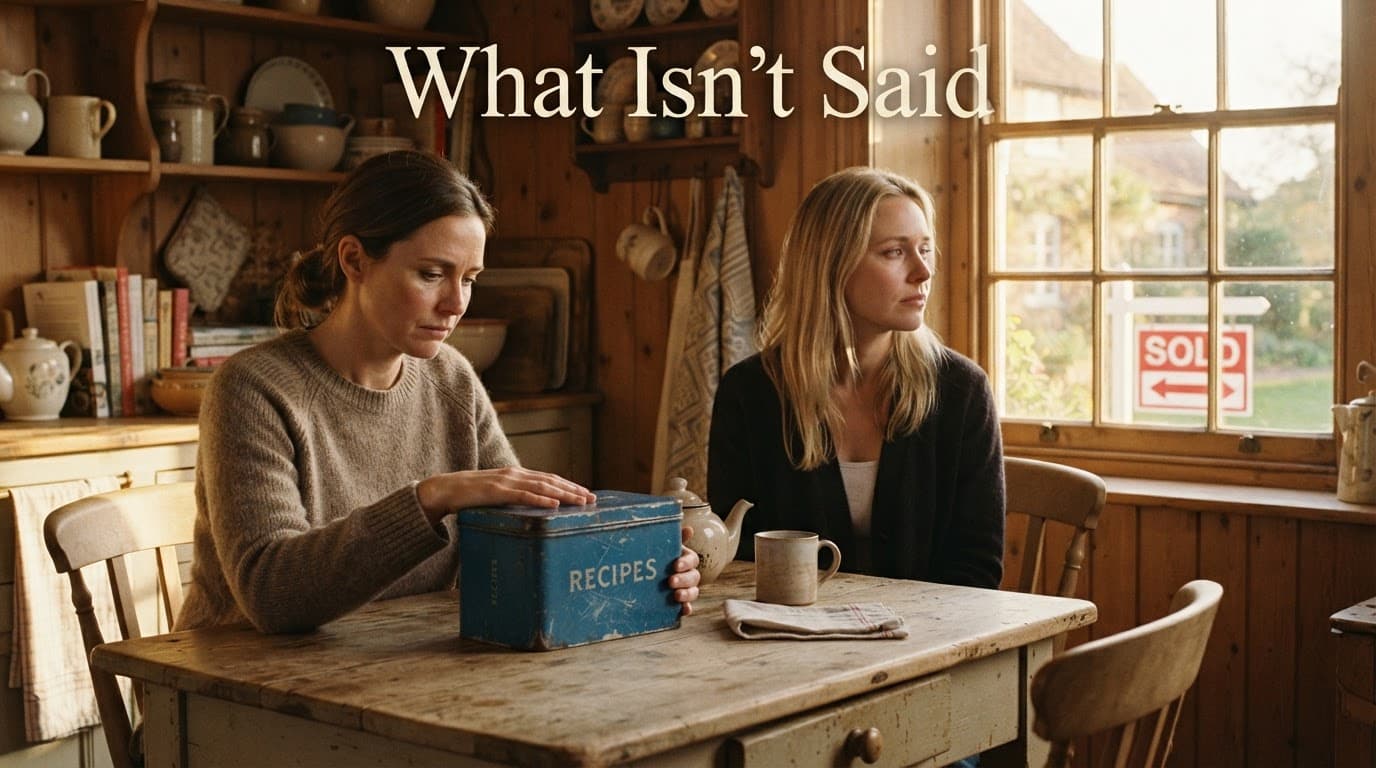
You asked for the scene where Nell finally tells her sister she's selling their mother's house. Two women, one kitchen, a decade of resentment under the linoleum. What came back was 1,400 clean words, and halfway down the first page Nell says: "I know you feel betrayed, Jo, and honestly I feel guilty about it too. But I need to do this for myself."
Jo replies that she's hurt, but she understands.
Nothing in that exchange is wrong. It's also the deadest thing you've read all week, and you can't quite say why. The reason has a name: there's no subtext. Everyone in the kitchen is saying exactly what they mean, and when characters say exactly what they mean, the reader has nothing left to do.
What is subtext in fiction?
Subtext is the meaning underneath what's said on the page: what a character wants, fears or hides, communicated through what they say instead. The reader works it out without being told. In dialogue, it's the gap between the words and the intent behind them.
Zeeva Bukai, writing for Writer's Digest on subtext and dramatic tension, calls it "the unconscious implicit desire that motivates a character to behave explicitly." That's the useful part. Subtext isn't a decoration you add to a line. It comes from a character who wants something they can't, or won't, ask for directly.
Its opposite is on-the-nose dialogue. K.M. Weiland defines it in her guide to getting rid of on-the-nose dialogue as dialogue "that explicitly states what characters think, feel, or want instead of allowing readers to infer meaning through subtext." Her example is a breakup where the boyfriend explains his absent father and the girlfriend announces she's leaving. The rewrite is four lines long: "You're late." "I called." "I know." Then she slides a box across the floor with her foot and says the rest are by the door.
Nobody says breakup. Everybody knows.
Why AI dialogue is so on the nose
Language models write on-the-nose dialogue by default because they're trained to be clear and helpful, and clarity is exactly what subtext holds back. Ask a model for an emotional confrontation and it will make sure the emotion arrives, usually by having a character name it.
Writing about AI dialogue, Guru Dan put it bluntly: "Models tend to be too honest; characters will tell you exactly what they are thinking." Screenwriting teacher Paul Peditto ran a small workshop at Script Magazine where he asked an AI for five lines of dialogue actors would love to play. After two rounds of feedback, some of the lines were still, in his words, "too on the head."
So the problem isn't just a first-draft wobble. It's how the model works. Its instinct is to resolve ambiguity, and your scene runs on ambiguity. It's the same pull that makes AI prose default to telling instead of showing, just moved from the narration into the characters' mouths.
The model sees your prompt, not your book. It doesn't know Jo was the one who stayed home and nursed their mother for three years while Nell sent money and excuses from Chicago. Without that, it can't write what Jo would refuse to say, because it doesn't know there's anything to refuse.
The label test: find the lines that need subtext
The fastest diagnostic is what I call the label test: any line of dialogue that names an emotion out loud (betrayed, guilty, hurt, scared, proud of you) fails, unless the character naming it is lying, deflecting or breaking after a long silence.
Run it like this:
- Print the scene or copy it into a fresh document.
- Highlight every line where a character names a feeling, explains their motive ("I'm doing this because…"), or sums up the relationship ("We've always been competitive").
- Count them. One per scene can be a deliberate punch. Three or more means the scene is a therapy session in costume.
The ScreenWeaver subtext rewrite pass uses almost the same threshold: flag direct lines first and don't fix them yet, and treat more than two per scene as a sign the scene is lecturing. It also has the best one-line summary of the cure I've found: "Characters do not announce theme; they fight about keys, money, or silence."
A worked rewrite: Nell, Jo and the house
Back to the kitchen. The generated scene has 34 lines of dialogue. The label test flags 11 of them. Jo says she feels "abandoned" twice. Nell explains her reasons four separate times, each a slightly reworded version of I need a fresh start. And there's a closing exchange where both sisters agree they "never really talked about Mom."
Here's the pass, step by step, with each step changing something real.
Give each character a secret objective. Write one sentence per character that the scene never states. Nell: I want Jo to say it's okay so I can stop feeling like the bad daughter. Jo: I want Nell to admit she left me alone with all of it. Neither will say these. Both will push toward them.
Pick the proxy object. Find something physical in the room for them to fight about instead of the real thing. In this kitchen it's their mother's recipe tin, the battered blue one with index cards in her handwriting. Nell has already put a SOLD-AS-IS sticker on the stove. Jo is holding the tin.
Rewrite from the objectives, not the emotions. The confession becomes:
"The realtor says the kitchen's the selling point," Nell said. "Original cabinets."
Jo opened the tin, thumbed past Pot Roast and Mrs. Kowalski's Pierogi, and stopped on a card with a coffee ring on it. "She couldn't hold a pen by the end. I wrote these last ones for her."
"I didn't know that."
"No." Jo closed the lid. "You'll want to take this, though. For your new place."
Nobody says betrayed. Jo's "I wrote these last ones" is the three years of caregiving in seven words. Nell's "I didn't know that" is an admission she doesn't realize she's making. And Jo offering the tin is a sharper accusation than anything she could say out loud. The scene drops from 34 lines to 19, and the label test flags zero.
Leave one direct line, and make it count. Weiland makes the point in her FAQ: on-the-nose dialogue isn't always bad, and a direct line "can feel like a lightning bolt of clarity when subtext has been appropriately set up previously." So you save it. Three chapters later, in the hospital car park, Jo finally says, "You left me with her." It lands because she's spent forty pages not saying it.
That's the whole technique, and it fits in one sentence worth taping above your desk: write the argument they'd have in the car, not the one they'd have in therapy.
How to prompt an AI for dialogue with subtext
You can get much closer on the first generation if you give the model what it's missing: what each character wants, what each one hides, and a rule against naming feelings. Asking for "more subtext" is too vague to change much on its own. Instructions the model can act on work better.
Here's a prompt structure that works:
- State the hidden objective for each speaker, in the same one-sentence form as above, and label it never stated aloud.
- Name the proxy. "They argue about the recipe tin, the stove sticker and who keeps the car, never about their mother directly."
- Ban the labels outright. "No character names an emotion. No character explains why they're doing something."
- Ask for behavior that contradicts speech. "At least twice, a character's action should undercut what they're saying."
The hidden objective is the part that changes from scene to scene, and it's the part writers skip because retyping a character's backstory into every prompt is tedious. That's where a persistent character file helps. In NovelMage, the Character Codex holds that information (what Jo did for three years, what Nell has never admitted) and the AI references it while writing, so the subtext has something to come from without you pasting it into every request.
If you're not sure what a character is hiding, ask them. Weiland suggests a character-interview exercise for exactly this, because, as she says, "real people have blind spots, conflicting desires, old wounds, and carefully guarded secrets." NovelMage has an AI Character Interviews feature built around the same idea. You can just as easily do it on paper by asking a character twenty questions and paying attention to the ones they dodge.
Subtext beyond dialogue
Dialogue is where subtext shows up most, but it also comes from two other places, and AI drafts tend to flatten both.
Behavior. Bukai's Writer's Digest piece lists revealing "emotion through behavior" as a core technique: the unconscious action that gives away what the character won't admit. Jo straightening the dish towel on the oven handle of a stove she'll never cook on again. A model writing generic gestures will give you a sigh and a nod instead, so name the specific action in your prompt or add it in revision.
Narration. In close third, what a POV character notices is subtext. If Nell's eye keeps going to the pencil marks on the pantry doorframe where their mother measured them as kids, you never have to say she's grieving. This is also why distant narration kills subtext: a camera floating above the room can't notice anything. If your AI drafts read like a transcript, the deep POV fix for flat AI writing works on the same problem from the narration side.
Don't overcorrect into fog
There's a failure on the other side, and you'll hit it once you start rewriting. Strip every direct statement and you get scenes where two people trade cryptic half-sentences and the reader has no idea what's at stake.
Weiland has a good test for this in the comments under her post: readers "should understand enough of the surface context to recognize that something is happening underneath." You want them asking what's the backstory?, not huh? The recipe-tin scene works because the reader already knows the house is being sold and Jo stayed behind. The surface is clear, and that's what lets the undercurrent read.
One more trap is specific to AI drafts: when every character dodges in the same way, they all start sounding alike. Subtext should come out differently in each one. Jo goes quiet and precise, while Nell fills silence with logistics. If you can't tell them apart with the tags covered up, that's a separate problem, and why AI characters all sound the same covers how to fix it.
Frequently Asked Questions
Is on-the-nose dialogue ever correct?
Yes, when it's been earned. A character who has spent the whole book deflecting and finally says the true thing gets more out of it because of everything that came before. Characters who take everything literally can also speak on the nose as a trait, and the contrast with characters who don't can be a source of tension in itself.
Can AI write subtext at all?
It can, if you give it the hidden material. Models are good at dramatizing a secret objective once they know what it is, and bad at inventing one when they don't. Hidden objectives, a ban on naming emotions and a proxy object usually get you most of the way, and the label test catches what's left.
Where the subtext actually comes from
Subtext doesn't come from clever phrasing. It comes from you knowing things about your characters that they'd never say. The AI can produce the dodge, the proxy fight and the action that contradicts the words, but only if somebody has written down what's being dodged.
So keep that somewhere. If you want the hidden objectives, secrets and history for your cast stored next to the manuscript, on your own machine, and read by the AI every time it drafts a scene, NovelMage does that with local models through Ollama or LM Studio, or with your own Claude, GPT or Gemini key. It's a one-time $99.99 lifetime license with no subscription, and there's a 7-day free trial with no credit card. Download NovelMage and run the recipe-tin test on your own worst scene.