What Is the Midpoint in a Novel? Fix the Sagging Middle
You're at 44,000 words and the book has stopped pulling. The opening still works. You know the ending, and in your head it's the best thing you've ever written. In between you have ten chapters of your protagonist investigating, worrying, getting a clue, worrying some more. Every scene is fine, and none of them moves. Your critique partner calls it "the middle stretch," and they mean it kindly.
Writers call this a sagging middle and usually blame stamina. Most of the time the problem is one missing scene: the midpoint. Here's what a midpoint in a novel is, the four forms it takes, how to check your draft for one, and why AI-assisted drafts tend to slide straight past it.
What Is the Midpoint in a Novel?
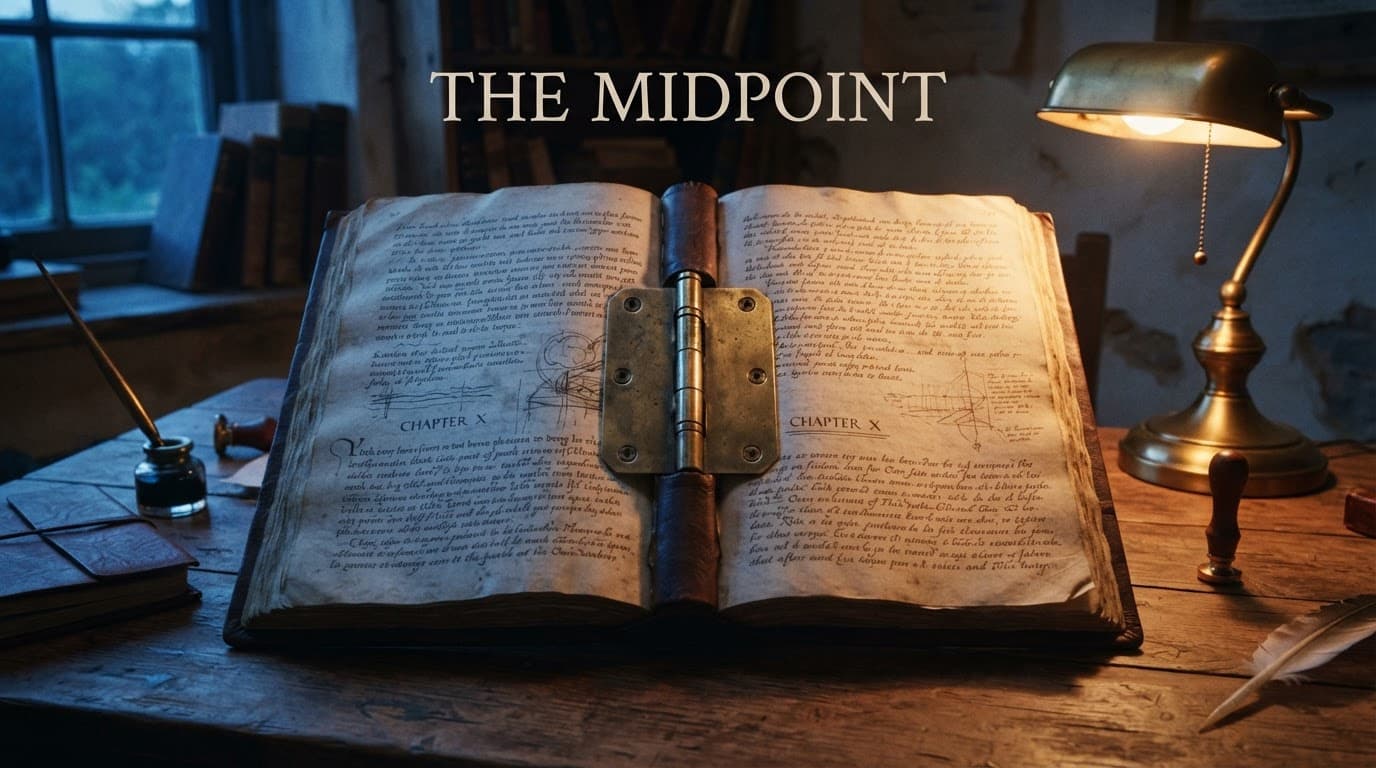
The midpoint is the turning point at roughly the 50% mark of a novel, where new information or a major event changes what the story is about and the protagonist stops reacting and starts acting. It splits the book into two halves. In the first, the protagonist mostly responds to what happens to them. In the second, they go after the problem.
K.M. Weiland puts this better than anyone in her midpoint chapter of Secrets of Story Structure. The midpoint "caps the reactions in the book's first half and sets up the chain of actions that will lead the characters into the Third Act." She describes it as the place where "the protagonist begins to take charge of the story by moving proactively against the antagonistic force." Scribophile's guide to the midpoint calls it a "hinge," which is the most useful word for it.
Weiland's examples:
- Pride and Prejudice: Darcy proposes, Elizabeth turns him down flat, and their unspoken conflict is suddenly out in the open.
- Ender's Game: Ender gets command of his own army, and it's made up of Battle School's worst students.
- Master and Commander: rescued whalers bring news of the enemy ship, and Aubrey switches from surviving to hunting.
None is an explosion. Each changes the question the book is asking.
Where the Midpoint Falls (and Why 50% Matters)
Aim for 45–55% of your word count. In a 90,000-word novel, that puts the midpoint scene somewhere between words 40,000 and 50,000. Weiland's reasoning is practical: the first half needs room to set up characters and their weaknesses, the second needs room to resolve everything, and a midpoint placed too far off center cuts one half short.
Other frameworks reach the same spot under different names. Blake Snyder's Save the Cat! puts the midpoint at page 55 of a 110-page screenplay and, as Wikipedia's summary of the book puts it, calls it "either a false victory or a false defeat, through which the stakes are raised." We walked through the full fifteen-beat version, with percentages adapted for novels, in our Save the Cat beat sheet guide for novelists. James Scott Bell gives the middle so much weight that his book and course Write Your Novel From the Middle argue it's the place to start writing. He calls it the "mirror moment." Different names, same job: halfway through, the story turns.
The Four Shapes a Midpoint Takes
Most midpoints are one of four things: a revelation, a big win, a big loss, or an impossible choice. Scribophile uses those four categories, and they hold up when you test them against books you love. Here's what each one does to the second half:
The revelation. New information reframes everything before it. The ally is the informant. The orb is an Infinity Stone (Weiland's Guardians of the Galaxy example), so selling it is off the table. The goal changes because the facts changed.
The big win (false victory). The protagonist gets what they wanted, and it isn't enough. Scribophile's Wizard of Oz example fits: the travelers reach the Wizard and are immediately handed a new task. Things usually get worse from here.
The big loss (false defeat). A death, a capture, a burned house. The personal stakes jump, and the protagonist has to change how they operate.
The impossible choice. Two things the protagonist wants can no longer both happen, and the choice can't be undone. It's the strongest option for character-driven fiction, because the turn happens inside the character.
Here's the version I keep on an index card above my desk: the first half asks "what is happening to me?" and the second half asks "what am I going to do about it?" The midpoint is the scene where the first question stops being enough.
A Worked Midpoint Rescue
Odile is writing an 86,000-word fantasy mystery. Her protagonist, Brannagh, is a river-pilot in a delta city, and her younger brother has disappeared on the night barges. The inciting incident works: his empty boat drifts into the harbor at 6% of the book. By 22%, Brannagh has signed onto a smuggler's crew to search the barges herself. Act one does its job.
Then come words 19,000 through 52,000. Brannagh asks questions in four taverns, finds his knife, gets warned off by a customs officer, finds a ledger page with his name on it. Each scene ends with a bit more information and the same emotion. Odile's beta reader marked chapter 14 "slow?" and chapter 17 "still slow?"
Odile makes a list of every scene with its word count and asks one question of each: after this scene, is Brannagh doing something different from what she did before? For thirty-three thousand words the answer is no. She gathers, she reacts, she gathers again. The closest thing to a turn is at word 61,000 (71%), where Brannagh learns her brother wasn't kidnapped. He signed onto the barges himself to pay off their mother's debt.
That's her midpoint, and it's sitting 18,000 words late.
The fix is surgery, not a rewrite. Odile moves the revelation to word 43,000, about 50%. Three tavern scenes collapse into one, and the knife and ledger page become clues pointing at the truth. The second half gets a new question: if he chose this, does she drag him home against his will, or help him finish it? That's a revelation turning into an impossible choice, and the back half of the book now has an engine. The draft comes out about 4,000 words shorter and reads like a different book.
Odile didn't need better sentences. A sagging middle is almost never a prose problem. It's a book that keeps asking the same question long after the reader has stopped wondering about it.
Why AI Drafts Sail Past the Midpoint
AI models write scene by scene, and a midpoint only exists at the level of the whole book. Ask a model for chapter 15 and it sees your prompt and whatever context you included. It has no sense that chapter 15 is the 50% mark or that the next 40,000 words depend on something changing here. So it writes a competent chapter 15, much like chapter 14 and the chapter 16 it'll write next.
This is my experience, not a study: in my AI-assisted drafts, three patterns recur at the halfway mark.
- The revelation gets softened. You ask for the reveal, and the model hedges it into a suspicion ("she began to wonder whether…"), so the book never fully commits to the turn. It's the same instinct that leads models to soften your villain.
- The turn gets resolved in the same scene. Brannagh learns the truth, has a tearful talk with her brother, and they agree on a plan, all in 1,400 words. The impossible choice gets used up before the second half can run on it. If your generated scenes regularly cover a week of story time in one sitting, our guide to fixing AI pacing covers how to slow them down.
- The protagonist stays reactive. Even after the turn, generated scenes keep putting things in front of your protagonist instead of having your protagonist go after something.
How to prompt the midpoint so it lands
Give the model what it can't work out for itself:
- Say where you are. "This scene is the midpoint, at 50% of an 86,000-word novel. Everything before it was reactive, and everything after it is proactive."
- Say exactly what changes. "By the end of this scene, Brannagh knows her brother went willingly. She does not confront him in this scene."
- Say what must stay unresolved. "Do not resolve the choice between bringing him home and helping him. End on her standing at the barge rail with the ledger page, undecided."
- Give the model the setups. The knife and the ledger only pay off if the model knows they exist, so paste in those story bible entries. In NovelMage, the Character Codex holds them as entries the AI writing agent references while it writes, so you're not pasting the same 900 words into every prompt.
Then read the generated scene with one question: will the protagonist do something different tomorrow because of this? If not, regenerate or rewrite. Don't polish a midpoint that doesn't turn; line editing can't fix a scene in the wrong job.
How to Check Whether Your Draft Has a Midpoint
Write a one-line summary of every scene, mark the 45–55% range, and look for the scene where your protagonist's strategy changes. If you can't find one, you've found your sag.
- List every scene with its cumulative word count.
- Highlight everything between 45% and 55%.
- For each highlighted scene, write what the protagonist wants going in and what they do coming out.
- Find the first scene where the "do" column changes from reacting to pursuing. That scene is your current midpoint.
- If it falls outside the range, work out how far it would need to move, and which first-half scenes it would make redundant.
Making the scene list by hand is the tedious part. NovelMage generates chapter and scene summaries automatically and shows word counts in its Story Planner, so you can see where your turns fall without a spreadsheet, and as a desktop app for Windows, macOS, and Linux, it keeps the draft you're dissecting on your machine. A printed list and a highlighter get you the same answer, just more slowly.
Frequently Asked Questions
Is the midpoint the same as the climax?
No. The climax is near the end, usually around 85–95%, and it resolves the central conflict. The midpoint sits at the center and changes the conflict. A useful test: after the climax there's nothing left to do, and after the midpoint there's suddenly much more.
What's the difference between a midpoint and a plot twist?
A twist is a technique; a midpoint is a position. Many midpoints are twists, but a midpoint can also be a win, loss, or choice the reader saw coming. What makes it a midpoint is the reactive-to-proactive shift at the center, not surprise.
Does every genre need a midpoint?
Practically, yes, though it looks different by genre: a capture in a thriller, the first open confession in a romance, a single admission over dinner in literary fiction. Weiland notes it "won't always be a dramatic storming of the enemy's castle walls." Sometimes it's just "a figurative squaring of the shoulders."
Should I write the midpoint first?
That's James Scott Bell's whole argument, and it works especially well for discovery writers: once you know the mirror moment, you know what both halves are for. If you're drafting with AI, writing the midpoint yourself first also gives you a fixed point to steer every generated chapter toward.
Find the Hinge Before You Fix Anything
Before you rewrite chapter 14 a fourth time, read the scene at your manuscript's halfway mark. If nothing turns there, you've found both the problem and where the fix goes.
If you want to run that audit against a manuscript that already tracks its own structure, NovelMage's lifetime license is a one-time $99.99, with a 7-day free trial and no credit card required. It works with local models through Ollama or LM Studio, or with your own Claude, GPT, or Gemini API key.