Chekhov's Gun: Why AI Drafts Leave the Rifle Unfired
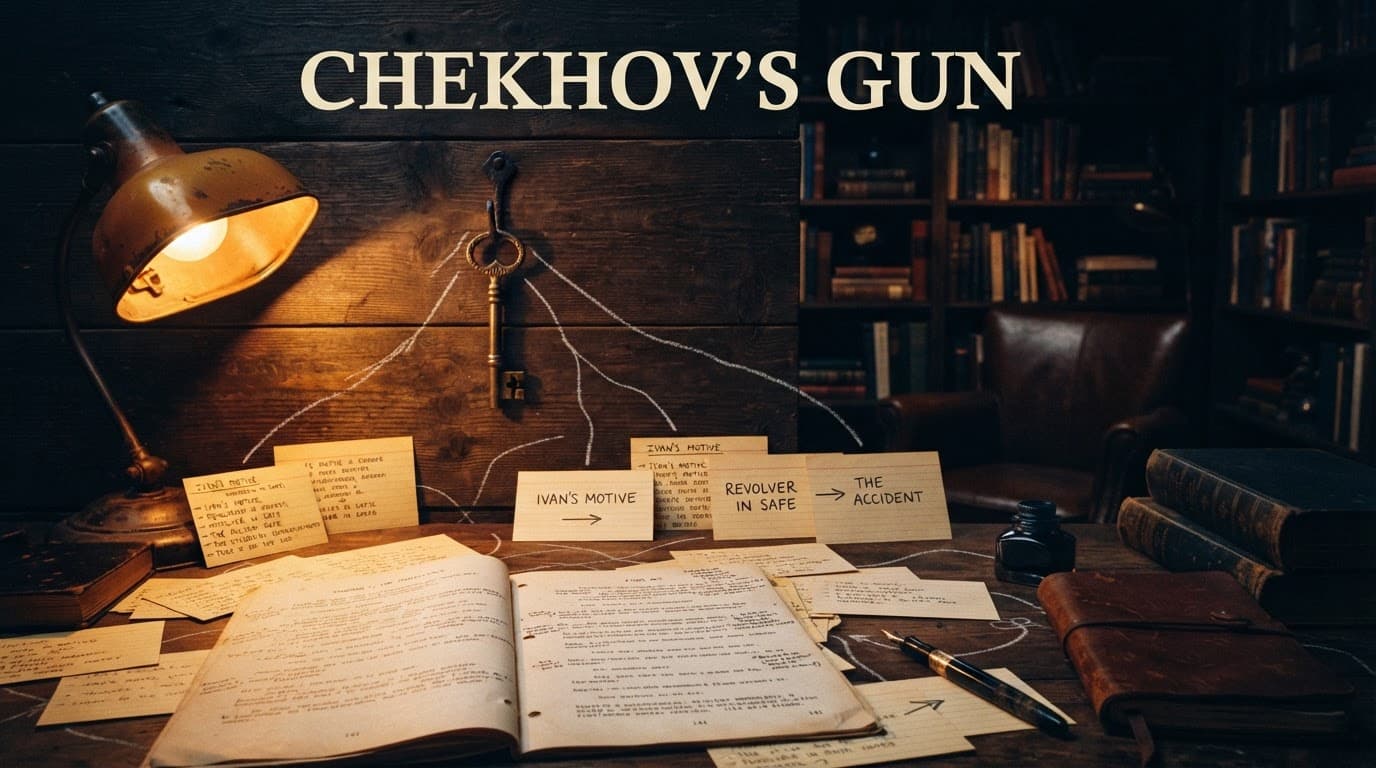
You're on the third pass through a draft you mostly like, and chapter four stops you. Your protagonist notices a brass key on a nail behind the harbormaster's desk — one clean sentence, the kind of detail that makes a room feel real. You wrote it because you meant something by it.
You search the rest of the manuscript. The key appears exactly once. Ninety-two thousand words, thirty-eight chapters, and the thing you planted never goes off.
That's Chekhov's gun, and it separates a draft that feels composed from one that feels accumulated. It's also the specific structural weakness of AI-assisted drafting — not because a model writes bad sentences, but because a promise made in chapter four and a payoff owed in chapter twenty-nine are the two things hardest to hold in the same thought.
What Chekhov's Gun Actually Means
Chekhov's gun is the principle that anything you introduce prominently must eventually matter — and that anything which won't matter should be cut. The second half is the half people forget. It isn't a rule about payoffs so much as a rule about deletion.
The source is Chekhov himself, in a letter to the writer Aleksandr Lazarev dated 1 November 1889: "One must never place a loaded rifle on the stage if it isn't going to go off. It's wrong to make promises you don't mean to keep." That last clause is the whole craft argument. A planted detail isn't decoration; it's a contract, and the reader is keeping score whether or not they could name what they're doing.
The useful reframe: a gun is a promise with a deadline. Foreshadowing is the broader category — any hint that something is coming, including tonal ones. A Chekhov's gun is the narrow, load-bearing case: a concrete object, ability, wound, debt, or piece of knowledge that the story has visibly put on the table. And a red herring is the deliberate inversion — a plant you intend to leave unfired, which only works if the real payoff lands somewhere else with enough force to justify the misdirection. Scrivener's own guide to the technique makes the same three-way split, pointing at Snape as the canonical red herring: a character engineered to read as a loaded rifle for six books.
The distinction matters practically. An unfired gun reads as forgetfulness. A red herring reads as craft. The difference between them is entirely in whether something else paid off.
Why AI Drafts Break This Rule in Both Directions
Generated drafts fail at setup-and-payoff twice over: they leave your plants unfired, and they add new plants nobody asked for. The second problem is worse, because it multiplies the first.
This isn't a vibe. A January 2026 paper by Longfei Yun and colleagues, Codified Foreshadowing-Payoff Text Generation, puts the failure precisely: large language models "frequently fail to bridge these long-range narrative dependencies, often leaving 'Chekhov's guns' unfired even when the necessary context is present." The bolded part is the part that should change how you work. It isn't a context-window problem you can solve by pasting more chapters into the prompt. The setup was right there in the window, and the model still didn't recognize that it was owed a payoff. The authors' explanation is that models struggle to grasp the triggering mechanism — the causal question of what event, specifically, makes a planted thing finally matter. Their fix was to mine Foreshadow-Trigger-Payoff triples from the BookSum corpus and hand the model explicit causal predicates, which beat ordinary prompting on payoff accuracy.
You can't run their framework at your desk, but the finding generalizes into something you can act on tonight: the model will not infer your debts, so you have to itemize them.
There's a second, nastier reason unpaid setups pile up where they do. A separate 2026 benchmark, Lost in Stories: Consistency Bugs in Long Story Generation by LLMs, ran 2,000 prompts across a taxonomy of five error categories and nineteen subtypes, and found that contradictions in long generated narratives cluster around the middle of the story — roughly the 40–60% mark. That benchmark measures contradictions rather than unfired guns specifically, so don't stretch it further than it goes. But it maps onto the same soft spot: your chapter-four key goes missing right around chapter eighteen, which is exactly where you stopped rereading from the beginning.
The over-planting problem is the flip side. Ask a model for atmosphere and it will give you atmosphere: a locked drawer, a scar the narrator doesn't explain, a second set of footprints. It generates props, not promises — objects with the texture of significance and none of the intent. Each one is a gun you didn't hang, and your reader can't tell the difference between the key you meant and the drawer the model improvised.
Build a Setups-and-Payoffs Ledger
The fix is boring and it works: one running list, maintained as you draft, with four columns — the planted thing, the chapter it's planted in, what it's supposed to mean, and the chapter where it pays off. Blank payoff column means open debt.
Four columns, not three. The "what it's supposed to mean" column is the one writers skip and the one that saves you, because six weeks later you will remember planting the key and have no idea what you meant by it.
What belongs in it: objects given more than a glancing sentence, abilities demonstrated early, injuries, debts, oaths, and — most easily lost — who knows which secret when. That last category does more damage than any prop, because it's invisible. An object that reappears is checkable with a text search. A character who suddenly acts on information they were never told is not.
Keep the ledger where the draft is. If your planted details live in a spreadsheet in another window, you will stop updating it around chapter nine; a story bible that sits beside the manuscript gets maintained because it's already on screen. The entry format that actually gets your details in front of the model matters more than the tool you keep it in.
One honest exception: if you're writing a 40,000-word novella and you outline to the scene before you draft, skip the ledger — your outline already is one, and duplicating it is pure overhead.
A Worked Draft: Thirty-One Guns, Nine Unfired
Here's what the audit actually looks like. Say you've finished a 92,000-word harbor fantasy — thirty-eight chapters, drafted over five months with a model handling roughly half the scene generation.
You read the whole thing once with a notebook, logging every planted detail without fixing anything. It takes two evenings and you come out with thirty-one entries. Twenty-two have payoffs. Nine don't.
Now you sort the nine, and this is where the real work is, because "unfired" isn't one problem:
Four are cuts. The locked drawer in chapter seven, the second set of footprints in eleven, two atmospheric objects in the customs house. You didn't plant these — the model did, filling space with props. They go, and the prose gets tighter, not thinner.
Three are payoffs you owe. The brass key. Sela's sister's limp, established in chapter two and never once inconvenient. A salt-guild debt mentioned twice in act one and never collected. These need scenes, and the key is the easy one: it opens the harbormaster's manifest drawer in chapter twenty-nine, where Sela is already breaking in for other reasons. One paragraph, and a detail from chapter four suddenly looks like planning.
Two become red herrings on purpose. The stranger at the salt dock reads like a plant, and you now decide it stays unfired because the real betrayal comes from the harbormaster's clerk — the person nobody was watching. That reclassification costs nothing but a decision. An unfired gun becomes craft the moment something better fires.
Nine open debts, four deletions, three new scenes, two reclassifications. Maybe nine hours of work. The draft that comes out the other side reads as though you planned it, which — after the audit — you did.
Auditing a Draft the Model Helped Write
Do the audit in two passes, and keep them separate. Pass one: extraction, no judgment. Go chapter by chapter and list every noun that got more attention than it strictly needed — judgment during extraction is how you talk yourself past your own mistakes. Pass two: reconcile. Search the manuscript for each entry and count appearances. One appearance is an open debt. Two or more clustered in the same act, then silence, is usually a model-generated prop.
An AI pass genuinely helps with extraction — feed it a chapter and ask it to list every object, ability, or piece of knowledge introduced with emphasis, and it's a fast, tireless noticer. It's much worse at pass two, for exactly the reason the CFPG paper identified: it doesn't reliably know what a setup obligates. Use it as a highlighter, not a judge.
Running extraction over 92,000 words is also a real token bill if you're paying per call — thirty-eight chapters through a cloud API adds up fast for a job that's mechanical rather than creative. It's grunt work a local model handles fine; NovelMage runs through Ollama or LM Studio at no per-token cost and with nothing leaving the machine, which makes "audit the whole book again" a decision you make casually instead of budgeting for.
Prompting So the Gun Actually Fires
Three changes to how you ask, in rough order of payoff.
Name the debt in the prompt. Not "continue chapter twenty-nine" but "in this scene, the brass key from chapter four opens the manifest drawer; Sela should recognize it before she uses it." You are supplying the trigger the model can't infer.
Give it the ledger, not the manuscript. Ten lines of open debts beat ten chapters of context, and they beat it decisively — the CFPG result was that context presence wasn't the bottleneck. Structured obligations are.
Ask for payoffs, never for plants. The instruction "add foreshadowing to this chapter" is how you end up with four more props. The instruction "this chapter must set up the salt-guild debt that gets collected in chapter thirty-one" produces a plant with a known destination. And across a series, the setups you owe from book one are the ones most likely to quietly expire.
Frequently Asked Questions
Is Chekhov's gun the same as foreshadowing?
No. Foreshadowing is any hint that something is coming, including mood, weather, or a line of dialogue that lands differently on reread. Chekhov's gun is the stricter subset: a concrete element the story has visibly placed on the table, which therefore owes the reader a payoff. All Chekhov's guns foreshadow; most foreshadowing isn't a gun.
Does every single detail have to pay off?
No, and treating it that way produces airless fiction where every lamp and coat is load-bearing. The rule applies to emphasis, not mention. A detail given its own sentence, a beat of the protagonist's attention, or a paragraph break is a promise. A coat that exists because people wear coats is not.
Can the model catch its own unfired setups?
Partly. It's reliable at extraction — listing what was introduced with emphasis — and unreliable at deciding what a setup obligates, which is precisely the failure the CFPG researchers documented. Use it to build the list, then reconcile the list yourself.
Where should I keep the ledger?
Beside the draft, in whatever story bible you already maintain — in NovelMage that's the Codex, which generations pull from, so open setups stay in the model's context instead of in a spreadsheet you've stopped opening. It's the same problem as why models lose track of your story's details, solved by hand.
The Rifle on Your Wall
Go find the brass key in your own draft. Every manuscript has one — a detail you planted with intent in the first act and abandoned somewhere in the murky middle, right where the consistency research says things break. Log it, then decide: fire it, cut it, or promote something else to fire in its place.
If you want the ledger living inside the manuscript instead of beside it, NovelMage is a Windows and macOS desktop app with a Codex your generations actually read from — $99.99 once, for up to three devices, no subscription, local models or your own API key, manuscript never leaving your machine. The 7-day trial is full-access and needs no card, which is about how long the audit above takes anyway.
Either way: check the wall. Something's hanging there.