California AI Transparency Law: Novels Aren't Covered
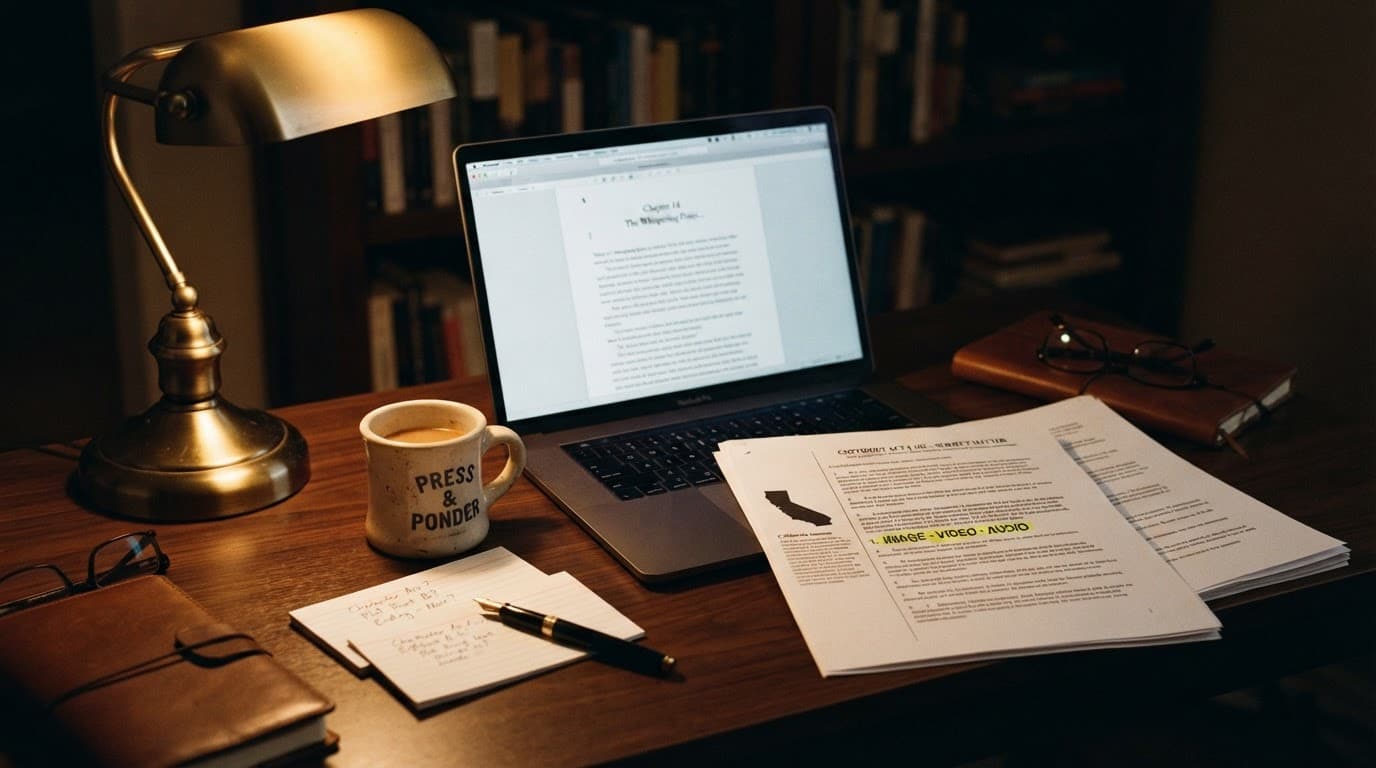
It's 11:40pm and someone in your writing Discord has posted a screenshot with the word illegal in it. California's AI Transparency Act went operative on August 2, the post says, so every novel written with AI now has to carry a disclosure label. You have 82,000 words in a folder. You used a model to break a sagging middle last spring and to line-edit maybe forty chapters since. Your first thought isn't a legal thought. It's: do I have to put a sticker on the book I've been writing for nine months?
No. You don't. Not under this law, and not under the European one people keep blending it with.
Here is the short version, and then the long one, because the long one is what you need when the Discord argues back.
What the California AI Transparency Act actually requires
The California AI Transparency Act — SB 942, amended in October 2025 by AB 853 — imposes obligations on companies that build large generative AI systems. It imposes none on the people who use them. And its disclosure requirements cover images, video, and audio. Not prose.
Read the operative text and the scope is unambiguous. A "covered provider" is defined in the bill itself as a person who produces a generative AI system "that has over 1,000,000 monthly visitors or users and is publicly accessible within the geographic boundaries of the state." That provider has to do three things: offer users the option to attach a manifest disclosure — a visible label — to "image, video, or audio content"; embed a latent disclosure, meaning invisible provenance metadata, in "AI-generated image, video, or audio content"; and publish a free AI detection tool that anyone can use to check a file against that provider's system.
Notice what's missing from every one of those clauses. Text.
This wasn't an oversight. The bill's definition of a generative AI system does mention text — it describes systems that "generate derived synthetic content, including text, images, video, and audio." But the definition is not the obligation. When the drafters got to the sections that actually command someone to do something, they narrowed to three media types and left prose out. Morgan Lewis's rundown of the operative rules puts it in one line: the Act's requirements "do not apply to AI-generated textual content."
The penalty structure tells you the same story from the other direction. A violation costs $5,000, collected "in a civil action filed by the Attorney General, a city attorney, or a county counsel." There is no private right of action — no reader, reviewer, or rival can sue you over this. And the liable party in every enforcement scenario the statute imagines is a covered provider, which you are not, unless you have somehow shipped a model to a million Californians while finishing your fantasy trilogy.
That's the whole answer. The obligation runs to the machine, not to the manuscript.
Why so many writers got this wrong
Three separate things happened around the same date, and the internet welded them together.
First, a calendar collision. California's Act became operative on August 2, 2026. Article 50 of the EU AI Act — the transparency article, the one that genuinely does mention text — also applies from 2 August 2026. That's not a coincidence in the conspiratorial sense; the California amendment was deliberately aligned to the European date. But it means two different laws from two different continents started biting on the same Sunday, and the summaries got stirred together in the retelling.
Second, the wrong bill got passed around. There's a thread in r/WritingWithAI titled "The misinformation of new AI transparency Law" where the author — correctly — tells the sub that the California law "focuses media and audio and excludes writen/text generation," then links to what they call "the actual laws and not articles that sumerize." The link goes to SB 53. SB 53 is a different statute entirely: the Transparency in Frontier Artificial Intelligence Act, which applies to frontier developers with over $500 million in annual revenue who train models using at least 10²⁶ computing operations. It's about catastrophic-risk frameworks and incident reporting at OpenAI-scale companies. It has nothing to say about your chapter twelve. Even the person correcting the misinformation cited the wrong law — that's how tangled this got.
Third, watermarking got confused with labeling. These are genuinely different things, and the sharpest comment in that same thread makes the distinction better than most legal explainers: a writer named LS-Jr-Stories quotes Article 50(2) in full and concludes, "I can write a novel using Claude and I am under no obligation to disclose that. But the novel itself is going to be machine readable and detectable as AI, regardless of my disclosure or lack thereof."
That's exactly right, and it's the sentence worth carrying out of this whole mess. A duty to disclose is a duty you owe. A machine-readable mark is a property of a file. One is on you; the other is on the text.
The European half, which does mention prose
Article 50 is where text appears, so it deserves a careful read rather than a skim.
Paragraph 2 requires providers of AI systems generating synthetic audio, image, video, or text to mark outputs "in a machine-readable format and detectable as artificially generated or manipulated." Again: providers. Anthropic, OpenAI, Google. Not you. And the obligation lifts "to the extent the AI systems perform an assistive function for standard editing or do not substantially alter the input data provided by the deployer or the semantics thereof" — which is a reasonable description of running your own paragraph through a model for rhythm.
Paragraph 4 is the one that creates a duty for deployers, and it's built with two carve-outs that a novelist walks straight through. For deep fakes, disclosure doesn't apply where the content is "evidently artistic, creative, satirical, fictional or analogous work." For text, the duty attaches only to text "published with the purpose of informing the public on matters of public interest" — journalism, essentially — and even there it's lifted where the content has undergone "human review or editorial control" with someone holding editorial responsibility.
A novel is evidently fictional and is not published to inform the public on matters of public interest. Both doors are open. We went through the mechanics of what the marking side means in practice in our piece on what Claude's text watermarking changes for novelists, and the conclusion held: the marking is real, the legal disclosure duty on the author isn't.
A worked example, because abstractions don't settle arguments
Maya finishes a 94,000-word domestic thriller in September 2026. She drafted the first pass herself, used a cloud model across about sixty chapters for line-level work, and generated maybe four scenes wholesale in a week when her father was in the hospital. She's querying US agents in October and has a small UK press interested.
Under the California AI Transparency Act, Maya owes nothing. She isn't a covered provider; the Act's disclosure duties cover images, video, and audio; and there is no private right of action for anyone to test the point. Her manuscript is a Word file, not a regulated output.
Under the EU AI Act, Maya owes nothing either. Her book is evidently fictional, which exempts it from the deep-fake disclosure rule, and it isn't public-interest journalism, which is the only category of text Article 50(4) reaches.
What Maya does face is real, and it has nothing to do with either law. Her query form has a yes/no AI checkbox with no text box. Her UK publisher's contract has a warranty clause about the work's origin. The Amazon KDP upload screen asks about AI-generated content. And some portion of those sixty chapters may carry provider-side machine-readable marking she didn't choose and can't inspect.
Four real pressures. Zero of them are the statute the Discord was shouting about. That gap — between the law people are panicking over and the paperwork actually sitting in front of them — is the whole story of the last six weeks.
Where the pressure actually comes from
Since the legal question is settled, spend your worry budget on the three places disclosure genuinely bites.
Agents and publishers. Contractual, not statutory, and increasingly standard. We wrote a full breakdown of how to answer the AI question on a query form — the short version is that these are private terms you agree to, and a warranty you sign is enforceable in a way a misread statute never was.
Retail platforms. Storefront policies change faster than legislation and apply at upload — a worse place to discover a problem than a query round.
Readers. The one with actual evidence behind it. The research on what happens when you volunteer AI use to a reading audience is covered in our piece on the disclosure penalty, and it's a marketing decision, not a compliance one.
What to actually do: keep a plain log of which tools touched which chapters and how heavily — date, chapter range, what the model did. It takes two minutes a week and answers every form above honestly without guesswork eight months later. If you're happy in your current cloud setup and none of this bothers you, nothing here is a reason to move.
If the provider-side marking does bother you — the fact that a file leaves your machine and comes back carrying metadata you didn't author — the cleanest answer is to keep the model on your own hardware. A 7B model running locally through Ollama or LM Studio inside NovelMage isn't a covered provider under any of these statutes, needs no internet connection, and produces text that was never transmitted anywhere to be marked. That's a privacy preference rather than a legal requirement, and the longer case for drafting entirely offline makes the practical argument better than the legal one does.
Frequently asked questions
Does the California AI Transparency Act require me to disclose AI use in my novel?
No. The Act's manifest and latent disclosure requirements apply to image, video, and audio content only, and they bind covered providers — companies operating generative AI systems with over 1,000,000 monthly users accessible in California. Individual authors have no obligations under it, and there's no private right of action, so no one can sue you over it either.
What changes on January 1, 2027 and January 1, 2028?
Two later phases from AB 853, and neither reaches authors. From January 1, 2027, large online platforms — public-facing social, file-sharing, messaging, or search services exceeding 2,000,000 unique monthly users — must detect provenance data in content they distribute and let users inspect it, and generative AI hosting platforms can't knowingly offer a system that lacks the manifest and latent disclosure options. From January 1, 2028, camera and recording device manufacturers must support provenance data in captured content. Still images, video, and audio throughout.
My AI tool watermarks text. Doesn't that prove the law covers prose?
It proves the vendor is complying with something, but not with California's Act. Text marking traces to Article 50(2) of the EU AI Act, which does cover synthetic text — and which binds the model provider, not you. The mark is a property of the file; a disclosure duty would be an obligation you personally owe. You don't owe one.
Does running a local model change my legal position?
Not your obligations — you had none to begin with. It changes what exists in the file. A model running on your own machine through Ollama or LM Studio isn't a covered provider under California's Act and isn't a provider under Article 50, so nothing attaches provider-side marking to what it writes, and your manuscript never leaves the device to be processed.
The line worth remembering
August 2, 2026 was a calendar collision, not a crackdown. Two transparency regimes took effect on the same day, one of them mentions text in a definition and not in a duty, the other mentions text in a duty that exempts fiction by name, and somewhere in the retelling that became "novels must be labeled."
Write the book. Keep your log. Answer the query form honestly when it asks. And if you'd rather the question never arise — if you want the draft to live on your hard drive and the model to run there too — NovelMage is a desktop app for Windows and macOS at $99.99 one-time for a lifetime license across up to three devices, with local models through Ollama or LM Studio and no servers that touch your manuscript. No subscription, and nothing to disclose to anyone but yourself.