Goncourt Winner Used ChatGPT: Where's the AI Line?
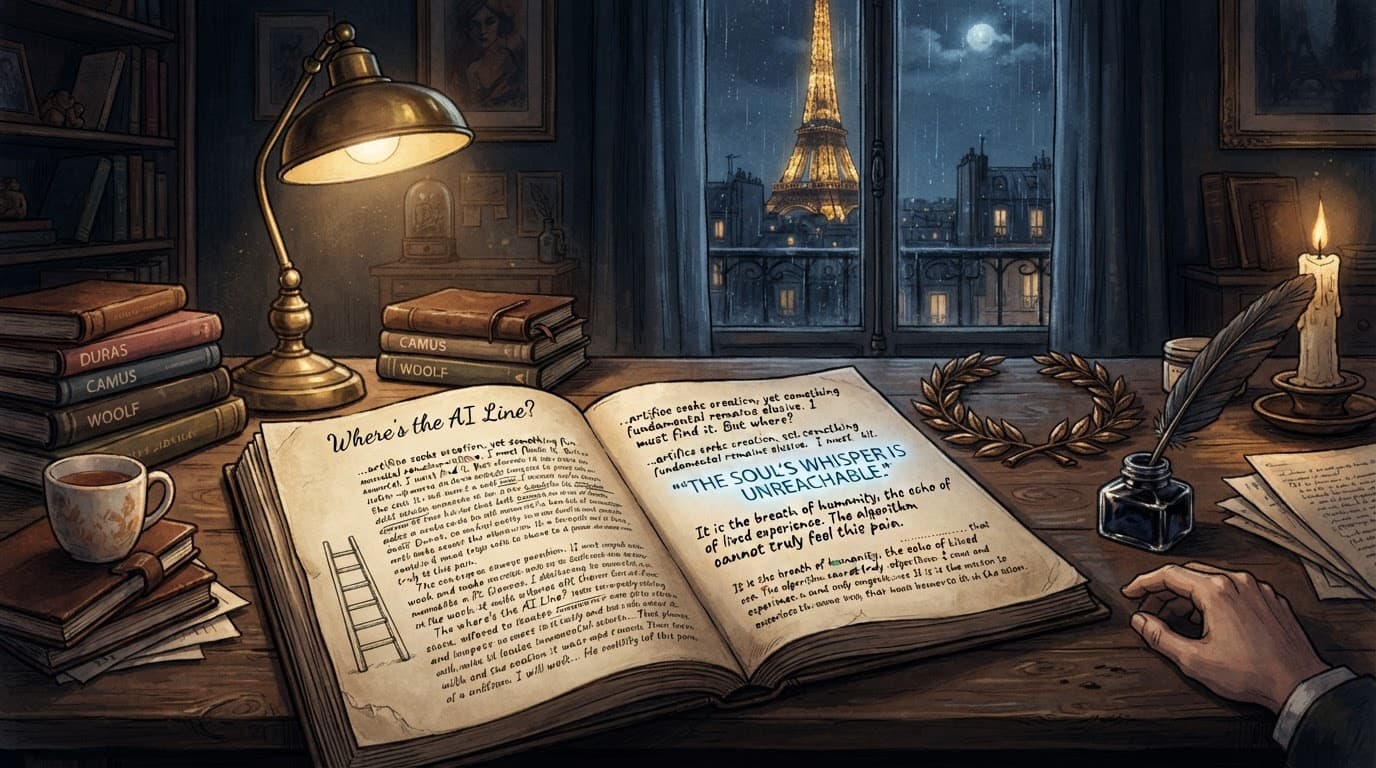
You saw the headline between two other tabs: France's biggest literary prize goes to a novelist who used ChatGPT. Your first reaction was relief. Your second was a small cold drop in the stomach, because you've been keeping a quiet list of your own: the evening you asked a model what a 1920s Lisbon harbor pilot would have been paid, the week it helped you untangle chapter seventeen, the one line of dialogue it suggested that you liked too much to cut. Two months ago a different writer was pushed out of the same prize over AI. So which of those two stories is yours?
The honest answer is that neither the prize juries nor the platforms have drawn one line. They've drawn several, in different places, and most of the anxiety comes from treating them as one. This post goes through what Philippe Jaenada actually did, why his case went one way and Thélyson Orélien's went the other, and where each kind of AI use lands with KDP, prizes, and certification schemes.
What did the Goncourt winner actually use ChatGPT for?
Philippe Jaenada, who won the 2026 Prix Goncourt on November 3 for L'Inconnue du quai de Javel, said he used AI three times: once to slip a ChatGPT-written sentence into the book "to play with the reader," once to mock ChatGPT's "completely absurd answers about a technical detail," and once for technical research. That's the whole list, per his France Inter interview as reported by AFP.
A few details matter more than the headline suggests. He told the jury about the generated sentence the day the prize was announced, not months later under questioning. He hasn't said which sentence it is. And his framing was blunt: "You have to use it, you have to acknowledge it, you have to tame it and not let yourself be replaced."
The book itself is a true-crime novel about the unsolved murder of a young woman in Paris in the late 1940s, the kind of project where you'd expect research to dominate. One generated sentence in a full-length novel is, by any measure, a garnish. The reaction online split predictably. Some readers compared AI to a spellchecker; others, quoted by Euronews, asked what "playing with the reader" had to do with the novel at all.
Why was one author celebrated and another removed?
The short version: Jaenada volunteered a small, specific, bounded use. Orélien's case was an accusation first and a confirmation later, and the use in question was much larger. Institutions forgive what you declare and punish what they discover.
Orélien's debut, C'était ça ou mourir, was once considered a Goncourt frontrunner. In September it was withdrawn from contention amid suspicion of AI use, and his Montreal publisher, Éditions du Boréal, later said it had confirmed he used AI to help write the book, ended the relationship, and said the novel won't be reprinted. Arts Lounge Magazine's follow-up notes that Orélien had denied a machine wrote any of it, and that commentators have accused the institutions of a racial double standard, given how little scrutiny Jaenada's admission has drawn by comparison. The Académie Goncourt hasn't said whether it will change its approach.
That criticism deserves to sit there without being explained away. A celebrated 62-year-old French novelist and a Haitian-Canadian debut author were not standing on level ground, and the same disclosure can land differently depending on who makes it. But for a working novelist trying to decide what to do with their own manuscript, the usable lesson is narrower and more mechanical: the line isn't the amount of AI; it's who tells the story first. Jaenada named the use, sized it, and owned it before anyone went looking. Orélien's use was framed by other people, and every later fact arrived as an admission rather than a statement.
We've covered the detection side of this before. In our look at what a 97% Pangram score really proves, the point was that a detector readout is not a verdict. The Goncourt contrast adds the other half: once suspicion starts, a detector doesn't need to be right to cost you.
The AI-use spectrum: five rungs, four gatekeepers
Most writers who use AI aren't asking "did I use it?" They're asking "how far up the ladder did I go, and who cares at that height?" Here's the ladder, ordered by how much of the text on the page came from the machine.
Rung 1: Research
Asking a model what a harbor pilot earned, how long a letter took from Lisbon to Southampton in 1924, what a coroner's report of the period would include. No words from the model reach the page; facts do, and you're responsible for checking them, which is exactly why Jaenada's "absurd answers about a technical detail" is a joke every historical novelist will recognize.
- KDP: Not AI-generated content. Nothing to declare.
- Authors Guild Human Authored: Explicitly allowed. The certification's definition carves out "minimal uses such as AI applications that check spelling and grammar or for research," per the Authors Guild's Human Authored page.
- Prizes: Jaenada did this, said so, and won.
Rung 2: Brainstorming
Talking through a sagging middle, asking for ten ways the brother could find out about the forged will, rejecting nine and rewriting the tenth in your own words.
- KDP: Its content guidelines treat this as AI-assisted if you wrote the text yourself, and "you are not required to disclose AI-assisted content."
- Authors Guild: The page doesn't address brainstorming either way. If the certification matters to you, ask them rather than assume.
Rung 3: Line edits and polish
Running your own chapters through a model to tighten sentences, catch repetition, flag a tense slip.
- KDP: AI-assisted. Using tools to "edit, refine, error-check, or otherwise improve" your own content doesn't need to be disclosed.
- Agents and publishers: This is where contracts and query forms start to diverge. Our guide to whether you have to disclose AI to literary agents covers how the yes/no radio buttons on submission forms handle this.
Rung 4: A generated line you kept
Jaenada's rung. One sentence, or a handful, that a model wrote and you left on the page.
- KDP: This is where people get it wrong. KDP defines AI-generated content as content "created by an AI-based tool," and says that holds "even if you applied substantial edits afterwards." The guideline sets no minimum. A single kept sentence is technically generated text. Whether you tick the box for one line is your call, but you should know the rule doesn't round down.
- Prizes: The only data point we have is Jaenada's: declared to the jury, prize kept.
Rung 5: Drafted passages
A model wrote the scene and you revised it. Even heavy revision doesn't move this back down the ladder under KDP's wording. It also takes you out of Human Authored territory, and it's the rung that sank Orélien.
Notice what the ladder shows: rungs 1 through 3 are "assisted" almost everywhere, and rungs 4 and 5 are "generated" almost everywhere. The fight over the Goncourt is really a fight over rung 4, a single line, and whether a playful, declared exception should count the same as a manuscript-scale one. For a fuller walk through KDP's form, see our KDP AI disclosure rules for generated vs assisted content.
A worked example: Marisol's 88,000 words
Marisol is finishing a historical mystery set in 1924 Lisbon, about 88,000 words. Over eighteen months she used AI in five ways she can actually remember: she asked it about harbor pilot wages and the Lisbon–Southampton mail service (rung 1); she spent two evenings talking through why her midpoint wasn't landing, then rewrote the midpoint herself (rung 2); she ran fourteen chapters through a model for line edits (rung 3); she kept two lines of dialogue it suggested for the harbormaster, who is gruff and was supposed to stay gruff (rung 4); and in month nine, exhausted, she had it draft a 600-word transition scene, which she then rewrote about half of (rung 5).
Here's where she stands at each gate.
On KDP, her research, brainstorming and line edits need no disclosure. The two lines of dialogue and the 600-word scene are AI-generated under the guideline's own wording, substantial edits or not. So she either rewrites that scene from scratch and replaces the two lines, or she answers yes. Rewriting 600 words and two lines is maybe a morning's work; for her, that's the cheaper option, and it also moves her manuscript back inside the Authors Guild's definition.
Querying agents, she's in a better position than she feared, because she can describe her use precisely: research, brainstorming, line edits, no generated text in the final manuscript. That's a two-sentence answer a form can hold. Compare it with "I used AI a bit," which invites exactly the follow-up questions she doesn't want.
And if she ever lands on a prize longlist, she can do what Jaenada did, telling the jury first, because the description is already written. The useful takeaway is that she didn't need to have used less AI to be safe; she needed to know which rung each use was on. Your disclosure is only as good as your memory of the draft, and eighteen months is a long time to remember things you never wrote down.
Keep the receipt while you write, not after
The practical fix is boring: keep a running note per chapter of what a model touched and how. One line per use is enough: "Ch. 12, line-edit pass, Claude"; "Ch. 19, two dialogue lines kept, harbormaster." If you ever need to answer a form, a jury, or a suspicious reader, you'll be quoting a record rather than reconstructing one. Our post on how to prove you didn't use AI to write your novel goes deeper on drafts, version history and what counts as evidence.
There's a second kind of receipt that matters once disclosure is on the table: where your manuscript went. If an editor, agent or publisher asks whether your unpublished book was uploaded to an AI service, "it never left my laptop" is the cleanest possible answer. In NovelMage you can run local models through Ollama or LM Studio, so a research question or a line-edit pass happens on your own machine, and when you do want Claude, GPT or Gemini you plug in your own API key rather than routing chapters through someone else's servers. Whatever tool you use, the habit is the same: decide per task whether the chapter needs to leave the building.
Before you take any of this as permission: if the prize, imprint or contract you care most about has a written AI clause, that clause beats anything on this ladder, Jaenada included.
Frequently Asked Questions
Did the 2026 Goncourt winner break any rules by using ChatGPT?
No rule breach has been reported. Jaenada disclosed one ChatGPT-written sentence to the jury himself, plus AI use for research and for a passage mocking the tool, and kept the prize. The Académie Goncourt hasn't said whether it will adjust its approach after his admission.
Do I have to disclose a single AI-generated sentence on Amazon KDP?
KDP's guidelines define AI-generated content as anything created by an AI tool, "even if you applied substantial edits afterwards," and set no minimum length. A kept sentence fits that definition. Research, brainstorming and editing your own writing are AI-assisted and don't need to be disclosed. If you don't want to tick the box, rewrite the line yourself.
Does using AI for research count as writing with AI?
For most gatekeepers, no. KDP doesn't treat research as generated content, and the Authors Guild's Human Authored certification explicitly allows AI used "for research" alongside spelling and grammar tools. You're still responsible for the facts; models get period details wrong with total confidence.
Are literary prizes going to start requiring AI declarations?
Some already plan to. According to Arts Lounge Magazine, the Caine Prize will require AI-use declarations from publishers and shortlisted writers starting with its 2027 edition. Expect more prizes to follow with written policies rather than leaving it to juries case by case.
The line you can actually hold
The Goncourt didn't settle where AI belongs in a novel. It showed that a known author who names a small use early gets the benefit of the doubt, and that a writer caught later, at scale, may get none. You can't control who gets that benefit of the doubt. You can control whether you know which rung you're on and can say so in two sentences.
If you want to do the assisted rungs (research, brainstorming, line edits) without your manuscript ever leaving your machine, NovelMage is a one-time $99.99 lifetime purchase, with no subscription, for Windows and macOS, and it works with local models or your own API keys.