Novel November 2026: Using AI Without Cheating
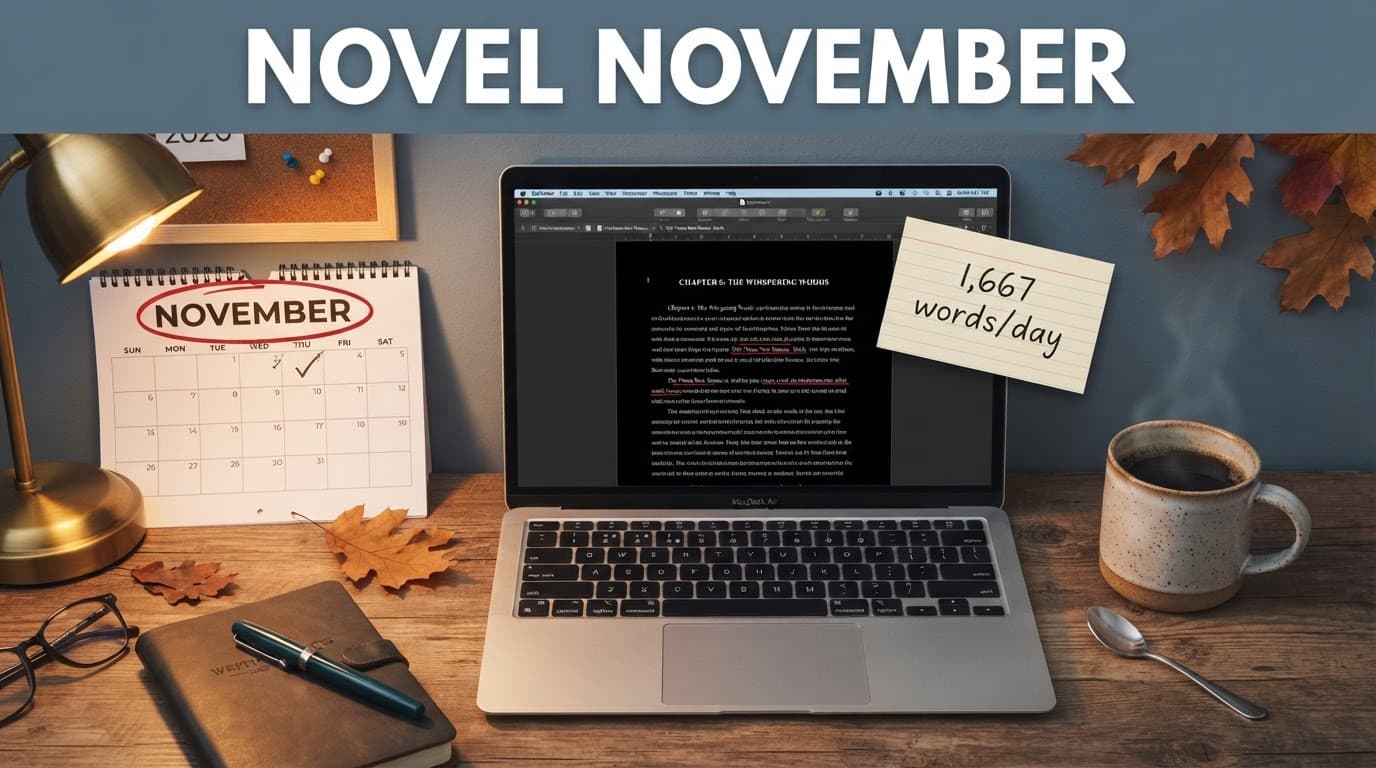
It's the first week of October and you have two tabs open. One is a signup page for a 50,000-word challenge that begins in 26 days. The other is chapter one of a novel you've been circling since spring — 1,900 words, three of which you actually like.
Somewhere between those tabs sits a question nobody answers straight: if you use AI during November, are you cheating?
Here's the straight answer, and then the part that actually matters.
Can you use AI during Novel November?
Nothing in Novel November's published rules polices which tools you draft with. ProWritingAid's help center defines the challenge as writing a 50,000-word manuscript in a single month and asks only that you make a free account. There's no toolchain declaration, no verification step, and your word count is self-reported.
What ProWritingAid has done is keep AI out of the event itself. Hayley Milliman, the company's director of community, told Beloit College's Round Table: "None of the features that exist for Novel November, none of the tools that we are creating, none of the events utilize AI in any way," adding that "we are here to empower writers, we are not here to replace them." That's a statement about what the organizers built. It isn't a rule about what you type.
So: nobody is going to catch you, because nobody is checking. Which makes is it cheating the wrong question entirely. The useful question is whether the 50,000 words sitting in your folder on November 30th are a draft you can revise — or 50,000 words of competent filler you now have to replace. Those two outcomes look identical in a progress tracker and nothing alike in February.
Why AI is the sore spot for this particular month
The November challenge changed hands because of a fight about exactly this.
On September 2, 2024, NaNoWriMo published a position statement on AI that included the line: "the categorical condemnation of Artificial Intelligence has classist and ableist undertones, and that questions around the use of AI tie to questions around privilege." The backlash was immediate and came from inside the house — Daniel José Older announced he was stepping down from the organization's Writers Board and urged other writers to do the same. NaNoWriMo revised the wording, conceding that "not being more careful about our wording was a bad decision on our part," but the damage held.
The nonprofit closed the following spring. Interim executive director Kilby Blade announced the shutdown on April 2, 2025, citing a six-year downward trend in participation and characterizing the closure as "a logical outcome of longstanding circumstances, not a salacious tale of scandal." Twenty-six years of trackers, forums, and regional write-ins went with it.
Novel November is the heir apparent — free, November 1–30, 50,000 words, 1,667 a day, with prep programming running from October 1 and 150+ live workshops across the season. It is not the only option: Reedsy runs a Novel Sprint over the same dates with a $5,000 first prize, and AutoCrit's Novel 90 stretches the same word target across October through December, among others. If you draft in Scrivener, Literature & Latte is running an extended trial through December 7 and discounting licenses for participants.
Knowing that history is useful for one reason: the people around you in November carry it. Expect the question, and expect some of them to have strong feelings about your answer.
What to do in the next three weeks
October is where this challenge is won. Not because preparation is virtuous, but because 1,667 words a day leaves no room to decide what happens next.
- Pick a shape, not a plot. You need enough structure to know what the next scene is at 6am without deliberating. A dozen beats is plenty — our guide to beat sheets for novelists walks through the version most drafters actually use.
- Build the story bible now. Names, ages, eye color, who knows which secret and as of which chapter, the three rules of your magic or your legal system or your small town. Forty minutes in October saves you a week in revision. Here's how to build one that stays useful.
- Write one voice anchor per major character. Not a description — a sample. Two lines of dialogue that only that person would say. Your gruff dockhand speaks in fragments; your archivist never does. This is the single highest-value thing you can prepare, because voice is the first casualty of speed, whether or not a model is involved.
- Decide your stuck protocol in advance. At 9:40pm on November 12th, 400 words short, you will not make a good decision about this. Decide now: when a scene won't move, do you skip it and write a bracket, talk it out loud, or ask a model three questions about what your character wants? Any of those works. Deciding in the moment doesn't.
- Write down your own line on AI and put it where you'll see it. One sentence. "I don't paste generated prose into the manuscript" is a line. "I use it to interrogate scenes, never to produce them" is a line. The point isn't purity; it's that a line decided in October survives a bad Tuesday and a line decided on a bad Tuesday doesn't.
Where AI genuinely earns its place at 1,667 words a day
The uses that hold up during a sprint are the ones that get you writing, not the ones that write.
Interrogation is the big one. You're 900 words into a confrontation scene and it's gone inert. Ask a model what your protagonist is avoiding saying, what she'd do if she couldn't say anything, what the other character wants that she hasn't noticed. You're not asking for prose. You're asking the questions a good writing partner would ask, at an hour when no actual writing partner is awake. The answers are often mediocre and still useful, because the third wrong answer tends to show you the right one.
Continuity lookup is the other. At 38,000 words you will stop mid-sentence because you cannot remember whether the brother was at the funeral. Searching your own manuscript for that answer costs you fifteen minutes and your momentum. Querying a story bible that already knows costs you ten seconds — this is the whole reason NovelMage keeps a codex adjacent to the draft rather than in a separate document you forget to update.
And then the end-of-session summary: three lines on what happened, what changed, and what's unresolved. Tomorrow's you starts from those instead of rereading.
What all three have in common is that the words in the manuscript stay yours. Your word count only moves when you type.
Where it will wreck your November
Generating the daily 1,667 is the failure mode, and it fails on a delay, which is what makes it dangerous.
Say Priya starts November 1 with a harbor-city fantasy and a reasonable-sounding compromise: she writes the hard parts herself and generates the connective tissue — the walking-across-town, the explaining-the-plan, the arrival scenes. Call it 1,200 of her 1,667 on an average day. By November 30 she's a winner. The badge is real. So are roughly 36,000 generated words.
Then December. The generated prose isn't bad, exactly. It's flat in a specific, recognizable way: every character names their own emotion out loud, every scene resolves on the same beat, and the model's default is to summarize feeling instead of rendering it. Rewriting at a realistic 400 words an hour, those 36,000 words are ninety hours of work — more than she spent drafting. And she can't cut them, because the plot now runs through them.
That's revision debt: words that count toward a total today and cost you more than they're worth later. A tracker can't see the difference between a page you wrote and a page you accepted. February can.
If you've never finished a draft of anything, skip all of this and do November entirely by hand — the habit is the actual prize that month, and nothing teaches it like finding out you can.
Keeping continuity when you're moving this fast
Speed breaks continuity before it breaks prose. At 1,667 words a day you're adding a chapter every three or four days and rereading none of it.
The structural problem is that a model generating chapter 20 sees only what's in its context window right then; everything outside it gets confidently invented, which is why AI forgets your story details no matter how long your story bible is. The fix is retrieval, not volume — the relevant five entries in front of the model at the moment of the scene, rather than all forty somewhere in a folder.
Practically, during November: keep a running one-line log per chapter as you finish it, update the bible the same minute you invent something (not "later"), and bracket rather than resolve. [CHECK: was Tobiah at the funeral?] costs four seconds. Going to look costs your session.
There's a privacy dimension too, and November is when it bites, because this is the month you'll be pasting chunks of an unpublished manuscript into whatever is closest to hand. If you'd rather your draft not leave your machine at all, NovelMage runs on Windows and macOS as a native desktop app with local models through Ollama or LM Studio — or your own API keys if you want a cloud model — and your files stay in local folders, because there are no NovelMage servers to send them to.
Frequently Asked Questions
Does Novel November ban AI?
No. Its published rules don't restrict which tools you draft with, and word counts are self-reported. ProWritingAid has kept AI out of the challenge's own features, tools, and events, and its community director has said plainly that the company doesn't believe AI should replace writers — but that's a description of what they built, not a condition of entry.
Is NaNoWriMo coming back in 2026?
No. The nonprofit shut down in April 2025, and the website, trackers, and forums closed with it. Novel November is the largest successor, with Reedsy's Novel Sprint and AutoCrit's Novel 90 running the same 50,000-word target on overlapping dates.
Will using AI make my November draft fail an AI detector?
Possibly, and detector output is a poor guide either way — they return false positives on entirely human prose often enough that a high score tells you very little. The practical concern isn't detection; it's that generated connective tissue is the material you'll rewrite first in revision.
How much should I generate per day to stay safe?
The number isn't the variable. A day where you generated 2,000 words and typed none leaves you further from a finished novel than a 600-word day you wrote yourself. Judge the session by what you'd keep, not what the tracker shows.
What does NovelMage cost if I want to use it for the challenge?
There's a 7-day free trial with no credit card, which covers enough of November to tell you whether the workflow fits. After that it's $99.99 one-time for a lifetime license on up to three devices, or $9.99/month if you'd rather not commit — and local models through Ollama or LM Studio add nothing on top, since they run on your own hardware.
Three weeks out
November owes you a draft, not a number. That distinction is the whole decision: every use of AI that gets you writing is on the right side of it, and every use that produces words you'd hand to a stranger as yours is on the wrong one.
Spend October on the shape, the bible, and the voice anchors. Then spend November typing.
If you want the sprint to happen on your own machine — manuscript in local folders, codex sitting next to the draft, local or cloud models your choice — download NovelMage and set your project up before November 1.